-
FREDERICK WISEMAN dies at 96
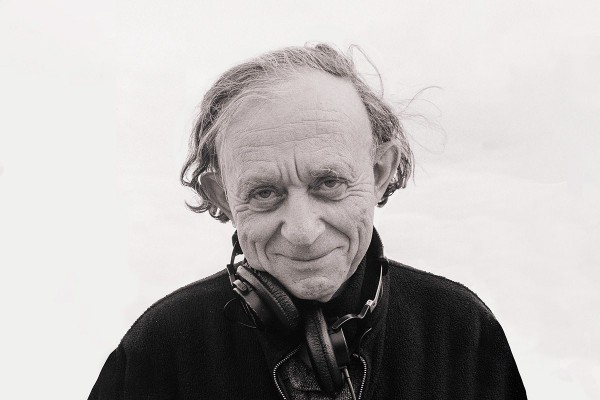
Image credit: From the Peggy Mckenna collection at the Penobscot Maine Museum
FREDERICK WISEMAN (1930-2026)
From PBS:
"Frederick Wiseman, a giant in the film industry, has died. In his directorial debut, "Titicut Follies," in 1967, Wiseman took an unsparing look at conditions inside a mental hospital in Massachusetts. The film was banned for years, but it eventually aired on PBS in the early 1990s after the ban was lifted. Wiseman went on to create dozens of films over a nearly six-decade career that explored, and sometimes exposed, America's social and cultural institutions. Wiseman was 96 years old."
The little man with the big ears and the wrinkly face (he was already 75 when I first heard of him), a Jew from Boston who attended Williams and Yale, graduating in law, focused on "institutions" or collective activities rather than individuals: that mental hospital just happened to be horrible and its notoriety gave a boost to his career no doubt. But others were less controversial: a boxing gym, a ballet, a high school, army basic training (is that an institution? no), a primate research center, a welfare office, centers for the deaf and blind, a hospital IC unit, a ballet company (the American, and later the Paris Opera Ballet), public housing, a police department working in a high crime area, a New York fashion modeling agency, Central Park, the town of Belfast Maine, the Jackson Heights neighborhood of New York City, a famous Paris restaurant, a university (UC Berkeley), a city hall (his native Boston's), and on and on and on.
His method, apparently, by his own description, was to shoot for ten weeks and then spend a year editing the footage. During that year he discovered what he was saying, what his point of view, what his style was to be in approaching that particular subject. He would have wide latitude, since he might have 125 hours to work with.
I was personally resistant at first when a Wiseman film came up in a film festival. Why do I want to spend three or four house watching a meticulous account of some mondaine subject, something with no particular angle or personality to set it off? But in the end, though I have not seen a lot of his films other than the recent festival-released ones, one settled in. Four hours to observe Restaurant Troisgros in Paris is a lot; but it's also a privileged view of something rather special. He seems to have spent a lot of time in later years in Paris, and the Paris Opera Ballet was another privileged view. I went to Berkeley so why wouldn't I want to see the Wiseman treatment given in a film called Berkeley? City Hall was another time it was fine to settle in for the long ride to try to understand urban American government up close. Even a tough or seemingly grim subject he might show a droll side too as well.
In the end it is Wiseman's omnivarious taste and his tirelessness and patience that set him apart the most. His focus on collective activities and public institutions gives a universality and common humanity to his work. He is interested in the "thing-ness" or the "it-ness" of his subjects, what make them tick, how their parts interact to function and to be. Most other even great documentary filmmakers (I note that he disliked the label and preferred them just to be called "films") are different from Fred Wiseman in focusing on just a few things a lot, not on so man things, and seeking more particular angles or topicality about their subjects. Every Wiseman film is a classic approach to that particular subject. He worked for the ages.
Wiseman also directed some plays and made some fiction films.
It's hard to imagine that film lovers will not now start knuckling down and watching more Wiseman films. And you have your work cut out for you since there are 47 of them.
See also:
The New York Times obituary
BFI's Frederick Wiseman: 10 essential films
Film at Lincoln Center's program of a large number of Wiseman's films last year
Richard Brody's essay published in The New Yorker .. Brody suggests Wiseman's passion comes from filmmaking being his second career, begun at age 36 when he was a Boston University law professor and had produced Shirley Clarke's The Cool World; he suggests his small, unprepossessing appearance helped him film people being natural.
Last edited by Chris Knipp; 02-19-2026 at 08:57 PM.
 Posting Permissions
- You may not post new threads
- You may not post replies
- You may not post attachments
- You may not edit your posts
-
Forum Rules




 Reply With Quote
Bookmarks