-
Open Roads: New Italian Cinema At Lincoln Center 2014
Open Roads: New Italian Cinema At Lincoln Center June 6-12, 2014
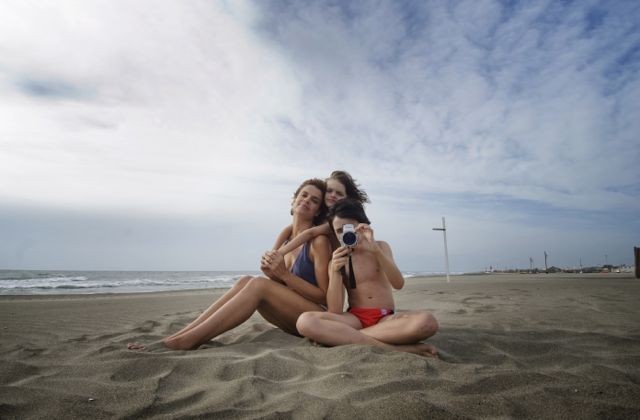
Daniele Luchetti's Those Happy Years. Photo: Emanuela Scarpa
Filmleaf forum thread here.
Reviews.
 Open Roads: New Italian Cinema, June 5-12, 2014
Thumbnail reviews and links to my longer ones of some of the Open Roads 2014 public screenings on the website Filmleaf will be found below. That coverage begins here.
Fifth Wheel, The/L'ultima ruota del carro (Giovanni Veronesi 2013)
A genial and appealing if unremarkable life story about a Roman everyman born in the Sixties and living on through Berlusconi.
Human Factor, The/Il variabile umano (Bruno Oliviero 2013
A downbeat police procedural about a murder in Milan's seedy nightclub-drug milieu that turns out to involve a police inspector's family. The director previously has made documentaries. He tries to combine noir with a commentary/meditation on the current state of Italy's moral climate, but the combination is mired in gloom and the action has so little momentum the 83-minute run-time feels longish.
Lonely Hero, A/L'Intrepido (Gianni Amelio 2013)
Gianni Amelio is a great director (his LAMERICA and THE KEYS TO THE HOUSE, among others, are heart-rending and powerful works), but sometimes he seems to be treading water. This is a meandering fantasy about a man who practices the non-existent job of "il rimpiazzo" or "filling in," taking any job at random every day and working at it for only a few hours. Amelio means to provide a meditation on the value of work, or having a job, and the pain of unemployment, but the film seems to make itself up as it goes along, varying wildly in tone. Partly it's clear this was meant by Amelio as a vehicle for the soulful, appealing actor Antonio Albanese, but one winds up wondering: what was he thinking?
Long Live Freedom/Viva la libertà (Roberto Andò: 2013)
The Italian opposition party leader goes into hiding in Paris and is replaced by his mentally unhinged twin brother, a philosophy prof who's been in a mental institution. The new version is a great success. Both are played by the great Toni Servillo of GOMORRAH, IL DIVO, and THE GREAT BEAUTY, and if this fantasy-satire doesn't live up to all its possibilities, Servillo is always fun to watch in action.
Those Happy Years/Anni felici (Daniele Luchetti 2013)
A buoyant loosely autobiographical account of growing up in an artistic, bohemian (but evidently well-off) family in Italy in the Seventies. There is fun and emotion, though this seems less original in its overall outlines than Luchetti's more historically rich 2007 MY BROTHER WAS AN ONLY CHILD. A good cast is highlighted by the charismatic Kim Rossi Stewart as the would-be genius artist dad Guido, with a warm Micaela Ramazzotti as mom Serena, who turns out to be more unconventional than he is. Two cute little boys include an older one who is the budding filmmaker. The series opening night film.
I Can Quit Whenever I Want/Smetto quando voglio (Sydney Sibilia 2014)
A group of seven university specialists who can't find good jobs manufacture and sell a drug like Ecstasy in dance clubs in this loud, colorful, profane social comedy from a first-time director wildly enamored of American movies and TV series like Breaking Bad." A big success in Italy, but it makes you miss the great Italian comedies of the late Fifties into the Seventies, like BIG DEAL ON MADONNA STREET.
The Mafia Only Kills in Summer/La Mafia uccide solo d'estate (Pierfrancesco Filiberto/PIf 2013)
On the surface a charming coming of age rom-com, set also in Palermo, but underneath a statement against the way the city is dominated by Mafia violence. Arturo, the young protagonist, comes in contact, Forest Gump-like, with a series of anti-Mob leaders who one by one are assassinated. When the action jumps to adult Arturo, indifferently played by the director, it degenerates somewhat into episodic TV comedy stuff, though the underlying message and some of the initial charm remain.
Quiet Bliss/In grazia di Dio (Edoardo Winspeare 2013)
A drama about a family that gets into legal and economic problems when their small clothing factory fails. Two men go to jail for a dumb money-making venture and four women, who are often at odds, to put it mildly, move out to a small farm with an olive grove overlooking the sea. This all happens in the stark, sun-drenched Salento region of Lecce, Publia, where the director grew up, at the tip of the heel of the "boot" of Italy within sight of the Greek coast, and it was shot with non-actors, including Winspeare's wife and stepdaughter in the two main roles, and using ecological methods. All that is more interesting than the turbulent but center-less and only intermittently involving action, marred by an unappealing protagonist who overwhelms the other characters. Debut at the Berlinasle this year and praise in Italy don't add up to much international potential.
A Street in Palermo/Via Castellana Bendiera (Emma Dante 2013)
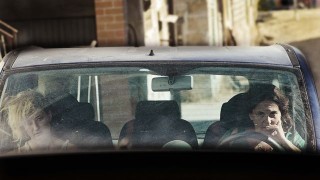
A standoff in a little street in the named Sicilian capital between two women whose cars face each other. Neither will back up. On one side, a lesbian couple. On the other, a local family whose boss may want his Albanian mother-in-law to stand her ground so he can take bets on who will give in first. It's funny, specific to the region, and perhaps a metaphor for a blocked country. But it can also be pretty tedious, and the whole business seems inexplicable. Based on Emma Dante's own novel. This is her first film. She is a well-known theater director and she also plays one of the lesbians, the driver.
Tir (Alberto Fasulo 2013)
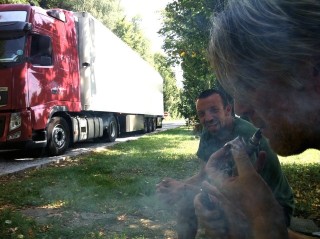
This docudrama depicts the plight of Eastern European big rig drivers in western Europe who settle for a kind of servitude far from their homes and families and original jobs in exchange for making three or four times as much as they could at home. The director, with his first feature, did years of research, and his main actor, a well-known Croatian star, got a trucker's license and was hired by the shipping company before enacting his role for the four-month shoot. The authenticity and significent socio-economic message of the resulting film, which tends to capture the boredom of the long haul a little too well, nonetheless won Fasulo the top prize at the Rome Film Festival in November 2013.
Not reviewed here but also included in the 2014 Lincoln Center series: The Administrator, Happy to Be Different, Small Homeland, Sacra, and The Referee.
Last edited by Chris Knipp; 06-08-2015 at 11:01 PM.
-

Film Society Unveils 13th Open Roads: New Italian Cinema Series Lineup
The Italians are returning to Film Society this June with the 13th edition of Open Roads: New Italian Cinema, an annual showcase of contemporary Italian cinema. This year's lineup includes the latest work from established veteran, top award winners, as well as new talent. The U.S. Premiere of Daniele Luchetti's Those Happy Years will open the series June 5. Overall, the lineup includes 16 features, with over a dozen screening Stateside for the first time.
Those Happy Years is one of several selections that explore the evolution of Italy's political transformation. The film is a coming-of-age autobiographical tale of the director's childhood as a budding filmmaker growing up in Rome in the '70s, coinciding with a radical, transformative period in Italy. The Fifth Wheel by Giovanni Versonesi also falls in this group. It is a humorous tale that takes audiences on a journey of a half-century of pivotal political events through the eyes of actor and screenwriter Ernesto Fioretti.
Documentaries and hybrid combinations of nonfiction and narrative work factor heavily into this year's roster. Highlights include Gianfranco Rosi’s Sacro GRA, the first documentary to win the Golden Lion for Best Film at the Venice Film Festival. The feature explores Rome’s 43.5-mile highway Grande Raccordo Anulare that encircles the city, focusing on areas drivers pass through but never see, revealing a different side of the bustling city’s inhabitants. Alberto Fasulo’s docudrama debut Tir won the top prize at the Rome Film Festival and follows a former teacher from Bosnia who takes a job driving a tractor trailer (“tir”) through Europe. The film uses both professional actors and real truck drivers to create a story about what life is really like on the road.
Other documentaries include Vincenzo Marra’s Naples-set The Administrator, which looks at a building administrator’s dealings with his larger-than-life tenants, providing a tough-minded yet affectionate portrait of an Italy mired in crisis. Gianni Amelio’s Happy to Be Different, meanwhile, is a moving work of oral history of gay life in Italy from the fall of fascism through the early 1980s.
Politics and social issues facing Italians also play a role in Gianni Amelio’s A Lonely Hero, starring comedian and actor Antonio Albanese, whose character learns to reinvent and adapt himself to any job as a professional substitute (train conductor, fishmonger, tailor, etc.), as a result of the country’s unstable unemployment crisis. Roberto Andò’s Long Live Freedom is a scathing critique of Italian political dynamics and stars Toni Servillo as a seasoned politician navigating the decline of his party by fleeing to Paris and hiding out at the home of his ex-girlfriend.
Renowned TV host and political comedian Pierfrancesco Diliberto wrote, directed, and stars in The Mafia Only Kills in Summer, his feature debut about a young boy and his obsession with the Mafia’s presence in his city and a beautiful schoolmate who remains his love interest until adulthood. The love story is set against a backdrop of some of Italy’s most tragic past criminal events. Edoardo Winspeare’s Quiet Bliss follows three generations of women who seek refuge in their family’s olive grove after their small textile business collapses and their efforts to revive their lives in the wake of economic catastrophe and the recession.
"We are pleased to welcome some familiar faces back to Open Roads—including Daniele Luchetti for Opening Night and Gianni Amelio with his two latest films—and also to introduce so many promising emerging filmmakers," commented Film Society of Lincoln Center Director of Programming Dennis Lim. "This year’s rich and diverse program, which ranges from sober drama to irreverent comedy, includes films from all across Italy, continuing the strong regionalist trend of recent years. With exemplary new work by Gianfranco Rosi and Vincenzo Marra, it also underscores the emergence of documentary as a breeding ground for some of the most exciting developments in contemporary Italian cinema."
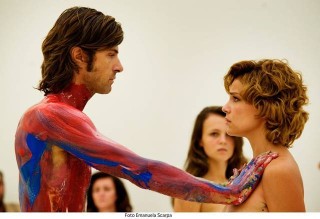 ]
]
Opening Night - included in press screenings
U.S. Premiere
Those Happy Years (Anni felici)
Daniele Luchetti, Italy, 2013, DCP, 100m
Italian with English subtitles
Luchetti’s warm-hearted, bittersweet autobiographical account of his childhood as a budding filmmaker growing up in Rome in the ’70s stars Kim Rossi Stuart and Micaela Ramazotti as unconventional parents caught up in turbulent times. He’s an avant-garde artist and she’s wrestling with gender roles as she discovers feminism and free love. Luchetti (My Brother Is an Only Child) brilliantly re-creates the atmosphere of urgency and rapid change surrounding the family. He also poignantly conveys his own coming-of-age perspective, that of a boy grappling with radical transformations inside his family and on the street, capturing it all with his brand-new Super-8 camera.
Thursday, June 5, 1:00pm (Q&A with Daniele Luchetti)
Thursday, June 5, 6:30pm (Q&A with Daniele Luchetti)
U.S. Premiere
The Administrator (L’amministratore)
Vincenzo Marra, Italy, 2013, 83m
Italian with English subtitles
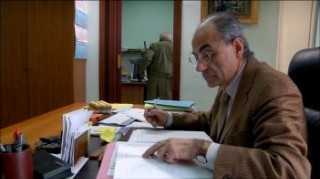
In the lively and absorbing fifth installment in a series of docs celebrating his native Naples, Marra turns a spotlight on the life of Umberto Montella, a building administrator whose job seems to demand skills in management as much as in therapy. An effortless arbiter of the passionate conflicts that arise among tenants, the Quixotic Montella leads us in and out of the homes of his larger-than-life clients, rich and poor Neapolitans whose lives illuminate the city’s volatile moods. Sometimes funny and always poignant, these profoundly human stories flow in and out of one another following a natural rhythm. However specific the tales, characters, and places, the immersion into these entangled lives is also a tough-minded yet affectionate look at an Italy mired in crisis.
Monday, June 9, 6:30pm
Tuesday, June 10, 1:30pm
U.S. Premiere
The Fifth Wheel (L’ultima ruota del carro)
Giovanni Veronesi, Italy, 2013, DCP, 113m
Italian with English subtitles
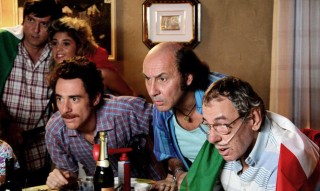
Veronesi’s irresistible romantic comedy takes a journey through pivotal events in four decades of recent Italian history, as seen through the lens of Ernesto Fioretti’s unexceptional life. Played with charm and a disarming sense of humor by Elio Germano, Ernesto is a good-hearted, honest middle-class guy who struggles to keep up with changes and is always a step behind. His father disparaged Ernesto by likening him to the “fifth wheel of the wagon,” and his aspirations and involvement through the rise and fall of Socialism and the Berlusconi era are accordingly modest. But his protagonist’s apparent simplicity is precisely one of the strengths of this Tuscan director’s fifteenth feature, which opened the Rome Film Festival last year to great acclaim. Rich in emotions, its ups and downs coinciding with those of the country, Ernesto’s life serves as the perfect platform for abundant laughter and tears.
Friday, June 6, 6:30pm (Q&A with Giovanni Veronesi)
Wednesday, June 11, 1:00pm (Q&A with Giovanni Veronesi)
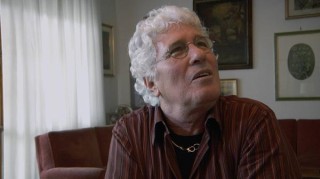
Happy to Be Different (Felice chi è diverso)
Gianni Amelio, Italy, 2014, 93m
In Italian with English subtitles
A moving and enlightening work of oral history, Gianni Amelio’s new documentary is a chronicle of gay life in Italy from the fall of Fascism through the early 1980s. Amelio combines interviews with a wide range of older gay Italian men (including Pasolini muse Ninetto Davoli), newsreel footage, and clips from “educational” films warning against homosexuality, and in the process reveals a profound gap between the subjects’ firsthand experiences and the Italian media’s representations of them. The resulting film is a deeply personal account of the advent of gay culture amid the ruins of Mussolini’s Italy and the eternally poignant story of how persecuted individuals developed pragmatic ways to attain everyday happiness.
Tuesday, June 10, 9:00pm
Wednesday, June 11, 4:00pm
U.S. Premiere
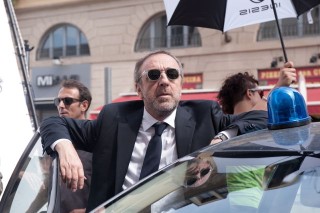
The Human Factor (La variabile umana)
Bruno Oliviero, Italy, 2013, DCP, 82m
Italian with English subtitles
Matters get very complicated for chief inspector Monaco (Silvio Orlando) after the murder of a high-profile member of Milan’s seedy nightlife. He is a widower with a teenage daughter, and, one night, all his neglected personal issues seem to catch up with him, forcing him out of the slump he’s been in since the death of his wife. Rendered darkly beautiful as a noir setting, Milan is the electric backdrop for this detective story that delves as much into the intimate life of one man and his daughter as into this elegant city’s underworlds. In his fiction debut, Olivierio’s extensive documentary experience is palpable in his portrait of Milan—a character in itself—as well as in the vivid and telling details with which he characterize its inhabitants.
Thursday, June 5, 4:00pm
Friday, June 6, 9:30pm
U.S. Premiere
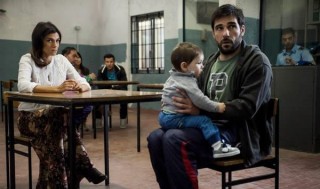
I Can Quit Whenever I Want (Smetto quando voglio)
Sydney Sibilia, Italy, 2014, 100m
Italian with English subtitles
A band of brilliant unemployed and underemployed academics—two Latinists, a chemist, a neurobiologist, an anthropologist, and an economist—turn to a life of crime in order to survive. Deftly assimilating such influences as Breaking Bad and Trainspotting, this biting parody on the plight of the Italian middle class in the aftermath of the economic crisis boasts a fast pace, witty dialogue, and a terrific cast. A debut to watch from Salerno-native Sibilia, the film was a resounding commercial and critical hit when released in Italy earlier this year.
Friday, June 6, 3:30pm (Q&A with actress Valeria Solarino)
Sunday, June 8, 9:00pm (Q&A with actress Valeria Solarino)
U.S. Premiere
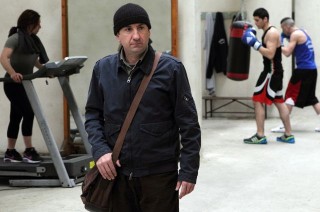
A Lonely Hero (L'intrepido)
Gianni Amelio, Italy, 2013, DCP, 104m
Italian with English Subtitles
Amelio follows his 2011 Camus adaptation, The First Man, with a deadpan parable about a small everyday hero from Milan who contends with the unemployment crisis in a very particular way: he’s a “professional” substitute worker, skilled and knowledgeable enough to replace anyone in any job. True to his name, Antonio Pane is as good and essential as bread. Whether working as a train conductor, fishmonger, tailor, street sweeper, or bricklayer, he approaches the country’s instability with a deep moral consistency as he reinvents himself everyday. Amelio wrote this film especially for actor Antonio Albanese, who personifies the film’s dark humor and underlying sense of hope. An Emerging Pictures release.
Monday, June 5, 9:15pm
Tuesday, June 10, 6:30pm

U.S. Premiere
Long Live Freedom (Viva la libertà)
Roberto Andò, Italy, 2013, DCP, 93m
Italian with English Subtitles
Enrico Oliveri (a brilliant Toni Servillo) is a seasoned center-left politician and president of the opposition who realizes that the decline of his party is inevitable. As the polls announce he will lose dramatically in the upcoming elections, he falls into a profound existential crisis and disappears. We later learn that he has fled to Paris and is hiding out at the home of his ex-girlfriend Danielle (Valeria Bruni Tedeschi). While his colleagues panic, his top aide (Valerio Mastandrea) discovers that Enrico has a twin brother living in a psychiatric institution. What at first seems like a crazy plan soon proves to be their only solution. A scathing critique of Italian political dynamics, Andò’s film is also a pulsating thriller with great comic moments that brings together some of the most talented actors working in Italy today.
Friday, June 6, 1:00pm (Q&A with Roberto Andò)
Saturday, June 7, 9:00pm (Q&A with Roberto Andò)

U.S. Premiere - included in press screenings
The Mafia Only Kills in Summer (La mafia uccide solo d’estate)
Pierfrancesco Diliberto, Italy, 2013, DCP, 89m
Italian with English subtitles
Pierfrancesco Diliberto (a renowned TV host and political comedian, better known as Pif) wrote, directed, and stars in this subversive, irreverent feature debut about Arturo, a young boy whose obsession with the Mafia’s casual presence in his city surpasses even his passion for Flora, the beautiful schoolmate who remains his main love interest until adulthood. Pif uses Arturo’s unrequited love story as the vehicle to narrate the most tragic events in Italy’s recent history, starting with the Cosa Nostra’s criminal actions in Sicily in the ’70s, which soon spread through the country (encompassing the barbaric murder of judges Falcone and Borsellino, an event that Pif handles with astounding boldness). Winner of the Audience Award at the Torino Film Festival, Mafia is a brave and intelligent dark comedy with a powerful message.
Saturday, June 7, 3:30pm (Q&A with Pierfrancesco Diliberto aka Pif)
Thursday, June 12, 4:00pm (Q&A with Pierfrancesco Diliberto aka Pif)
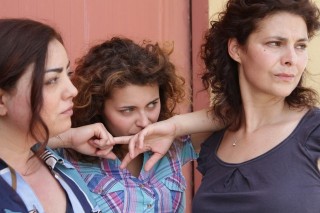
Quiet Bliss (In grazia di Dio)
Edoardo Winspeare, Italy, 2014, 127m
In Italian with English subtitles
Three generations of women seek refuge in their family’s Salento olive grove after their small textile business collapses in Winspeare’s warm and vibrant drama. Against the backdrop of a radiant southern Italian landscape, Winspeare’s characters—serene Salvatrice (Anna Boccadamo), hardened Adele (Celeste Casciaro), loudmouthed Ina (Laura Licchetta), and aspiring thespian Maria Conchetta (Barbara De Matteis)—revive their lives in the wake of economic catastrophe. Turning to a back-to-basics existence as a means of healing the wounds wrought by the recession, they undergo transformations that the director renders with equal parts pathos, insight, and humor.
Saturday, June 7, 6:00pm (Q&A with Edoardo Winspeare)
Monday, June 9, 1:00pm (Q&A with Edoardo Winspeare)
U.S. Premiere
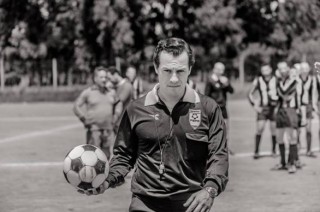
The Referee (L’arbitro)
Paolo Zucca, Italy/Argentina, 2013, 96m
Italian with English subtitles
Sardinian third-league soccer team Atletico Pabarile is suddenly winning every match of the season, after years of losing consistently to Montecrastu, the team led by cocky and abusive landowner Brai. The return of soccer wizard Matzutzi from a sojourn in Argentina has turned the team of farmers into unexpected champions—and now it feels like anything is possible. Enter Cruciani (a great Stefano Accorsi), a young referee greedily climbing his way to the top, and two cousins playing for Montecrastu who are involved in an escalating conflict about archaic sheep-breeding codes in Sardinia. These disparate plots come together explosively in the lush black-and-white world of Zucca’s slyly funny and utterly distinctive first feature.
Tuesday, June 10, 4:00pm
Wednesday, June 11, 9:00pm
U.S. Premiere--shown in press screenings
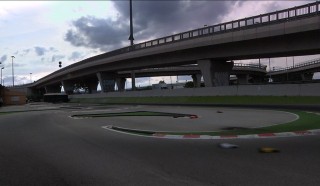
Sacro GRA
Gianfranco Rosi, Italy/France, 2013, DCP, 93m
Italian with English subtitles
The first documentary to win the Golden Lion for Best Film at the Venice Film Festival, the latest from Gianfranco Rosi (El Sicario, Room 164 and Below Sea Level), reveals the sheer diversity of life bubbling around the margins of Rome’s Grande Raccordo Anulare, the 43.5-mile highway that encircles the city, the longest in all of Italy. The absorbing and often moving individual portraits that emerge—an ambulance driver caring for his ailing mother, a scientist studying palm trees ravaged by beetles, an eel fisherman nostalgic for old traditions—give visibility and a human face to the places Sacro GRA drivers pass through but never see, while exposing the city’s striking contradictions. Inspired in part by Italo Calvino’s novel Invisible Cities, Rosi’s captivating chorale plunges the viewer into this paradoxical reality, allowing us a more direct, even sensorial experience of life in the shadow of progress.
Sunday, June 8, 6:30pm Q&A with Gianfranco Rosi)
Monday, June 9, 4:00pm (Q&A with Gianfranco Rosi)
U.S. Premiere - included in press screenings
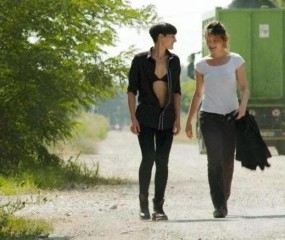
Small Homeland (Piccola Patria)
Alessandro Rossetto, Italy, 2013, DCP, 111m
Italian with English subtitles
Best friends Luisa and Renata long above all else to leave their stifling provincial town in northeastern Italy, where tensions between locals and immigrants are forever threatening to boil over. They work as maids in a hotel but supplement their income with sexual trysts, sometimes assisted by Luisa’s Albanian boyfriend, and hatch a blackmail scheme that fails to play out as expected. The rhythms of daily life in this border zone—where city meets countryside—are captured in vivid detail in the highly promising fiction debut by Rossetto, an experienced documentarian working mainly with nonprofessional actors.
Sunday, June 8, 3:30pm (Q&A with Alessandro Rossetto)
Thursday, June 12, 8:45pm
U.S. Premiere
South Is Nothing (Il Sud e niente)-reviewed in SFIFF
Fabio Mollo, Italy, 2013, DCP, 86m
Italian with English subtitles
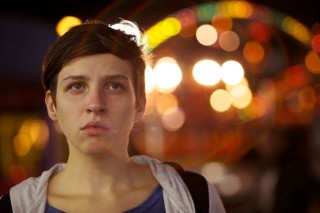
Grazia was 12 years old when she was told by her widower father that her beloved older brother Pietro had died, and never spoken a word since. Now a tomboyish 18, after one of her regular arguments with her father, Grazia flees to the seaside and into the water, where she has an otherworldly experience and thinks she sees her brother. Thus begins her quest to discover another truth, not only about her lost sibling but also about herself. This poised and striking debut by the young Mollo, who shot this film in the Reggio Calabria village where he grew up, features a remarkable central performance by the young Miriam Karlkvist.
Sunday, June 8, 1:00pm
Monday, June 9, 9:00pm
U.S. Premiere - included in press screenings
A Street in Palermo (Via Castellana Bandiera)
Emma Dante, Italy, 2013, DCP, 92m
Italian with English subtitles
Based on her own novel, Emma Dante’s first feature is set in Palermo and shot almost entirely in a narrow alleyway in a run-down neighborhood. On a hot Sunday afternoon, three women are caught in what turns out to be a tragic confrontation. Rosa (Dante) and her partner, Clara (Alba Rohrwacher), have just driven in from Milan and are on their way to a friend’s wedding. As they turn onto Via Castellana Bandiera, they find the Calafiore family jammed into a car driven by Samira (Elena Cotta), a mule-headed Sicilian of Albanian descent. Both drivers stubbornly refuse to back up, as tensions escalate and the neighborhood looks on. An accomplished theater director, Dante includes some knowing nods to spaghetti Westerns and genre conventions in her ambitious film debut, and coaxes formidable performances from her skilled cast (Cotta won the Best Actress Award at the Venice Film Festival).
Wednesday, June 11, 6:30pm
Thursday, June 12, 1:30pm
U.S. Premiere
Tir
Alberto Fasulo, Italy/Croatia, 2013, 83m
Italian with English Subtitles
The first Italian film to win the top prize at the Rome Film Festival, Fasulo’s striking fiction debut follows Branko (played by Branko Zavrsan, from the Oscar-winning No Man’s Land), a former teacher from Bosnia who takes a job driving a tractor trailer (“tir”) through Europe. A native of Friuli with a documentary background, Fasulo immerses the viewer in the experience of the trucker on the road—the sounds, the landscape, and the longing for company (Branko’s phone conversations with his wife are particularly poignant). Part of a growing movement of Italian filmmakers exploring hybrid combinations of documentary and fiction, Fasulo uses both professional actors and real truck drivers, and his approach yields both an intimate connection to his characters and an evocative sense of place.
Saturday, June 7, 1:00pm
Thursday, June 12, 6:30pm (Q&A with Alberto Fasulo)
____________________________________
Open Roads: New Italian Cinema takes place June 5-12, 2014.
Public Screening Schedule
Screening Venues:
The Film Society of Lincoln Center
Walter Reade Theater, 165 West 65th Street, between Broadway and Amsterdam
Thursday, June 5
1:00PM Those Happy Years (100m)
4:00PM The Human Factor (82m)
6:30PM Those Happy Years (100m)
9:15PM A Lonely Hero (104m)
Friday, June 6
1:00PM Long Live Freedom (93m)
3:30PM I Can Quit Whenever I Want (100m)
6:30PM The Fifth Wheel (113m)
9:30PM The Human Factor (82m)
Saturday, June 7
1:00PM Tir (83m)
3:30PM The Mafia Only Kills in Summer (89m)
6:00PM Quiet Bliss (127m)
9:00PM Long Live Freedom (93m)
Sunday, June 8
1:00PM South Is Nothing (86m)
3:30PM Small Homeland (111m)
6:30PM Sacro GRA (93m)
9:00PM I Can Quit Whenever I Want (100m)
Monday, June 9
1:00PM Quiet Bliss (127m)
4:00PM Sacro GRA (93m)
6:30PM The Administrator (83m)
9:00PM South Is Nothing (86m)
Tuesday, June 10
1:30PM The Administrator (83m)
4:00PM The Referee (96m)
6:30PM A Lonely Hero (104m)
9:00PM Happy to Be Different (93m)
Wednesday, June 11
1:00PM The Fifth Wheel (113m)
4:00PM Happy to Be Different (93m)
6:30PM A Street in Palermo (92m)
9:00PM The Referee (96m)
Thursday, June 12
1:30PM A Street in Palermo (92m)
4:00PM The Mafia Only Kills in Summer (89m)
6:30PM Tir (83m)
8:45PM Small Homeland (111m)
Last edited by Chris Knipp; 06-08-2015 at 11:05 PM.
-
THE HUMAN FACTOR (Bruno Oliviero 2013)
BRUNO OLIVIERO: THE HUMAN FACTOR/IL VARIABILE UMANO (2013)
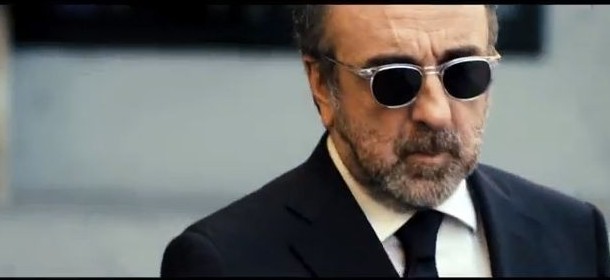
A police inspector who finds out more than he might like to
The Human Factor attempts to blend police procedural with a mood piece that ruminates on the putative moral decay of contemporary Italy. This scheme doesn't succeed, though. Unlike Elio Petri's tour de force Investigation of a Citizen Above Suspicion (1970), which does something similar with brilliance and triumphant irony, Oliviero's film founders from the get-go, never developing momentum or making us care about its concerns or its unresolved plotline. This is the filmmaker's feature debut after a history of documentaries. Yet Olivierio's approach, with his use of hermetic settings and glossy cinematography, is highly cinematic. Except for a hi-tech modern room for post-mortems, Oliviero doesn't strive for documentary realism. Here, the chief police inspector, Monaco (Silvio Orlando), assigned to investigate the death of a German notorious for his involvement in Milan's druggy nightlife finds out his own young daughter is not above suspicion. Whether he is going to be overly judgmental or overly indulgent remains undecided; and this vagueness is what the filmmaker intends, though it contributes to the general blurry, unfocused effect. Due to this film's lack of momentum it seemed long even though it's well under an hour and a half. Newcomer Alice Raffaelli, in real life an aspiring dancer, is interesting as the inspector's daughter, and as Monaco's associate the oddly named Carlo Levi (that's the name of one of Italy's most famous modern writers), the very large Giuseppe Battiston, resembling a young version of the mature Orson Welles, is interesting and appealing, but underused. The cinematography by Renaud Personnaz is elegant and atmospheric but, like the action, uninvolving.
The Human Factor/Il variabile umano, 83 mins., debuted at Locarno August 2013; a few other low-profile fests. In his Locarno review Jay Weissberg of Variety described the film as "too downbeat to make much of a splash at home" but perhaps able to "find larger auds via streaming sites and smallscreen airings." As a straight-to-DVD item, it's classy, but a disappointment. Screened for this review as part of Open Roads: New Italian Cinema at Lincoln Center, 6 June 2014. Surprisingly, considering the film's moody, ultra-downbeat tone, in the Q&A that followed director Oliviero proved lively and full of humor. He said he's like to do a comedy, but the next film he has planned and partly funded is not one.
Last edited by Chris Knipp; 01-02-2015 at 02:30 PM.
-
THOSE HAPPY YEARS (Daniele Luchetti 2013)
DANIELE LUCHETTI: THOSE HAPPY YEARS/ANNI FELICI (2013)
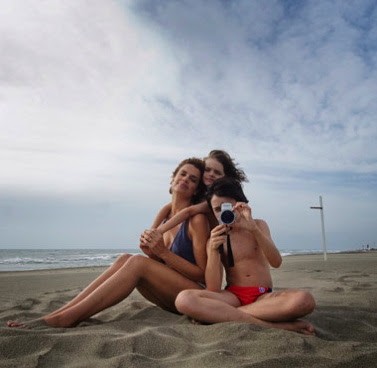
Growing up bohemian in the Seventies
Luchetti's "most autobiographical movie yet" is however not a straightforward account but a riff on a set of characters drawn from his life growing up in the Seventies, which is reimagined conventionally, but with a certain emotion and charm, even if both those qualities are telegraphed operatically. There is the father who wants to be a groundbreaking conceptual artist but comes up only with conventional titillation, who keeps his wife at arm's length while cheating on her with nude "models." There is the artist's withholding, always-critical mother, part of an artistic and intellectual family; the wife's family of people successful in business. And there are the two cute little boys, the older of whom, Dario (Samuel Garofalo) gets a video camera and turns out to be a budding filmmaker, shooting the mother's feminist convocation in the Camargue with the boys and her husband's lesbian art dealer, with whom she has an affair and falls in love. Guido's two big conceptual pieces seem crudely conceived, and there is too much yelling at times. But the film is original for focusing mostly on women. A more mature, less pretty Kim Rossi Stuart is very watchable here as dad Guido, and Micaela Ramazotti is well cast as the well-meaning, tormented wife Serena, who turns out to be the really unconventional one. Whether it's healthy for a kid to having parents who carry out their sexual explorations openly is a question that's left open-eneded, but while director said in a Lincoln Center Q&A that the title is ironic, the narrator twice says he realized the years of his youth were happy, even though the family may not have known it at the time. On the other hand when Dario throws himself in the river after hearing his parents frankly declare their extramarital affairs, it's surely a cry for help. He's rescued and they all drive home, though. There is lots of drama, but nothing too deep here. Sure, this may be more autobiographical than My Brother Is an Only Child, or his 2010 Our Life, but its historical content is relatively vague and its overall shape more familiar. Luchetti remains a reliably entertaining but never very profound director; however, with Serena's lesbian affair he takes a conventional Italian movie in an unaccustomed direction.
Those Happy Years/Anni felici, 106 mins., debuted at Toronto Sept. 2013 and showed at some other big festivals including London and Hong Kong. It opened in France 28 May 2014 under the title Ton absence (Your Absence), with only fair reviews (Allociné press rating 3.1). Screened for this review as part of Open Roads: New Italian Cinema at Lincoln Center 6 June 2014, where it was presented as the opening night film.
Last edited by Chris Knipp; 06-08-2015 at 11:33 PM.
-
A LONELY HERO (Gianni Amelio 2013)
GIANNI AMELIO: A LONELY HERO/L'INTREPIDO (2013)
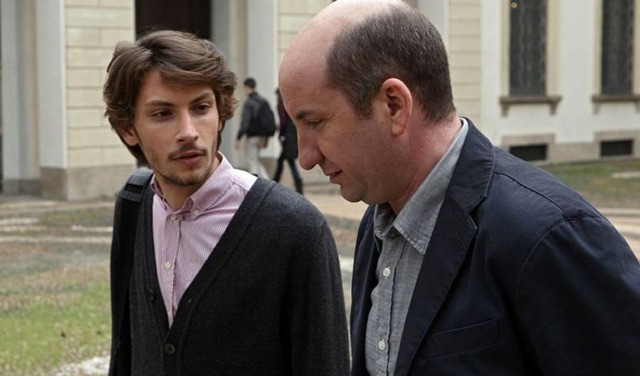
GABRIELE RENDINA AND ANTONIO ALBANESE IN A LONELY HERO
Parable or ramble?
Amelio is a great director but sometimes he seems to be treading water. His concerns simply vary, though they are never far from social issues, and a tricky relationship between father and son is often present. Clearly L'Intrepido, which considers the beauty of work and the pain of unemployment, is meant as a vehicle for the appealing and soulful Antonio Albanese, and he stars in a fantasy about a 48-year-old divorced man with a grown son and an imaginary occupation, "il rimpiazzo," or "filling in," where the character, Antonio Pane, takes on any job, selling roses in restaurants, packing fish, taking apart wrecked cars, working in a restaurant, but each time only for a few hours. Amelio and cowriter Davide Lantieri seem to improvise the plot as they go along, reshaping the concept. At first Antonio seems charming, Chaplinesque, then a bit nutty, then sad, and so do the young woman he befriends and his saxophone-playing son Ivo (Gabriele Rendina), who first seems happy and accomplished and uncomplicated, then tormented by crippling panic attacks. Antonio's "job" turns out to be a coverup for being out of work. But as the film meanders from one angle to another, you begin to wonder about Amelio here: what was he thinking, making a full-length feature that is so meandering, random, and uneven in tone?
A Lonely Hero/L'Intrepido, 104 mins., debuted at Venice, August 2013, also showed at Toronto, London, and Hong Kong festivals. Screened for this review as part of the Open Roads: New Italian Cinema series at Lincoln Center 5 June 2014.
Last edited by Chris Knipp; 01-02-2015 at 02:37 PM.
-
LONG LIVE FREEDOM (Roberto Andò 2013)
ROBERTO ANDÒ: LONG LIVE FREEDOM/VIVA LA LIBERTÀ (2013)
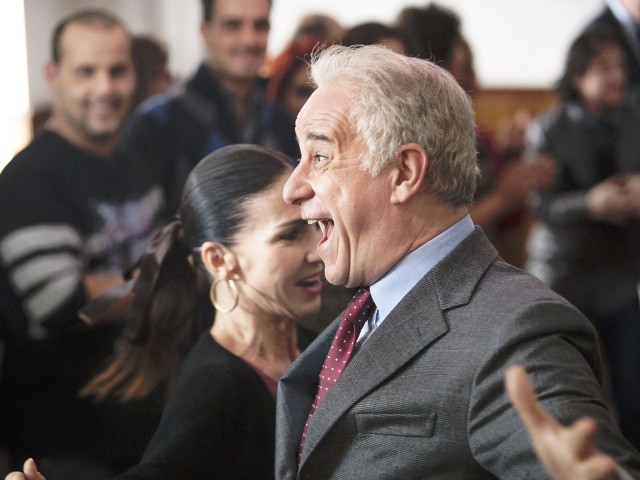
TONI SERVILLO, MANIC, IN LONG LIVE FREEDOM
Fooling the public some of the time in a quiet political satire anchored by Toni Servillo
When Enrico Olivieri, the failing chief Italian opposition leader, goes walkabout in Paris with an old girlfriend after an especially depressing electoral defeat in Rome, his panicked political handlers, who don't know where he has gone, replace him temporarily (or permanently; it's left vague) by his literally crazy identical twin, pen name Giovanni Ermani, a philosophy professor whose unstable condition has led to a long sojourn in a mental institution. Welcoming a chance to pose as Enrico (a game they played in youth), Giovanni delivers odd pronouncements and erratic behavior that make the fake Enrico a great success and rejuvenate his party. Andò's Long Live Freedom is part fantasy, part rather obvious, but certainly welcome, political satire.
The implication that even a guy just out of the nut house can govern, or at least enunciate policy principles, better than the men in power may be a bit heavy-handed, but Andò, whose own novel the screenplay is adapted from, gets in some good digs at the anti-Berlunsconi generation. Its not just an addition to the fun but an essential element that the two twin brothers are played by the brilliant technical actor Toni Servillo, famous for his work with Paolo Sorrentino (Il Divo, The Great Beauty), and one may watch the film just for the pleasure of seeing Servillo at work. As the film oscillates between the fake Enrico in Rome and the real one hiding out in Paris quietly nursing his depression with Valeria Bruni Tedeschi (posing as a filmmaker, as in real life) and her famous Chinese filmmaker husband, Mung (the French-Vietnamese Eric Nguyen), Andò provides good material for the crazy twin; but nothing worthy to balance it occurs in France, where the real Enrico's helping out with kids and a film production with Danielle (Bruni Tedeschi) is no substitute for soul-searching or moral development.
This is material for madcap, fantastic comedy or ruthless satire, but in the event, both Servillo and Andò deliver relatively staid performances -- though the restraint still can't make convincing the premise that the entire country would be deceived by an unhinged impostor, even an identical one, and not know Enrico had a twin. The idea somewhat resembles that of Hal Ashby's Being There, from the Jerzy Kosinski novel about a humble gardener whose utterances are taken as political wisdom by the US president. It's the fact that Chauncy Gardner (the Peter Sellars character) is out of touch that turns his words into seeming political punditry. The failure of the real Enrico highlights the left's failure at marketing. Jay Weissberg, writing about the film for Variety when it debuted in Italy in February 2013, observed that its merit is sufficient to get it out from under the shadow of Sorrentino," (thinking of Servillo's most famous role as the immortal politico in Il Divo,), but that Andò "doesn’t quite manage to make the hoary conceit of identical twins feel fresh." Certainly as Weissberg noted, Servillo as the crazy twin is fun, his manner always threatening to go over-the-top but remaining convincing. The actor's turn as the real politician twin is in the more familiar range of his buttoned down, overly staid characters, though Servillo is always a pleasure to watch. Roberto Andò, whose earlier film reviewed here (Open Roads 2007) was a show of beautiful style without much substance, delivers both classy looks and content this time, but in the development of the story there's a sense of various missed opportunities.
Long Live Freedom/Viva la libertà, 93 mins U.S. Premiere. Screened for this review as part of Open Roads: New Italian Cinema, at Lincoln Center, New York, where it played Friday, June 6 and 1:00pm Saturday, June 07. The film opened in Paris in Feb. 2014 to only so-so reviews (Allociné 3.2). US theatrical release coming 7 November 2014 (2 January 2014 Bay Area).
Last edited by Chris Knipp; 05-14-2023 at 06:28 PM.
-
I CAN QUIT WHENEVER I WANT (Sydney Sibilia 2014)
SYDNEY SIBILIA: I CAN QUIT WHENEVER I WANT/SMETTO QUANDO VOGLIO (2014)

Heated-up comedy about overeducated drug dealers
A topical Italian theme is of young men whose university education can't lead to commensurate professional opportunities and find their efforts trumped by others manipulating bribes and favors. Here, debut director Sydney Sibilia, who is mad about American movies and TV series, emulates them to a fault with a loud and unruly comedy of amateur criminals that only makes one nostalgic for Italian classics like Big Deal on Madonna Street. What has been added are high-decibal music, drugs, and vulgar language. This time there is a scientist, a mathematician, an anthropologist, Latin scholars, and so on whose poor employment leads them to accept the scheme of one of their number who designs an Ecstasy-like drug with a different chemical formula that is not on the Italian government's list of illegal substances. What they leave out of their calculations is a drug kingpin whose territory they are impinging on. The loud, precipitous action, vivid color, and noisy music and Roman settings are infections, if not overwhelming. The cast and crew may be having more fun than we are. Breaks in shooting reportedly had to be taken to stop laughing at the antics of the handsome comic leading man Edoardo Leo, who plays Pietro, the neurobiologist (see photo) who creates the new drug and hatches the plan to make big money skirting the law, gathering together a half dozen of his underemployed university colleagues. Given that I Can Quit is full of influences from "Breaking Bad" and other shows, the movie's big Italian success is a sign of Italy's deep infatuation with things American, but also a need to laugh at the country's social and economic injustices. An Italian review of the movie is called "'Big Deal on Madonna Street' at a time of 'Breaking Bad.'" The difference is that at the time of Germi's Big Deal (1958), Italian filmmakers were in the vanguard both in comedy and serious films; now they feel the need to see their own experience through the filter of American TV. Scenes show Pietro dealing with a thuggish university superior who is strictly interested in making lucrative deals. He has Latinist colleagues who work for a Pakistani boss at a gas station. Another in a typically funny, over-the-top scene tries in vain to pretend he never finished high school to get an illegal job. Even the rival drug kingpin turns out to have a specialized university degree. In his family life Pietro is retro: he must hide the facts from his shrewish, suspicious wife Giulia (Valeria Solarino). Needless to say, the social issues referred to here have been seriously addressed in quite a few recent Italian films. Facing the inroads of downsizing or other financial disasters was taken up in Silvio Soldini's memorable Days and Clouds, (Open Roads 2008) and this theme got a more downbeat treatment in Ivan De Matteo's Balancing Act (New Italian Cinema, SFFS 2012). Giovanni Avellini's Some Say No (New Italian Cinema SFFS 2011) showed young people revolting against the pervasive injustice of Italian corruption and favoritism.
I Can Quit Whenever I Want/Smetto quando voglio, 100 mins., debuted in Italy 6 Feb. 2014. Screened at its US premiere in Open Roads: New Italian Cinema at Lincoln Center Fri. 6 June 2014. It showed also Sun. 8 June.
Last edited by Chris Knipp; 01-02-2015 at 02:39 PM.
-
THE FIFTH WHEEL (Giovanni Veronesi 2013)
GIOVANNI VERONESI: THE FIFTH WHEEL/L'ULTIMA RUOTA DEL CARRO (2013)
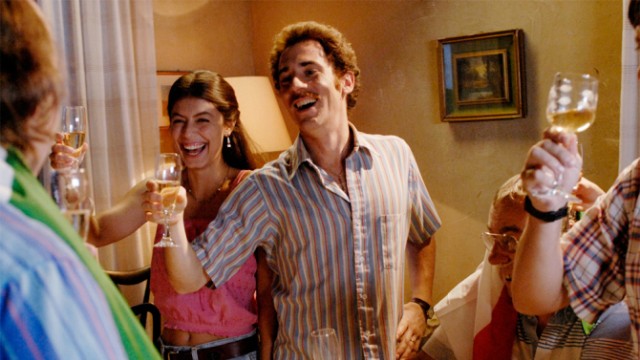
ELIO GERMANNO AND ALESSANDRA MASTROARDI IN THE FIFTH WHEEL
Saga of an ordinary man
In this sometimes winning and always tumultuous Italian drama, appealing for its lead performance by Elio Germanno of Luchetti's My Brother Is an Only Child, here playing Ernesto, a Roman everyman is followed from childhood up to middle age. Germanno, who at thirty-four already has 49 film credits, also played a family striver in Luchetti's 2010 Our Life. (SF New Italian Cinema 2011). Ernesto is called a loser by his father early on, and his various efforts to find interesting work fail. Ernesto winds up working for his dad, later running his own moving company, really shouldering symbolic heavy burdens up and down stairs despite having a bad back. A friendship with an eccentric "pop" artist (Alessander Habe) who does giant Seventies-style collage-paintings gets Ernesto close to success and fame, though he only winds up delivering the artist's paintings to rich buyers. Again and again the movie underlines the inequalities of Italian and particularly Roman life, while affirming Ernesto's soulfulness. To underline his everyman-ishness, Ernesto and his family, both generations, are depicted as passionate football fans, reciting the names of the favorite team's main players being a requirement at each birthday celebration. Things get most satisfyingly corny at the end when Ernesto frantically searches in the Rome city dump for a lost winning lottery ticket, then tells his wife he's already won the lottery -- just having his life.
Besides its sentimental celebration of being Roman, honest, and average, The Fifth Wheel is is a quick runthrough of recent Italian history. So Ernesto and his coworkers get held in a building just as the Aldo Moro assassination has occurred, Bettino Craxi is showered in pennies by an angry crowd, and eventually a row of Berlusconi campaign posters appears, and one of Ernesto's more dubious, but useful, associates sings the praises of the rich politician at the dinner table. Meanwhile a succession of scenes show Ernesto's coworkers becoming more and more crooked, particularly his moving company partner Giacinto (Ricky Memphis), who gets involved in a socialist party scam of switching receipts. Lots of the improprieties of the Seventies and Eighties are superficially alluded to in in this good-natured but never profound film, whose protagonist remains a Forest Gump-like blank, surrounded by the kind of boisterous, noisy Italian family we've seen in many pictures before. Italians must like this kind of movie, since they make so many of them, but this is not one of the memorable or original ones. Even the sympathetic Elio Germanno can be considered rather wasted.
The Fifth Wheel/L'ultima ruota del carro, 113 mins., debuted at Rome out of competition Nov. 2013 as the opening night film and opened theatrically in Italy a week later. It was screened for this review 6 June 2014 as part of Open Roads: New Italian Cinema at Lincoln Center, its US premiere, where it also played 11 June.
Last edited by Chris Knipp; 01-02-2015 at 02:40 PM.
-
TIR (Alberto Fasulo 2013)
ALBERTO FASULO: TIR (2013)
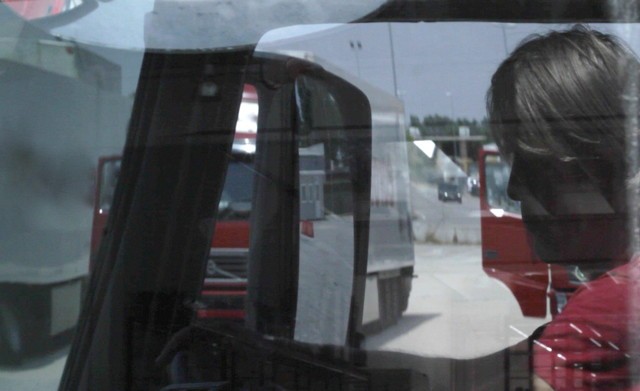
The voluntary servitude of relatively good money in a pan-European market
The hardworking, sincere Italian filmmaker Albert Fasulo's debut feature, which some have called "neo-neorealism," is a docudrama using actors in authentic found settings to present socio-economic reportage in dramatic form. In Tir the settings are not glamorous, though they provide the glamor, or shock, of the authentic. The protagonist, Bronko (Bronko Zavrsan of No Man's Land), drives a "tir" or big rig tractor trailer all over western Europe. His Italian employers constantly push him and his coworkers to give up sleep time and add to driving time to make deadlines and satisfy clients. Bronko, like his co-driver Maki (Marijan Sestak), with whom he is working at first, is a composite based on Fasulo's three-plus years of research accompanying many different drivers on their trips. Fasulo chose a Croatian rather than Italian lead because today the majority of these drivers are Eastern European. Bronko is a former schoolteacher who drives big rigs for an Italian shipping company all ll around western Europe. He accepts being cut off from his family for lengthy periods because this way he can earn around $2,00 a month, three or four times what a teacher gets at home, besides which, his teaching job was not secure.
The director also operated the camera, living in the truck with Zavrsan for most of the four months during which he shot the film. Zavrsan likewise is living the experience he is performing. In today's Italian cinematic scene of glossy, feel-good films, Fasulo's authenticity created such an impression that Tir won the top prize at its debut in the Rome Film Festival in November 2013. There is something tonic and fresh, in an Italian context, anyway, about a movie that doesn't go for glitz or entertainment. But it's only fair to add, as Jay Weissberg of Variety wrote from Rome, that while Tir is "solid" and "intermittently engrossing," it's "rarely vital," and it does "perhaps too good a job of showing the boredom of the long haul."
Tir is even more monotonous, or at least harsher, than the much admired little Latin American truck-travel docudrama Las Acacias (ND/NF 2012), Pablo Giorgelli's closely observational film set in a vehicle loaded with lumber that's driven all across Argentina. From start to finish of Giogelli's film the driver has a hitchhiker, a young woman with a cute little baby in tow. Contact between the two adults is shy and reserved, but there's a kind of sweet romantic pull. Fasulo is dealing with a more widespread and specific phenomenon. Bronko is driving a big rig that's like many others, one equipped with modern electronic maps and a device for drivers to clock in and out, among other things, an essential transport vehicle that's part of a network of networks in which the driver is only a pawn in the game, though an essential one. Most of the time Bronko is alone, if connected to home by cell phone, so far less cut off than a nineteenth-century indentured sailor spending two years before the mast, but still in a sense trapped in limbo. When Bronko and Maki are together then share meals by the side of the truck and talk. Maki wants to quit as soon as he can. Broko gets calls from his wife Isa (Lucka Pockaj that are annoying, even maddening at times. She leads him to believe the mechanic that fixed her car's lights went out drinking and dancing with her and a friend and they were tempted to do more. Another time Isa calls saying a temporary teaching job has come up for him, but he must annoy her by rejecting it, because the money and security won't be sufficient, though he is choosing a longly life thousands of kilometers from home over being with his family working at a quiet, civilized job in his own native land. Later Bronko agrees grudgingly to let his grown son have a large block of his savings for the down payment on an apartment in town. His wife calls soon after, furious after learning about this and insisting the savings are her and Bronko's retirement account. Bronko is helpless as these conversations wash over him, so numbed by the long tiring drives at times he barely knows what day it is.
Sometimes the load and even the truck can be switched by the company at the last minute, most tellingly, near the film's end, going from earlier potatoes and apples to a truck full of live pigs, a burden Bronko does not know how to deal with. The driver of the pig truck has just gotten fed up and bailed from his job. Bronko has to fill in and save the pigs. Patience is required to watch all this. Fasulo cunningly edits to convey the sense of a good long stretch of real time. But imagine the patience required of these drivers. Fasulo's film may be slight, if original seen in an Italian context; but as a contribution to a cinema of social and economic issues, it has a place.
Tir, 90 mins., debuted at Rome, with the prize mentioned; also played at Belfort and Vilnius. Screened for this review as part of Open Roads: New Italian Cinema at Lincoln Center 7 June 2014. At the Lincoln Center Q&A Fasulo reported that Zarvan not only got his trucker's license for this role but was officially hired for by the trucking firm, which commended him on the thoroughness of his preparation. This makes the performance and the shoot scrupulously true-to-life, as well as informed by Fasulo's years of research. In this case as Weissberg suggests, the Rome prize is as much for the ideas and information the film conveys and its authenticity as for the film itself.
Last edited by Chris Knipp; 01-02-2015 at 02:42 PM.
-
QUIET BLISS (Edoardo Winspeare 2013)
EDOARDO WINSPEARE: QUIET BLISS/IN GRAZIA DI DIO (2013)
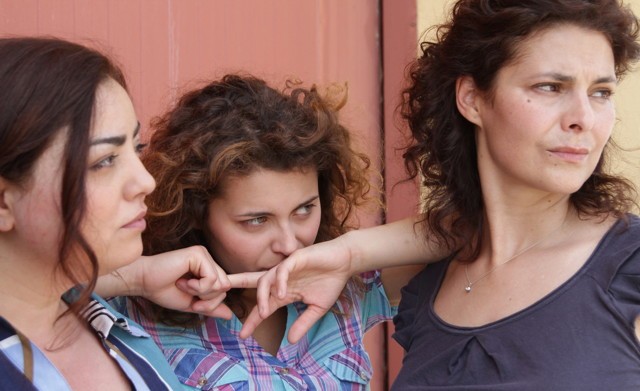
BARBARA DE MATTEIS, LAURA LICCHETTA AND CELESTE CASCIARIO IN QUIET BLISS
Women on the verge of a nervous breakdown
In Edoardo Winspeare's turbulent, shifty Quiet Bliss (In grazia di Dio) a family cedes to debt and Chinese competition in making high fashion wear for Milanese couturiers and must close their small clothing factory, sell it and their house, and move to their property overlooking the sea, which includes an olive grove. Back to the Land. But Quiet Bliss? Hardly. The English-language title is ironic if not simply off-the-wall. Four women of three generations are thrown on their own devices, and at each other's throats, while men hover on the periphery, only causing trouble. Before the move, two men, dad Croccifisso, (Antonio Carluccio) and brother Vito (Amerigo Russo) get caught while marooned in a stolen boat in some stupid but unspecified illegal venture and go to jail. Vito gets out and takes his family away to the north. This movie is like an opera in which instead of singing arias, the ladies and an occasional man periodically haul off and scream invective at each other, in dialect. The effect is wearing, if intermittently involving. As time goes on and the various plotlines sputter, it turns into a neorealist soap. The patois is thick and the setting is the stark but lovely Finis Terrae, Leuca, where the Adriatic meets the Ionian sea within sight of the Greek coast. This is in the region of Lecce, Puglia, in the tip of the heel of the "boot" of Italy where the Austrian-born director grew up, and with which he seems obsessed.
The film is notable not only for sunlit locations but Winspeare's use of non-pros throughout. In charge of the family is Adele, played by Celeste Casciario, the director's wife, a ravaged Sofia Loren type. It's Adele who decides the factory must close and the property must be quickly sold (at a considerable loss). Adele then persuades her frivolous sexpot daughter Ina (played by Laura Licchetta, Winspeare's stepdaughter), still in school and making out with various young men in cars, and her plump sister Maria Concetta (Barbara De Matteis), who wants to become an actress, to join her still-attractive mother Salvatrice (Anna Boccadamo) on the little farm. Adele begins selling their fruit, vegetables, and eggs to businesses in town to pay off outstanding debts. The patient, pious Salvatrice takes up with a 65-year-old local farmer, Cosimmo (Angelino Ferrarese), and a late-blooming romance is born that repels the obstreperous, foul-mouthed Ida. The nicest person in the story (and the most believable non-actor) is Adele's former classmate Stefano (Gustavo Caputo), a shy government bureaucrat who lives with his 90-year-old mother. Stefano spots Adele, whom he evidently had a crush on, in an office of Equitalia where he works protesting her debts, and he becomes a good samaritan, or tries to, beginning with adjusting down the debt. His efforts to tutor the lazy, stubborn Ina aren't much of a success at first, and Adele is hard hearted toward most men, including him. She and Maria Concetta hurl plenty of abuse at each other, and Maria Concetta misses a big audition for Ozpotek due to her sister's hard-heartedness, indifference, and obsession with debts. An inexplicable interlude when Adele treats herself one night to a costly dress and solitary fancy dinner suggests her responsible ways may indeed mask the selfishness the other women accuse her of.
The film loses focus in its latter half and suffers from an unappealing and somewhat opaque protagonist and a failure to develop other characters except peripherally. Prison visits, Salvatrice's wedding to Cosimo, and a subplot involving Ina's unintended pregnancy don't make up for this. A feel-good final tableau of reconciliation among the women seems hastily tacked on and leaves everything still dangling after over two hours of rambling episodes. The production is interesting for its unusual setting and "homemade" nature, including not only non-actors (though more refrained and subtle pros might have been better) but eco-sensitive use of local products and avoidance of gas emissions, more than for the erratic, overlong film. Writing by Alessandro Valenti, Anna Boccadamo, and Edoardo Winspeare and editing by Andrea Facchini could have used greater selectivity and focus. There seem to have been no English-language Berlinale reviews. One negative one in Italian on "filmtv" by Maurri 63, is brutal but makes good points. The film's Salentino dialect was subtitled for Italian viewers.
Quiet Bliss/In grazia di Dio, 127 mins., debuted in the Panorama section of the Berlinale 6 February 2014 and was released in Italy 27 March. Screened for this review as part of Open Roads: New Italian Cinema at Lincoln Center 9 June 2014.
Last edited by Chris Knipp; 01-02-2015 at 02:43 PM.
-
A STREET IN PALERMO (Emma Dante 2013)
EMMA DANTE: A STREET IN PALERMO (2013)
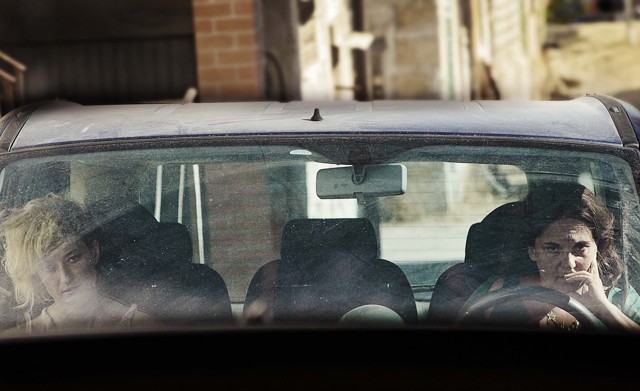
ALBA ROHRWACHER AND EMMA DANTE IN A STREET IN PALERMO
Stubborn hotheads
In this original but claustrophobic and overlong movie a lesbian couple squabble in their car in front of a jittery camera. Rosa, played by Emma Dante, a theatrical director whose novel this is based upon, and and her lover, Clara (Alba Rohrwacher, I Am Love, The Man Who Will Come), have made the trip from Milan to Sicily's capital and are on their way to a friend’s wedding. It's hot, they're tired, and their relationship seems on the verge of ending. Apart from travel fatigue, Rosa, who hails from Palermo but rarely comes back now, is put in a bad mood just by the memories her home town brings back. As they drive into a narrow street (we're told it's Via Castellana Bandiera, the film's Italian title, but to the untutored eye it just looks like any dusty alley), they come head-on to a tiny old vehicle full of locals coming in the opposite direction from a day by the water, which we have also gotten glimpses of. The occupants turn out to be members of the Calafiore family. Driving is Samira (Elena Cotta, who won the Venice Best Actress award for her stolid performance), an aged crone of Albanian origin. In the car is her large, boorish son-in-law, Saro Calafiore (Renato Malfatti), a former handyman who now claims disability, and a bossy, foul-mouthed, dialect-spewing troublemaker. He insists they not back up, and commands Samira to remain in place. Rosa, angry at the world, apparently, and happy for a fight, is unwilling to back up too. The standoff lasts all evening, all night, and into the early morning, though people get in and out of the cars.
This is meant to be a portrait of Sicilian and perhaps Italian stubbornness, and hardly a flattering one. Many details of local culture are presented during the course of the lengthy standoff, which includes action in the Calafiore house nearby, where the son-in-law takes bets on what will happen. Young Nicolò (Dario Casarolo), who has been diving -- the family is coming from a day by the sea, is a peacemaker, who is concerned for Samira, whose physical strength is taken to its limits by this standoff, and also spends an hour or so walking around with Clara.
There are amusements and Dante pumps a lot of dramatic content and a surprising variety of characters and scenes into this basically simple and static situation, but the action nonetheless is overshadowed by its inevitable air of utter pointlessness. While this may or may not be entertaining for viewers, it is a kind of metaphor for Italy, which may see itself as stuck in hopeless conflicts and unable to movie forward. One may question whether the action can support such larger significance, however. Other than the side betting on the outcome, which winds up being only a small element, there seems to be not so much at stake in the action. Perhaps Saro has the betting scheme in mind all along. But Rosa's willingness to dig in seems somewhat inexplicable. One would think she of all people would want to get on with it. At the end there is a quietly tragic finale, a relaxation of the tension, and the seeming reconciliation of Rosa and Clara, but all that feels like a bit of a letdown after the ordeal we've gone through. There are a lot of scenes that feel drawn out too long, like the extended stable shot that ends the film, with people running up to and beyond the camera, which is attractive at first, but then continues till it loses all verisimilitude. More patient viewers may feel otherwise.
Alba Rohrwacher is the sister of Alice Rohrwacher, director of Corpo Celeste, who just won the Grand Prize at Cannes for her new film The Wonders/Le meraviglie.
A Street in Palermo/Via Castellana Bandiera, 93 mins., debuted at Venice.
Last edited by Chris Knipp; 01-02-2015 at 02:45 PM.
-
THE MAFIA ONLY KILLS IN SUMMER (Pierfrancesco Diliberto 2013)
PIERFRANCESCO DILIBERTO: THE MAFIA ONLY KILLS IN SUMMER/LA MAFIA UCCIDE SOLO D'ESTATE (2013)

ALEX MISCONTI AS ARTURO COSTUMED AS ANDREOTTI IN THE MAFIO ONLY KILS IN SUMMER
Growing up journalistic
This is a very charming semi-autobiographical comedy that at the same time is a meaningful study of southern Italian politics, in particular the destructive, homicidal role played by the Mafia. Unfortunately Diliberto's story as he tells it lacks thrust and unity as a movie, falling too much into two unrelated parts, and as it progresses it degenerates into the style of TV sit-com. This is not surprising given the director's primary experience as a television comedian and political commentator known by the nickname "Pif." But despite this disappointment thre is much to enjoy here.
Diliberto does something unique, though it may not altogether translate for non-Italian audiences, by building rom-com charm on top of a grizzly chronicle of organized crime assassinations, blending charm and horror. The first half concerns the adolescent protagonist, who worships longtime politician (with rumored Mafia connections) Giulio Andreotti (of Il Divo, alluded to here) and even goes to a school costume party made up as him, collecting clippings of Mafia killings of political and government figures in town. Even his birth has coincided with the election of the Mafioso mayor Vito Ciancimino and a massacre ordered by the crime boss Salvatore Riina. Some of these later eliminated figures Arturo gets to know personally, because he is an accomplished amateur journalist. He is also hopelessly in love with pretty blond in his class Flora (Ginevra Antona), who mostly seems to prefer another boy. It doesn't hurt that at this age the narrator, Arturo, is played by the adorable Alex Bisconti.
The way Arturo's interest in politics, the law, and Mafia killings and his precocious journalistic ambitions lead him to meet up with real-life Eighties anti-Mafia figures, including General Carlo Alberto Dalla Chiesa and judges Giovanni Falcone and Paolo Borsellino (all, along with half a dozen others chronicled here, later offed by the Mob) makes Arturo into a sort of localized, Sicilian version of Forest Gump, brushing with history, Mafia-style.
The time when the movie becomes lopsided comes when it suddenly jumps to Arturo as an adult, played by Diliberto himself (not looking as young as he's supposed to be, or resembling the younger actor) Alex Bisconti). And at this point there is a certain disappointment also because the boy's promise and ambition don't see to have led him very far. h His journalistic ambitions have narrowed to television, and he joins a silly, broadly caricatured Italian TV show called "Bonjour," at first only as its comically incompetent pianist. Flora reappears after being out of Arturo's life for years, as the attractive actress Cristiana Capotondi. She seems as indifferent as ever, but willing to help Arturo into more serious work, as she's the aide of a politician and brings him on the staff. Arturo remains a virgin; his innocence may be meant to mimic the feigned ignorance of Sicilians and Palermitani, who pretend not to know their world is surrounded by corruption. The Mafia, obviously, dos not only kill in summer. But Arturo only becomes aware of the crime all around him with major news coverage of a mass trial of a Mafia clan.
The appeal of this movie despite its lopsidedness is in how its amusing and lighthearted surface only slightly hides the darker truths underneath. At the end, there is a homage to all the judges and politicians assassinated by the Mafia in Palermo in the period covered, with a collage of the newspaper clippings to show every viewer that these were real events. Further we're informed that Pif AKA Diliberto avoided paying the usual bribes for location shooting, joining up with the "Addiopizzo" movement of businesses refusing to pay Mafia protection fees. So like Sydney Sibilia's I Can Quit Whenever I Want only more so, this conveys a serious message via an entertaining genre.
The Mafia Only Kills in Summer/La Mafia uccide solo d'estate,
Last edited by Chris Knipp; 01-02-2015 at 02:46 PM.
 Posting Permissions
- You may not post new threads
- You may not post replies
- You may not post attachments
- You may not edit your posts
-
Forum Rules




 Reply With Quote
Bookmarks