-
PARASITE (Bong Joon-ho 2019)
BONG JOON-HO: PARASITE 기생충 (Gisaengchung) (2019)
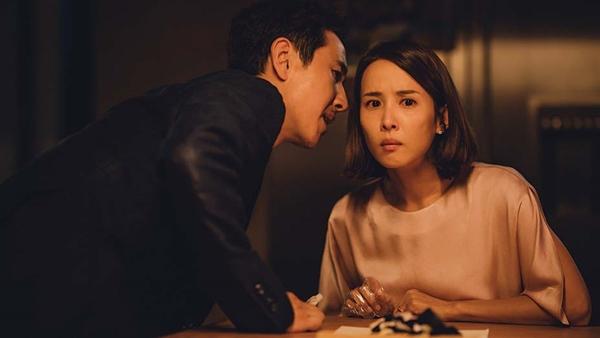
LEE SON-KYUN AND JO YEO-JEONG IN PARASITE
Crime thriller as social commentary? Maybe not.
I've reviewed Bong's 2006 The Host ("a monster movie with a populist heart and political overtones that's great fun to watch") and his 2009 Mother which I commented had "too many surprises." (I also reviewed his 2013 Snowpiercer.) Nothing is different here except this seems to be being taken more seriously as social commentary, though it's primarily an elaborately plotted and cunningly realized violent triller, as well a monster movie where the monsters are human. It's also marred by being over long and over-plotted, making its high praise seem a bit excessive.
This new film, Bong's first in a while made at home and playing with national social issues, is about a deceitful poor family that infiltrates a rich one. It won the top award at Cannes in May 2019, just a year after the Japanese Koreeda's (more subtle and more humanistic) Palm winner about the related theme of a crooked poor family. Parasite has led to different comparisons, such as Losey's The Servant and Pasolini's Theorem. In accepting the prize, Bong himself gave a nod to Hitchcock and Chabrol. Parasite has met with nearly universal acclaim, though some critics feel it is longer and more complicated than necessary and crude in its social commentary, if its contrasting families really adds up to that. The film is brilliantly done and exquisitely entertaining half the way. Then it runs on too long and acquires an unwieldiness that makes it surprisingly flawed for a film so heaped with praise.
It's strange to compare Parasite with Losey's The Servant, in which Dick Bogarde and James Fox deliver immensely rich performances. Losey's film is a thrillingly slow-burn, subtle depiction of class interpenetration, really a psychological study that works with class, not a pointed statement about class itself. It's impossible to speak of The Servant and Parasite in the same breath.
In Parasite one can't help but enjoy the ultra-rich family's museum-piece modernist house, the score, and the way the actors are handled, but one keeps coming back to the fact that as Steven Dalton simply puts it in his Cannes Hollywood Reporter review, Parasite is "cumbersomely plotted" and "heavy-handed in its social commentary." Yet I had to go to that extremist and contrarian Armond White in National Review for a real voice of dissent. I don't agree with White's politics or his belief that Stephen Chow is a master filmmaker, but I do sympathize with being out-of-tune, like him, with all the praise of Boon's new film.
The contrast between the poor and rich family is blunt indeed, but the posh Park family doesn't seem unsubtly depicted: they're absurdly overprivileged, but don't come off as bad people. Note the con-artist Kim family's acknowledgement of this, and the mother's claim that being rich allows you to be nice, that money is like an iron that smooths out the wrinkles. This doesn't seem to be about that, mainly. It's an ingeniously twisted story of a dangerous game, and a very wicked one. Planting panties in the car to mark the chauffeur as a sexual miscreant and get him fired: not nice. Stimulating the existing housekeeper's allergy and then claiming she has TB so she'll be asked to leave: dirty pool. Not to mention before that, bringing in the sister as somebody else's highly trained art therapist relative, when all the documents are forged and the "expertise" is cribbed off the internet: standard con artistry.
The point is that the whole Kim family makes its way into the Park family's employ and intimate lives, but it is essential that they conceal that they are in any way related to each other. What Bong and his co-writer Jin Won Han are after is the depiction of a dangerous con game, motivated by poverty and greed, that titillates us with the growing risk of exposure. The film's scene-setting of the house and family is exquisite. The extraordinary house is allowed to do most of the talking. The rich family and the housekeeper are sketched in with a few deft stokes. One's only problem is first, the notion that this embodies socioeconomic commentary, and second, the overreach of the way the situation is played out, with one unnecessary coda after another till every possibility is exhausted. This is watchable and entertaining (till it's not), but it's not the stuff of a top award.
Parasite 기생충 (Gisaengchung), 132 mins., debuted in Competition at Cannes, winning the Palme d'Or best picture award. Twenty-eight other festivals followed as listed on IMDb, including New York, for which it was screened (at IFC Center Oct. 11, 2019) for the present review. Current Metascore 95%. It has opened in various countries including France, where the AlloCiné press rating soared to 4.8.

PARK SO-DAM AND CHOI WOO-SIK IN PARASITE
Last edited by Chris Knipp; 02-19-2020 at 01:49 AM.
-
MOTHERLESS BROOKLYN (Edward Norton 2019)
EDWARD NORTON: MOTHERLESS BROOKLYN (2019)
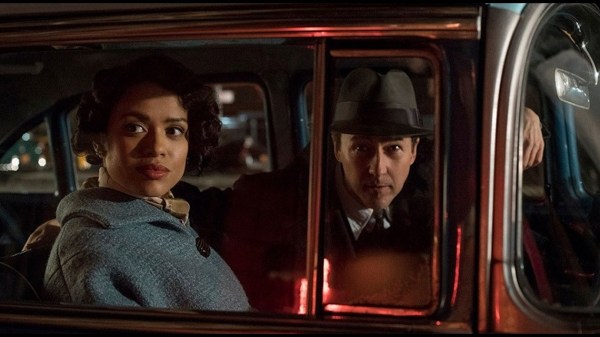
GUGU MBATHA-RAW AND EDWARD NORTON IN MOTHERLESS BROOKLYN
Edward Norton's passion project complicates the Jonathan Lethem novel
The NYFF Closing Night film is the premiere of Edwards Norton's adaptation, a triumph over many creative obstacles through a nine-year development time, of Jonathan Lethem's 1999 eponymous novel. It concerns Lionel Essrog (played by Norton), a man with Tourette's Syndrome who gets entangled in a police investigation using the obsessive and retentive mind that comes with his condition to solve the mystery. Much of the film, especially the first half, is dominated by Lionel's jerky motions and odd repetitive outbursts, for which he continually apologizes. Strange hero, but Lethem's creation. To go with the novel's evocation of Maltese Falcon style noir flavor, Norton has recast it from modern times to the Fifties.
Leading cast members, besides Norton himself, are Willem Dafoe, Bruce Willis, Alec Baldwin, Cherry Jones, Bobby Cannavale and Gugu Mbatha-Raw. In his recasting of the novel, as Peter Debruge explains in his Variety review, Norton makes as much use of Robert Caro's The Power Broker, about the manipulative city planner Robert Moses, a "visionary" insensitive to minorities and the poor, as of Lethem's book. Alec Baldwn's "Moses Randolph" role represents the film's Robert Moses character, who is added into the world of the original novel.
Some of the plot line may become obscure in the alternating sources of the film. But clearly Lionel Essrog, whose nervous sensibility hovers over things in Norton's voiceover, is a handicapped man with an extra ability who's one of four orphans from Saint Vincent's Orphanage in Brooklyn saved by Frank Minna (Bruce Willis), who runs a detective agency. When Minna is offed by the Mob in the opening minutes of the movie, Lionel goes chasing. Then he learns city bosses had a hand, and want to repress his efforts.
Gugu Mbatha-Raw's character, Laura Rose, who becomes a kind of love interest for Lionel Essrog, and likewise willem Dafoe's, Paul Randolph, Moses' brother and opponent, are additional key characters in the film not in the Johathan Lethem book. The cinematography is by the Mike Leigh regular (who produced the exquisite Turner), Dick Pope. He provides a lush, classic look.
Viewers will have to decide if this mixture of novel, non-fiction book and period recasting works for them or not. For many the problem is inherent in the Lethem novel, that it's a detective story where, as the original Times reviewer Albert Mobilio said, "solving the crime is beside the point." Certainly Norton has created a rich mixture, and this is a "labour of love," "as loving as it is laborious, maybe," is how the Guardian's Peter Bradshaw put it, writing (generally quite favorably) from Toronto. In her intro piece for the first part of the New York Film Festival for the Times Manohla Dargis linked it with the difficult Albert Serra'S Liberté with a one-word reaction: "oof," though she complemented these two as "choices rather than just opportunistically checked boxes." Motherless Brooklyn has many reasons for wanting to be in the New York Film Festival, and for the honor of Closing Night Film, notably the personal passion, but also the persistent rootedness in New York itself through these permutations.
Motherless Brooklyn, 144 mins., debuted at Telluride Aug. 30, 2019, showing at eight other festivals including Toronto, Vancouver, Mill Valley, and New York, where it was screened at the NYFF OCT. 11, 2019 as the Closing Night film. It opens theatrically in the US Nov. 1, 2019. Current Metascore 60%.
Last edited by Chris Knipp; 09-08-2021 at 02:08 PM.
-
THE IRISHMAN (Martin Scorsese 2019)
[Found also in Filmleaf's Festival Coverage section for the 2019 NYFF]
MARTIN SCORSESE: THE IRISHMAN (2019)
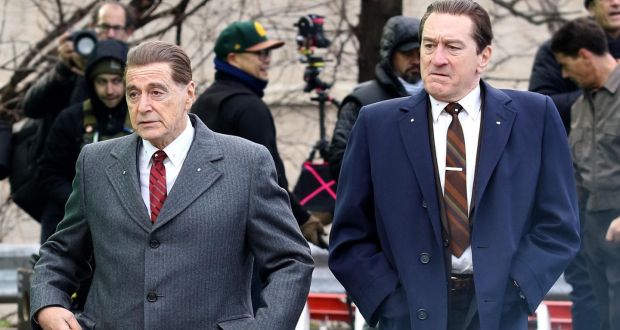
AL PACINO AND ROBERT DE NIRO IN THE IRISHMAN
Old song
From Martin Scorsese, who is in his late seventies, comes a major feature that is an old man's film. It's told by an old man, about old men, with old actors digitized (indifferently) to look like and play their younger selves as well. It's logical that The Irishman, about Teamsters loyalist and mob hit man Frank Sheeran (Robert De Niro), who became the bodyguard and then (as he tells it) the assassin of Union kingpin Jimmy Hoffa (Al Pacino) should have been chosen as Opening Night Film of the New York Film Festival. Scorsese is very New York, even if the film is set in Detroit. He is also a good friend of Film at Lincoln Center. And a great American director with an impressive body of work behind him.
To be honest, I am not a fan of Scorsese's feature films. I do not like them. They are unpleasant, humorless, laborious and cold. I admire his responsible passion for cinema and incestuous knowledge of it. I do like his documentaries. From Fran Lebowitz's talk about the one he made about her, I understand what a meticulous, obsessive craftsman he is in all his work. He also does have a sense of humor. See how he enjoys Fran's New York wit in Public Speaking. And there is much deadpan humor in The Irishman at the expense of the dimwitted, uncultured gangsters it depicts. Screenwriter Steven Zaillian's script based on Charles Brandt's book about Sheeran concocts numerous droll deadpan exchanges. It's a treat belatedly to see De Niro and Pacino acting together for the first time in extended scenes.
The Irishman is finely crafted and full of ideas and inspires many thoughts. But I found it monotonous and overlong - and frankly overrated. American film critics are loyal. Scorsese is an icon, and they feel obligated, I must assume, to worship it. He has made a big new film in his classic gangster vein, so it must be great. The Metascore, 94%, nonetheless is an astonishment. Review aggregating is not a science, but the makers of these scores seem to have tipped the scales. At least I hope more critics have found fault with The Irishman than that. They assign 80% ratings to some reviews that find serious fault, and supply only one negative one (Austin Chronicle, Richard Whittaker). Of course Armond White trashes the movie magnificently in National Review ("Déjà Vu Gangsterism"), but that's outside the mainstream mediocre media pale.
Other Scorsese stars join De Niro and Pacino, Joe Pesci, Harvey Keitel. This is a movie of old, ugly men. Even in meticulously staged crowd scenes, there is not one young or handsome face. Women are not a factor, not remotely featured as in Jonathan Demme's delightful Married to the Mob. There are two wives often seen, in the middle distance, made up and coiffed to the kitsch nines, in expensive pants suits, taking a cigarette break on car trips - it's a thing. But they don't come forward as characters. Note also that out of loyalty to his regulars, Scorsese uses an Italo-American actor to play an Irish-American. There's a far-fetched explanation of Frank's knowledge of Italian, but his Irishness doesn't emerge - just another indication of how monochromatic this movie is.
It's a movie though, ready to serve a loyal audience with ritual storytelling and violence, providing pleasures in its $140 million worth of production values in period feel, costumes, and snazzy old cars (though I still long for a period movie whose vehicles aren't all intact and shiny). This is not just a remake. Its very relentlessness in showing Frank's steady increments of slow progress up the second-tier Teamsters and mafia outsider functionary ladders is something new. But it reflects Scorsese's old worship of toughs and wise guys and seeming admiration for their violence.
I balk at Scorsese's representing union goons and gangsters as somehow heroic and tragic. Metacritic's only critic of the film, Richard Whittiker of the Austen Chronicle, seems alone in recognizing that this is not inevitable. He points out that while not "lionizing" mobsters, Scorsese still "romanticizes" them as "flawed yet still glamorous, undone by their own hubris." Whittiker - apparently alone in this - compares this indulgent touch with how the mafia is shown in "the Italian poliziotteschi," Italian Years of Lead gang films that showed them as "boors, bullies, and murderers, rather than genteel gentlemen who must occasionally get their hands dirty and do so oh-so-begrudgingly." Whittiker calls Scorsese's appeal to us to feel Sheeran's "angst" when he's being flown in to kill "his supposed friend" (Hoffa) "a demand too far."
All this reminded me of a richer 2019 New York Film Festival mafia experience, Marco Bellocchio's The Traitor/Il traditore, the epic, multi-continent story of Tommaso Buscetta, the first big Italian mafia figure who chose to turn state's witness. This is a gangster tale that has perspective, both morally and historically. And I was impressed that Pierfrancesco Favino, the star of the film, who gives a career-best performance as Buscetta, strongly urged us both before and after the NYFF public screening to bear in mind that these mafiosi are small, evil, stupid men. Coppola doesn't see that, but he made a glorious American gangster epic with range and perspective. In another format, so did David Chase om the 2000-2007 HBO epic, "The Sopranos." Scprsese has not done so. Monotonously, and at overblown length, he has once again depicted Italo-Americans as gangsters, and (this time) unions as gangs of thugs.
The Irishman, 209 mins,. debuted at New York as Opening Night Film; 15 other international festivals, US theatrical release Nov. 1, wide release in many countries online by Netflix Nov. 27. Metascore 94%.
Last edited by Chris Knipp; 11-23-2019 at 08:49 PM.
-
BACURAU (Kleber Mendonça Filho, Juliano Dornelles 2019)
KLEBER MENDOÇA FILHO, JULIANO DORNELLES: BACURAU (2019)
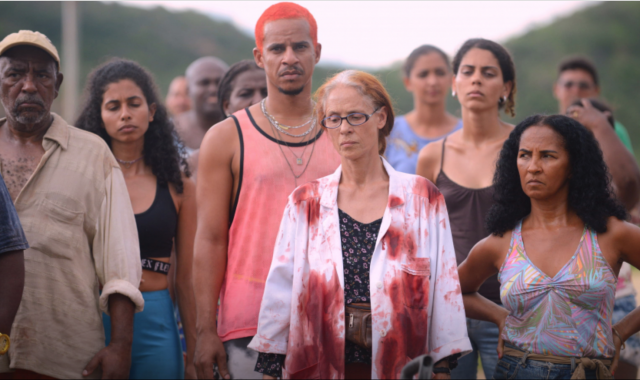
SONIA BRAGA (CENTER) IN BACURAU
Not just another Cannes mistake?
This is a bold film for an arthouse filmmaker to produce, and it has moments of rawness and unpredictability that are admirable. But it seems at first hand to be possibly a misstep both for the previously much subtler chronicler of social and political unease as seen in the 2011 Neighboring Sopunds and 2016 Aquarius, Kleber Mendonça Filho, and for Cannes, which may have awarded novelty rather than mastery in giving it half of the 2019 Jury Prize. It's a movie that excites and then delivers a series of scenes of growing disappointment and repugnance. But I'm not saying it won't surprise and awe you.
Let's begin with where we are, which is the Brazilian boonies. Bacurau was filmed in the village of Barra in the municipality of Parelhas and in the rural area of the municipality of Acari, at the Sertão do Seridó region, in Rio Grande do Norte. Mendonça Filho shares credit this time with his regular production designer Juliano Dornelles. (They both came originally from this general region, is one reason.) The Wikipedia article introduces it as a "Brazilian weird western film" and its rural shootout, its rush of horses, its showdowns, and its truckload of coffins may indeed befit that peculiar genre.
How are we to take the action? In his Hollywood Reporter review, Stephen Dalton surprises me by asserting that this third narrative feature "strikes a lighter tone" than the first two and combines "sunny small-town comedy with a fable-like plot" along with "a sprinkle of magic realism." This seems an absurdly watered down description, but the film is many things to many people because it embodies many things. In an interview with Emily Buder, Mendoça Filho himself describes it as a mix of "spaghetti Western, '70's sci-fi, social realist drama, and political satire."
The film feels real enough to be horrifying, but it enters risky sci-fi horror territory with its futuristic human hunting game topic, which has been mostly an area for schlock. (See a list of ten, with the 1932 Most Dangerous Game given as the trailblazer.) However, we have to acknowledge that Mendonca Filho is smart enough to know all this and may want to use the schlock format for his own sophisticated purpose. But despite Mike D'Angelo's conclusion on Letterboxd that the film may "require a second viewing following extensive reading" due to its rootedness in Brazilian politics, the focus on American imperialists and brutal outside exploiters from the extreme right isn't all that hard to grasp.
Bacurau starts off as if it means to be an entertainment, with conventional opening credits and a pleasant pop song celebrating Brazil, but that is surely ironic. A big water truck rides in rough, arriving with three bullet holes spewing agua that its driver hasn't noticed. (The road was bumpy.) There is a stupid, corrupt politician, mayor Tony Jr. (Thardelly Lima), who is complicit in robbing local areas of their water supply and who gets a final comeuppance. The focus is on Bacurau, a little semi-abandoned town in the north whose 94-year-old matriarch Carmelita dies and gets a funeral observation in which the whole town participates, though apart the ceremony's strange magic realist aspects Sonia Braga, as a local doctor called Domingas, stages a loud scene because she insists that the deceased woman was evil. Then, with some, including Carmelita's granddaughter Teresa (Barbara Colen), returned to town from elsewhere, along with the handsome Pacote (Tomaso Aquinas) and a useful psychotic local killer and protector of water rights called Lunga (Silvero Pereira), hostile outsiders arrive, though as yet unseen. Their forerunners are a colorfully costumed Brazilian couple in clownish spandex suits on dustrider motorcycles who come through the town. When they're gone, it's discovered seven people have been shot.
They were an advance crew for a gang of mostly American white people headed by Michael (Udo Kier), whose awkward, combative, and finally murderous conference we visit. This is a bad scene in more ways than one: it's not only sinister and racist, but clumsy, destroying the air of menace and unpredictability maintained in the depiction of Bacurau scenes. But we learn the cell phone coverage of the town has been blocked, it is somehow not included on maps, and communications between northern and southern Brazil are temporarily suspended, so the setting is perfect for this ugly group to do what they've come for, kill locals for sport using collectible automatic weapons. Overhead there is a flying-saucer-shaped drone rumbling in English. How it functions isn't quite clear, but symbolically it refers to American manipulation from higher up. The way the rural area is being choked off requires no mention of Brazil's new right wing strong man Jair Bolsonaro and the Amazonian rain forest.
"They're not going to kill a kid," I said as a group of local children gather, the most normal, best dressed Bacurauans on screen so far, and play a game of dare as night falls to tease us, one by one creeping as far as they can into the dark. But sure enough, a kid gets shot. At least even the bad guys agree this was foul play. And the bad guys get theirs, just as in a good Western. But after a while, the action seems almost too symbolically satisfying - though this is achieved with good staging and classic visual flair through zooms, split diopter effects, Cinemascope, and other old fashioned techniques.
I'm not the only one finding Bacurau intriguing yet fearing that it winds up being confused and all over the place. It would work much better if it were dramatically tighter. Peter DeBruge in Variety notes that the filmakers "haven’t figured out how to create that hair-bristling anticipation of imminent violence that comes so naturally to someone like Quentin Tarantino." Mere vague unexpectedness isn't scary, and all the danger and killing aren't wielded as effectively as they should be to hold our attention and manipulate our emotions.
Bacurau, 131 mins., debuted in Competition at Cannes, where it tied for the Jury Prize with the French film, Ladj Ly's Les misérables. Many other awards and at least 31 other festivals including the NYFF. Metascore 74%. AlloCiné press rating 3.8, with a rare rave from Cahiers du Cinéma. US theatrical distribution by Kino Lorber began Mar. 13, 2020, but due to general theater closings caused by the coronavirus pandemic the company launched a "virtual theatrical exhibition initiative," Kino Marquee, with this film from Mar. 19.
Last edited by Chris Knipp; 04-05-2020 at 01:24 PM.
-
ZOMBI CHILD (Bertrand Bonello 2019)
BERTRAND BONELLO: ZOMBI CHILD (2019)
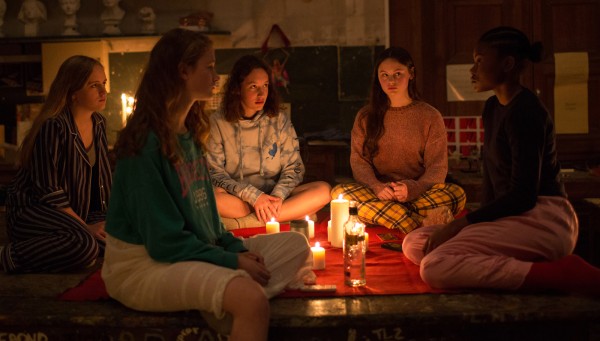
LOUISE LABEQUE AND WISLANDA LOUIMAT (FAR RIGHT) IN ZOMBI CHILD
Voodoo comes to Paris
If you said Betrand Bonello's films are beautiful, sexy, and provocative you would not be wrong. This new, officially fifth feature (I've still not seen his first one, the 2008 On War), has those elements. Its imagery, full of deep contrasts, can only be described as lush. Its intertwined narrative is puzzling as well.
We're taken right away to Haiti and plunged into the world of voodoo and zombies. Ground powder from the cut-up body of a blowfish is dropped, unbeknownst to him, into a man's shoes. Walking in them, he soon falters and falls. Later, he's aroused from death to the half-alive state of a zombie - and pushed into a numb, helpless labor in the hell of a a sugar cane field with other victims of the same cruel enchantment. In time however something arouses him to enough life to escape.
Some of the Haitian sequences center around a moonlit cemetery whose large tombs seem airy and haunted and astonishingly grand for what we know as the poorest country in the hemisphere.
From the thumping, vibrant ceremonies of Haitian voodoo (Bonello's command of music is always fresh and astonishing as his images are lush and beautiful) we're rushed to the grandest private boarding school you've ever seen, housed in vast stone government buildings. This noble domaine was established by Napoleon Bonaparte on the edge of Paris, in Saint Denis, for the education of children of recipients of the Legion of Honor. It really exists, and attendance there is still on an honorary basis.
Zombi Child oscillates between girls in this very posh Parisian school and people in Haiti. But these are not wholly separate places. A story about a Haitian grandfather (the zombie victim, granted a second life) and his descendants links the two strains. It turns out one of those descendants, Mélissa (Wislanda Louimat), is a new student at the school. A white schoolgirl, Fanny (the dreamy Louise Labeque), who's Mélissa's friend and sponsors her for membership in a sorority, while increasingly possessed by a perhaps imaginary love, also bridges the gap. For the sorority admission Mélissa confesses the family secret of a zombi and voodoo knowledge in her background.
Thierry Méranger of Cahiers du Cinéma calls this screenplay "eminently Bonellian in its double orientation," its "interplay of echoes" between "radically different" worlds designed to "stimulate the spectator's reflection." Justin Chang of the Los Angeles Times bluntly declares that it's meant to "interrogate the bitter legacy of French colonialism."
But how so? And if so, this could be a tricky proposition. On NPR Andrew Lapin was partly admiring of how "cerebral and slippery" the film is, but suggests that since voodoo and zombies are all most white people "already know" about Haitian culture, a director coming from Haiti's former colonizing nation (France) must do "a lot of legwork to use these elements successfully in a "fable" where "the real horror is colonialism." The posh school comes from Napoleon, who coopted the French revolution, and class scenes include a history professor lecturing on this and how "liberalism obscures liberty."
I'm more inclined to agree with Glenn Kenny's more delicately worded praise in his short New York Times review of the film where he asserts that the movie’s inconclusiveness is the source of its appeal. Zombi Child, he says, is fueled by insinuation and fascination. The fascination, the potent power, of the occult, that's what Haiti has that the first wold lacks.
One moment made me authentically jump, but Bonello isn't offering a conventional horror movie. He's more interested in making his hints of voodoo's power and attraction, even for the white lovelorn schoolgirl, seem as convincing as his voodoo ceremonies, both abroad and back in Haiti, feel thoroughly attractive, or scary, and real. These are some of the best voodoo scenes in a movie. This still may seem like a concoction to you. Its enchantments were more those of the luxuriant imagery, the flowing camerawork, the delicious use of moon- and candle-light, the beautiful people, of whatever color. This is world-class filmmaking even if it's not Bonello's best work.
Bonello stages things, gets his actors to live them completely, then steps back and lets it happen. Glenn Kenny says his "hallmark" is his "dreamy detachment." My first look at that was the 2011 House of Tolerence (L'Apollonide - mémoires de la maison close), which I saw in Paris, a languorous immersion in a turn-of-the-century Parisian brothel, intoxicating, sexy, slightly repugnant. Next came his most ambitious project, Saint Laurent(2014), focused on a very druggy period in the designer's career and a final moment of decline. He has said this became a kind of matching panel for Apollonide. (You'll find that in an excellent long Q&A after the NYFF screening.) Saint Laurent's "forbidden" (unsanctioned) picture of the fashion house is as intoxicating, vibrant, and cloying as the maison close, with its opium, champagne, disfigurement and syphilis. No one can say Gaspard Ulliel wasn't totally immersed in his performance. Nocturama (2016) takes a group of wild young people who stage a terrorist act in Paris, who seem to run aground in a posh department store at the end, Bonello again getting intense action going and then seeming to leave it to its own devices, foundering. Those who saw the result as "shallow cynicism" (like A.O. Scott) missed how exciting and powerful it was. (Mike D'Angelo didn't.)
Zombi Child is exciting at times too. But despite its gorgeous imagery and sound, its back and forth dialectic seems more artificial and calculating than Bonello's previous films.
Zombi Child, mins., debuted at Cannes Directors Fortnight May 2019, included in 13 other international festivals, including Toronto and New York. It released theatrically in France Jun. 12, 2020 (AlloCiné press rating 3.7m 75%) and in the US Jan. 24, 2020 (Metascore 75%). Now available in "virtual theater" through Film Movement (Mar. 23-May 1, 2020), which benefits the theater of your choice. https://www.filmmovement.com/zombi-child
Last edited by Chris Knipp; 12-07-2025 at 11:46 PM.
-
WASP NETWORK (Olivier Assayas 2019)
OLIVIER ASSAYAS: WASP NETWORK (2019)
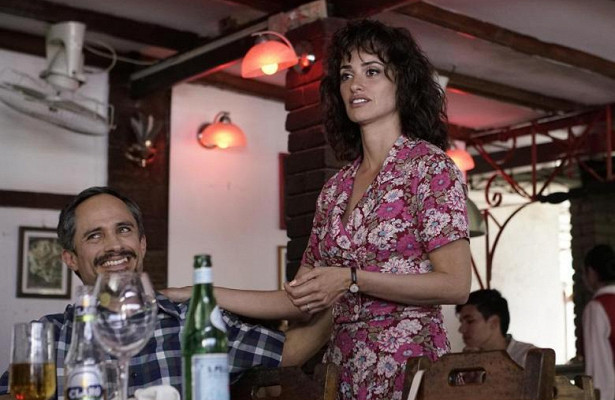
GAEL GARCÍA BERNAL AND PENELOPE CRUZ IN WASP NETWORK
Spies nearby
The is a movie about the Cuban spies sent to Miami to combat anti-Castro Cuban-American groups, and their capture. They are part of what the Cubans called La Red Avispa (The Wasp Network). The screenplay is based on the book The Last Soldiers of the Cold War by Fernando Morais, and it's mainly from the Wasp, Cuban point of view, not the FBI point of view. Unlike the disastrous Seberg, no time is spent looking over the shoulders of G-men, nor will this story give any pleasure to right wing Miami Cubans. But it won't delight leftists much either, or champions of the Cuban Five. The issues of why one might leave Cuba and why one might choose not to are treated only superficially. There's no analysis of US behavior toward Cuba since the revolution.
On the plus side, the film is made in an impeccable, clear style (with one big qualification: see below) and there's an excellent cast with as leads Edgar Ramirez (of the director's riveting miniseries Carlos), Penelope Cruz (Almodóvar's muse), Walter Moura (Escobar in the Netflix series "Narcos"), Ana de Armas (an up-and-comer who's actually Cuban but lives in Hollywood now), and Gael García Bernal (he of course is Mexican, Moura is Brazilian originally, and Ramirez is Venezuelan). They're all terrific, and other cast members shine. Even a baby is so amazing I thought she must be the actress' real baby.
Nothing really makes sense for the first hour. We don't get the whole picture, and we never do, really. We focus on René Gonzalez (Édgar Ramirez), a Puerto Rican-born pilot living in Castro’s Cuba and fed up with it, or the brutal embargo against Castro by the US and resulting shortage of essential goods and services, who suddenly steals a little plane and flies it to Miami, leaving behind his wife Olga and young daughter. Olga is deeply shocked and disappointed to learn her husband is a traitor. He has left without a word to her. Born in Chicago, he was already a US citizen and adapts easily, celebrated as an anti-Castro figure.
We also follow another guy, Juan Pablo Roque (Wagner Moura) who escapes Havana by donning snorkel gear and swimming to Guantanamo, not only a physical challenge but riskier because prison guards almost shoot him dead when he comes out of the water. Roque and Gonzalez are a big contrast. René is modest, content with small earnings, and starts flying for a group that rescues Cuban defectors arriving by water. Juan Pablo immediately woos and marries the beautiful Ana Marguerita Martinez (Ana de Armas) and, as revealed by an $8,000 Rolex, is earning big bucks but won't tell Ana how. This was the first time I'd seen Wagner Moura, an impressively sly actor who as Glenn Kenny says, "can shift from boyish to sinister in the space of a single frame" - and that's not the half of it.
This is interesting enough to keep us occupied but it's not till an hour into the movie, with a flashback to four years earlier focused on Cuban Gerardo Hernandez (Garcia Bernal) that we start to understand something of what is going on. We learn about the CANF and Luis Posada Carriles (Tony Plana), and a young man's single-handed effort to plant enough bombs to undermine the entire Cuban tourist business. This late-arriving exposition for me had a deflating and confounding effect. There were still many good scenes to follow. Unfortunately despite them, and the good acting, there is so much exposition it's hard to get close to any of the individual characters or relationships.
At the moment I'm an enthusiastic follower of the FX series "The Americans." It teaches us that in matters of espionage, it's good to have a firm notion of where the main characters - in that case "Phillip" and "Elizabeth" - place their real, virtually unshakable loyalties, before moving on. Another example of which I'm a longtime fan is the spy novels of John le Carré. You may not be sure who's loyal, but you always know who's working for British Intelligence, even in the latest novel the remarkable le Carré, who at 88, has just produced (Agent Running in the Field - for which he's performed the audio version, and no one does that better). To be too long unclear about these basics in spydom is fatal.
It's said that Assayas had a lot of trouble making Wasp Network, which has scenes shot in Cuba in it. At least the effort doesn't show. We get a glimpse of Clinton (this happened when he was President) and Fidel, who, in a hushed voice, emphatically, asserts his confidence that the Red Avispa was doing the right thing and that the Americans should see that. Whose side do you take?
Wasp Network, 123 mins., debuted at Venice and showed at about ten other international festivals including Toronto, New York, London and Rio. It was released on Netflix Jun. 19, 2019, and that applies to many countries (13 listed on IMDb). Metascore 54%.
Last edited by Chris Knipp; 07-31-2025 at 03:14 PM.
-
DAD GENES (Craig Downing 2025)
CRAIG DOWNING: DAD GENES
Meeting their maker
Dad Genes is a documentary film that follows Aaron Long, a former sperm donor who later connects with several of his biological children, eventually forming an unconventional family and becoming the subject or worldwide media attention.
[/B]
Not everyone fared well in this story. One of the girls leaves her lesbian moms in Richmond, Virginia to meet Aaron, her biologival father, in Seattle and settles there. This causes one of the ladies to remark that Aaron's role in the whole affair was really very, very tiny. Also ro say that his wearing a T shirt at his "meet the kids" party saying "I MAKE CUTE BABIES" was offensive, wholly egotistical.
But this little documentary is primarily about him and, from the viewer's point of view, for all we know, anyway, Aaron is wholly deserving of what results from modern, internet-driven tools not available in the nineties when his year of regular sperm donating took place -- the event of meeting Madi, Alice, Bryce, and one of the mom's, Jess out in Seattle, and their instantly bonding. This is because Aaron, as seen and heard from throughout Dad Genes, is a very nice guy indeed.
Aaron is a quiet, easygoing man. He turns out to work at an agency that provides housing for the neediest people in Seattle. In his spare time, he takes care of his mother, who has Alzheimer's, joining her for lunch and dinner every day. He is artistic - this is what the women seeking his sperm liked. He plays multiple instruments and he writes. He is warm and loving to his mother. He's not as close as his father - they divorced whe he was five - but he was a professor of economics with whom he played chess. A long haired hippie type back in the day pointed toward unconventional lifestyle, Aaron has never married. His mother had presciently guessed that his sperm donorship, which he told her about after returning from a year of teaching English abroad, moving in with her, and driving a taxi, would be the only sense in which she'd ever be a grandmother. Now he sleeps in a very small room in the Seattle cooperative to which he belongs, and has few possessions. You might almost think he could be a monk, except he's too much of a hugger.
Bryce, his deep-voiced son, is the one who turns up as his son when Aaron does a gene test. After much hesitation, he contacts Bryce, who responds almost instantaneously and joyously. Bryce is the only male offspring who goes out to meet their sperm-donor father. Bryce, who comes out from Long Island and school in upstate New York, never had a dad to throw a ball around with (he had lesbian moms too), and turns out Aaron, though he was similarly deprived of a backyard athlete father, was on a softball team a decade ago, and so he and Bryce try a little baseball throwing one day.
Eventually somehow there is media attention; the story of the uniting of half-siblings with their biological father Aaron can be dated back to 2018, when Aaron himself published a story in the New York Times, "First I Met My Children, Then My Girlfriend. They’re Related." The lede is "I didn’t meet my girlfriend, Jessica, until 12 years after our daughter, Alice, was born." (The dates and the relationships are a little hard for me to follow sometimes.)
Aaron was obviously open to building family. He was easy about how it might go. But the four half siblings who came to Seattle all felt an immediate connection with each other and with Aaron. Jess, the mother of Alice, felt drawn romantically to Aaron before he recognized the feeling in himself. The last part of the film documents their moving from the Seattle coop to a house on Vashon island, not far off. He has decided after the death of his mother to take time off from his housing work and decide what he wants to do with the rest of his life.
The story this film tells is surprising but basically simple. There's not much analysis here and it's almost more like an offbeat family album than a documentary film. A more searching film wouild have covered a longer period in more detail and depth, explored the some fifty possible offspring that may have resulted from Aaron's period of selling his sperm for $40 a pop as a young man.
Dad Genes opens in theaters Jan. 16, 2026.
Last edited by Chris Knipp; 12-21-2025 at 06:24 PM.
-
COVER-UP (Laura Poitras, Mark Obenhaus 2025)
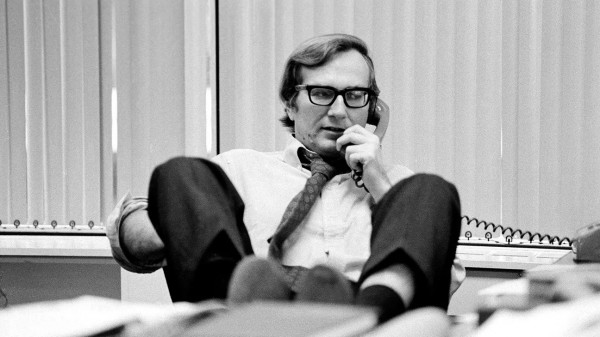
AN ARCHIVAL IMAGE OF SY HERSH FROM COVER-UP
LAURA POITRAS, MARK OBERHAUS: COVER-UP (2025)
Investigative reporter Seymour Hersh's career reviewed
It ends "Dedicated to all those killed and denied justice, and to those who resist, past and future." Fine. But this documentary is about journalism. It's about perhaps the most important reporter of our time (he may think so) - and that goes back a ways. For Seymour M. ("Sy") Hersh was the key reporter of the My Lai massacre during the US war on Vietnam and about the Abu Ghraib torture in the US Iraq war, and many other topics. He broke the stories. The rest of the world chimed in. You should perhaps also read the Wikipedia article, "Seymour Hersh," for a straightforward summary of the man's life and main achievements. This documentary is very good indeed (Hersh a great subject "by turns charming, surly and vulnerable," as Sheri Linden's Hollywood Reporter review puts it) but not quite up to the best of Poitras' other documentaries, which include Citizenfour, a lengthy interview with whistleblower Edward Snowden after he was forced to flee the US, and the recent All the Beauty and the Bloodshed, about the life of photo-artist Nan Goldin and the culpability of the Sackler family in the opioid epidemic. Those were front-line reporting; this is a review of the life of an older generation front-line reporter. Nonetheless, this is essential viewing for news buffs.
The background is easy. Hersh, son of Lithuanian Jewish immigrants in Chicago was a natural writer who was brash and sociable. The ingredients that have made him so significant are complex, though. Dedication is a big part of it, balls, persistence, rejection of the bland party line conventional journalists fall into, the crowds of Pentagon or White House reporters who sit and copy what they're told. Hersh eschewed that and went and interviewed Pentagon brass privately. His method, that of any reporter who is set apart, is cultivation of sources. Hersh is especially known for his use of anonymous sources. It is when duo Laura and Mark start to delve into those and he thinks he has revealed too much about them that at one point Hersh calls a halt and says he wants to stop dead this film Poitras had been trying to get maid for twenty years.
He is not an easy subject. "I have been very happy not talking about myself," he says at that difficult key juncture when he calls a halt to the whole entreprise of this film. It is by cultivating anonymous sources and zealously protecting them that he has been able to get the information he has gotten and done the reportage that he has done. He has been dealing with top military brass, with officials of the CIA and the FBI, people who were not going to reveal themselves because they were too visible, or small figures who would be crushed.
Repeatedly, as the film title signals, those various and unknown sources' willingness to speak to Hersh privately has come from discomfort with things that have been covered up, as the government wants to do with anything that might be at all embarrassing, humiliating, or ugly. A young military officer carrying out the murder of three hundred innocent civilians. Rank and file of Army and CIA wantonly torturing and killing innocent people.
But there is also Watergate. The dirty tricks of a major political party to insure its power. The naughty, embarrassing scheming of Richard Nixon and his White House cronies, including a major Hersh target, Henry Kissinger. Sometimes as a personality Seymour Hersh feels like an outsider. He may have had many who disliked him, for example for his exposure of Lieutenant Calley and My Lai. Many thought Calley was a hero, the unjust scapegoat. Responsible for hundreds of innocent dead, Calley wound up doing only a few months of jail time, because so many favored him. A song celebrating him, we see, was a record widely hawked and played on the radio. People have a limited appreciation of the First Amendment's importance. This is perhaps an even worse problem today. Or, as Hersh says, "People condemn the messenger."
But Seymour Hersh is not an outsider. He's just a hot item. He remains this now, well into his eighties. And we see him being contacted with someone with information to expose (not now, but it will go through him when the source is ready to reveal it) about the systematic nature of Israel's conduct in its war on Gaza. Hersh has been at work for sixty years. (He also has had a long and sustaining marriage, which he briefly talks about.) Not an outsider--but more an outsider recently. He was at one time a a broke freelance, when he came upon My Lai, but that led to being a respected reporter of the New York Times. That was, we learn, till he began reporting on corporate wrongdoing--and the Times was and is a corporate-run enterprise.
Hersh has also written eleven books (discovering his freest and fullest medium of reportage), and (for his best-edited work?) has frequently published essays in The New Yorker.. We glimpse many of these. Only, when his reportage on Syria deepened, he was pushed to the London Review of Books, then sometimes exclusively online, to Substack. This film, like many documentaries today, gives the viewer scans of the top ends of newspaper clippings; not to mention glimpses of Hersch’s own archive of photographs, notebooks, maps, and highly confidential documents, but often without pausing long enough - unless this is viewed online with a pause button at hand - for you to read anything. There needs to be better way than this game of doc film peekaboo.
Hersh is an unforgettable and persistent personality, not necessarily a likable one. That voice he has, that way of speaking, (familiar to me from "Democracy Now!") at least partly captured here, as he becomes the narrator of this film once it gains its final momentum--revals a sui generis, not unattractive manner of knowingly nattering away, coming back and grabbing a phrase again, never quite completing a thought, but never letting go of it either. Contrast the voice of his opposite number at the Washington Post, Bob Woodward, who with Carl Bernstein famously exposed the Watergate scandal, when heard from here, with its different register, deeper, calmer, almost soothing tone. Hersh provokes, stimulates. Any conversation with Hersh would be not all about him, but also that, through being all about whatever he is focused on at the time. You may admire more than like him. But he is essential, and this film has captured a lot of him and his essential work. And as "essential" means, our history might be different without him.
There is a mix of cockiness and despair here that may have typified Hersh's career and life. Note LIeutenant Calley's light sentence; how much the depredations of past US administrations are forgotten now; how simply awful were the wrongdoings he exposed, the violence he thinks leads to the excusing,the willingness to cover up.
Cover-Up, 117 mins., premiered at Venice Aug. 29, 2025, showing also at Telluride, Toronto, New York, Bend, Athens, Vancouver, Hamptons, BFI London, Hamptons, Woodstock, AFI, Vienna, Stockholm, DOC NYC, many other festivals, limited US theatrical release Dec. 19, 2025. Now on Netflix. Metacritic rating: 85%.
Last edited by Chris Knipp; 12-28-2025 at 11:10 PM.
-
SENTIMENTAL VALUE (Joachm Trier 2025)
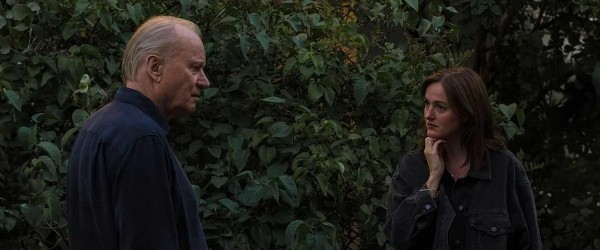
STELLAN SKARSGARD AND RENATE REINSVE IN SENTIMENTAL VALUE
JOACHIM TRIER: SENTIMENTAL VALUE (2025)
Forgiveness
The aging Norwegian filmmaker Gustav Borg (Stellan Skarsgård) turns up at the ancestral home (itself a character, through a voiceover early in Sentimental Value) with a new film script he has written, his first in fifteen years, that he wants his daughter Nora (Renate Reinsve), a stage actress, to star in. He also wants the young son Erik (Øyvind Hesjedal Loven) of his other daughter Agnes (Inga Ibsdotter Lilleaas) to be in the film. Nora refuses and Agnes refuses. Gustav fails in his scheme to make his movie instead in English, for Netflix, starring a newly successful American actress, Rachel Kemp (Elle Fanning), who agrees because she's an admirer. Another major health issue arises. But ultimately through a reading of the script things are hashed out.
Not everyone loves Trier's Sentimental Value. Mike D'Angelo, whom I often cite because of the clarity and bluntness of his views, and whose rankings I refer to because of the borderline absurd but nonetheless impressive precision as well as severity of them, currently places Sentimental Value 80th among the 88 for this year he has so far ranked on his site. Peter Bradshaw of theGuardian, whom I also often refer to, calls Sentimental Value "baggy." Well, I don't know how many critics make it number one, but Brother Bro of The Oscar Expert thought it was the most enthusiastically received by the Cannes audience, and the Cannes jurors gave it the number two prize, the Grand Prix. I have some reservations about Sentimental Value (see below). But for me it's got to be one of the year's best. It's about forgiveness, or at least that's one of its main themes. So let's be forgiving of it.. My ranking of it among the year's best relates to many things. I love Joachim Trier's films and this is one of the important ones, even if it's not my favorite.
To begin with this is a movie that does right what Hamnet gets badly wrong, about ways that artists struggle with their responsibilities as humans and as parents, about how they try to work out their salvation or simply try to understand their lives through their work, but above all simply take the raw material their lives give them in wholly new directions. We don't actually see or hear much of Gustav's new script. But this film ends with filming one scene, a memorable, but now ambiguous one.
The movie doesn't begin with any of this. It begins with a voiceover that talks about the big house Nora and Agnes grew up in, which goes back generations in Gustav's family. His mother committed suicide in this house. Then there is a memorable, agonizing scene about Nora, who evidently is both an excellent actress and suffers from terrible stage fright.
Trier and his regular coscripter Eskil Voit write wonderful screenplays, witty, specific, full of life's "stuff," with extremes positive and negative. Trier's films have been triumphs through the magnificent actor Anders Danielson Lie, and lately, with Renate Reinsve, her breakthrough being Trier's last film The Worst person in the World (2021). Danielsen Lie features in Trier's sparkling debutReprise (2006), in his gloomy, shatteringOslo, August 31st (2011) and The Worst Person in the World, which together have been dubbed the "Oslo trilogy." Trier, always with Eskil Vogt and with these and other great actors, have set out something unique in world cinema that's probably partly also distinctively Norwegian, a vigor, an intelligence, an alacrity for simultaneously taking on both the most challenging aspects and the greatest joys of a life. I saw that in a softer, teen-focused, different format way in the four-"season" 2015–2017 online TV series "Skam," also Norwegian, also set in Oslo.
D'Angelo starts his Patreon-only review with how he "cracked up" at how the reappearing Gustav gifts little Erik DVDs of Irreversible and The Piano Teacher , a gesture as hilarious as it is weirdly imappropriate for a kid, also dated since now, a kid accesses movies without need of DVDs. But Sentimental Value grabs you in other ways besides its humorous, somehow forgiving, picture of how Gustav, who basically wasn't there for the raising of his daughters and now ants to use them, is an asshole and yet we can't really not like him. He's so blatant. He asks Nora to star in his film yet admits he walked out of her most important play; it's funny how he justifies this.
Stellen Skarsgård is selfless and subtle in his handling of the role of Gustav. Renate Reinsve is too. So that matter is Elle Fanning, sho avoids being either gushy about how much she admires this art film director Gustav Borg or overly weepy, though she does weep, when things go wrong. When something is put together well it just plays itself. There is a kind of natural ease, like the renaissance Italian concept of sprezzatura.
When Peter Bradshaw calls Sentimental Value "baggy" he has a point in the whole digression about Gustav's attempt to make his new film in English. It's miraculously but ridiculously produced by Netflix. With everybody Norwegian except the American star, Rachel,. She agrees to do it because she admires Gustav so much, especially a film she comes to a revival screening of, that features Agnes as a girl. What Trier and Vogt are trying to say comes close to too complicated, though their humor and typically light touch, as well as the cast's restraint, help to compensate. In the end this is a film about forgiveness that asks us also to forgive it.. It's also one of the rare films - despite my Pauline Kael rule that if you watch well once should e enough - that requires multiple viewings and repays them. And you should certainly view it, with the other best films of the year.
Also recommended, another Norwegian comically about the opposite thing from forgiveness, revenge, Hans Petter Moland's 2016 In Order of Disappearance, in which Stellan Skarsgård also has the leading role.
Sentimental Value, 133 mins., premiered at Cannes May 2025, winning the Grand Prix, thereafter seen at many international film festivals including Telluride, Toronto, New York, and BFI London. Metacritic rating: 86%.
Last edited by Chris Knipp; 12-20-2025 at 01:23 PM.
-
Movie best lists 2024
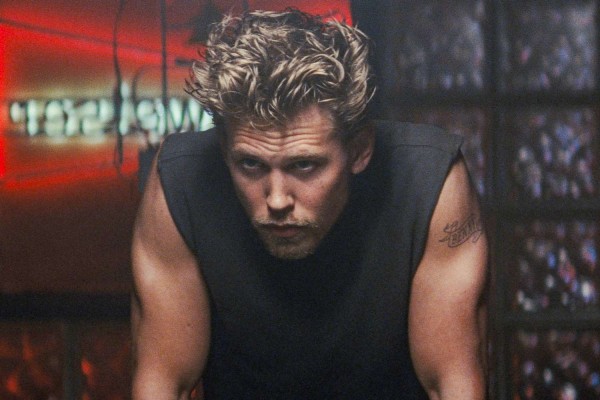
AUSTIN BUTLER IN THE BIKERIDERS
C H R I S__K N I P P'S__2 0 2 4__M O V I E__B E S T__L I S T S
FEATURE FILMS
All We Imagine as Light (Payal Kapadia)
Anora (Sean Baker)
Beast, The (Bertrand Bonello)
Bikeriders, THe (Jeff Nichols)
Blitz (Steve McQueen)
Challengers (Luca Guadagnino)
Close Your Eyes (Victor Erice)
Conclave (Edward Berger)
Goldman Case, The/Le Procès Goldman (Cédric Kahn)
Real Pain, A (Jesse Eisenberg)
Sing Sing (Greg Kwedar)
RUNNERS UP
The Damned (Roberto Minvervini)
BEST DOCUMENTARIES
Made in England: The Films of Powell and Pressberger (David Hinton)
Merchant Ivory (Stephen Soucy)
New Kind of Wilderness, A (Silje Evensmo Jacobsen)
No Other Land (Basel Adra, Rachel Szor, Hamdan Ballal, Yuval Abraham)
Sugarcane (Emily Kassie, Julian Brave NoiseCat)
UNRELEASED FAVORITES
Afternoons of Solitude/Tardes de soledad (Albert Serra)
Caught by the Tides/ 风流一代 (Jia Zhang-ke)
NOT SEEN YET
Babygirl (Halina Reijn) Dec. 25 release
Complete Unknown, A (James Mangold) Dec. 25 release
Misericordia (Alain Guiraudie) (also unreleased)
Nickel Boys (RaMell Ross) Dec. 13 release
LESS ENTHUSIASTIC ABOUT THAN SOME
Brutalist, The (Brady Corbet)
Civil War (Alex Garland)
Emilia Pérez (Jacques Audiard)
La Chimera La chimera (Alice Rohrwacher)
Megalopolis (Francis Ford Coppola)
Queer (Luca Guadagnino 2024)
Room Next Door, The (Almodóvar)
Substance, The (Coralie Fargeat)
____________________________
COMMENTS (Dec. 1, 2024)
Just a first draft; a work in progress. But I can guarantee that "Best Features" is a list only of new movies I have watched this year with a lot of pleasure and admiration and think you would enjoy. I'll be working on it. I tend to forget things, and there are late arrivals. I also may make it numerical but for now it's alphabetical. I'm expecting a lot of Babygirl, and as always there are buzz-worthy 2024 films I have not yet seen, notably Nickel Boys. I stive to focus on movies available to everyone to watch, but that's less a problem now that there are so many eventual releases on platforms. As for the "Less Enthusiastic" list, I recommend that you watch them too, because people are talking about them - a lot, especially The Brutalist, The Substance, and Emilia Pérez.
And then there's Megalopolis. Whether or not they are as great, or for that matter as awful, as some people are claiming, they will be talked about during awards season.
Enjoy - and try to get out to see all you can in a movie theter!
Last edited by Chris Knipp; 09-18-2025 at 04:52 PM.
-
DIE MY LOVE (Lynne Ramsey 2025)
Some short reviews of a few more notable 2025 films
DIE MY LOVE (Lynne Ramsay). "Returning to the screen after a long absence, Lawrence manages such profound levels of eye-rolling pissed-offness that it’s difficult not to take it as a sign of the actress pushing back on the suffocating levels of adoration she has been subjected to," Tom Shone in The Times wrote. That's a fun way of looking at this extreme tale of a woman who goes mad, leaving Robert Pattinson's husband staggering in the wake. It's been another long break between directorial efforts for Scottish auteur Lynne Ramsay (RATCATCHER 1999, MORVERN CALLAR 2002, WE NEED TO TALK ABOUT KEVIN 2011, YOU WERE NEVER REALLY HERE (2017). Her work provides great opportunities for actors, but may be more attention-getting than profound. This unconvincing effort undercuts her earlier ones. Metacritic rating: 72%.
MARTY SUPREME (Josh Safdie). "Mean-spiritedness lies in the eye of the beholder: one person’s aggressively sour-minded movie is another’s idea of delightfully jaundiced fun, and no movie this year proves that as aptly as Josh Safdie’s two-and-a-half-hour loop-de-loop character study Marty Supreme," wrote Stephanie Zacharek in Time. The surprise NYFF premiere was rapturously received (reflecting how very New York Chalamet's and his character's ambitious pushiness is) and the Metacritic rating is 88%. But for me in the watching this lead character seemed as Zacharek says, annoying and repetitious. What does stand out are the excerpts of tablre tennis games. Chalamet works hard to be authentic here at that.
SPLITSVILLE (Michael Angelo Covino). As in their breakthrough 2019 THE CLIMB Covino and beat friend-collaborator-costar Kyle Marvin craft a skillful comedy of musical couples involving themselves playing switcheroo, but it's more mechanical and less heartfelt, specific, and personal than last time. It just makes one want to go back and enjoy THE CLIMB and that's what you should do. Better luck next time, guys.
IF I HAD LEGS I'D KICK YOU (Mary Bronstein) Summary reads: "While trying to manage her own life and career, a woman on the verge of a breakdown must cope with her daughter's illness, an absent husband, a missing person, and an unusual relationship with her therapist." Guess who the therapist is? Conan O'Brien. With a last-minute celebrity cameo (Christian Slater). This sounds harrowing. Well, it is. But it is very watchable. Rose Byrne is excellent and sympathetic in the lead. Metacritic rating 77%.
Though other end-of-year catch-ups URCHIN and THE MASTERMIND are more essential, and yes, also HAMNET - decide for yourself what you think - these are well worth seeing. I'm trying, so far unsuccessfully, to see the semi-musical portrait of the founding of the Shakers TESTAMENT OF ANN LEE (Mona Fastvold), cowritten by Brady Corbet, starring Amanda Seyfried. Avi Ofer says it's one of Seyfried's best performances of her career. However he calls the film "beautifully shot and poetic, but tedious, overlong and heavy-handed." Do you very much want to see a film about the founding of a song-and-dance-centric religious movement whose members make wonderful furniture?
Last edited by Chris Knipp; 12-28-2025 at 01:04 PM.
-
THE THINGS YOU KILL (Alireza Khatami 2025)
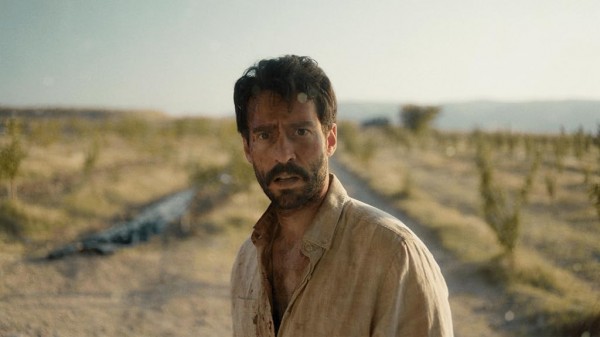
ERKIN COç in THE THINGS YOU KILL
ALIREZA KHATAMI: THE THINGS YOU KILL (2025)
Revenge tragedy is a dry puzzler
Starring Hazar Ergüçlü, Ekin Koç, and Erkan Kolçak Köstendil, this strange, some think "Lynchian" film directed by the Iranian filmmaker Alireza Khatami, for political reasons was filmed in Turkey with a local cast. The Things You Kill tells the story of Ali (Ekin Koç), an insecure university teacher with roiling emotions. His course in translation is likely to be cancelled. More than that or more intimately, Ali is shaken by the suspicious death of his ailing mother (Aysen Sümercan), and this leads him to spiral into a deep rage in a film that becomes an exploration of violence and suspicion in a family. In this film much admired at Sundance for its direction, hang on for a strange ride. if you will.
After struggling hard to have a baby, Ali has learned that he has a low sperm count, but he conceals this. He has a falling out with his wife Hazar (Hazar Ergüçlü), who is a vet dealing with cows, but she hangs on. During his grieving process for his mother, Ali's resentment toward his father Hamit (Ercan Kesa) resurfaces, along with an awareness that he was violent toward his mother. Ali forms a friendship with a mysterious man who turns up in his cabin out in the country and becomes his gardener, Reza (Erkan Kolçak Köstendil), a lookalike alter ego. Amid questions about rusty pipes and a "collapsed" well Ali must bribe an official in US dollars to replace, Ali devises a cold-blooded plan of revenge against the elder he has reason to believe is responsible for his mother's death. He persuades Reza to carry it out.
Ali's father disappears. He makes repeated trips back to his garden - a desolate place out in the country that reminds me of the Turkish director, Nuri Bilge Ceyla., with whom Ercan Kesal, who plays Hamit, is a regular collaborator. Long-buried family secrets are revealed, a history of violence. There is a magic realist finale.
Successive events come unexpectedly. Ali seems like a thoroughly unpleasant individual, and yet we don't entirely lose our sympathy toward him. He always remains the protagonist. The Things You Kill is an interesting watch that keeps you guessing to the end, though it may never quite gain your confidence.
Reviews for The Things You Kill are generally positive,favoring the film's confident technical craft and psychological depth, though some critics have found the film emotionally cold or overly reliant on stylistic imitation. It's been described as a psychological thriller and a layered, surreal drama about grief, revenge, and the pressures of masculinity and societal expectations. The reason for attributing a "Lynchian" style to Khatami, is its way of shifting between naturalistic drama and surreal, disorienting sequences.
Ali's secrets are very slowly revealed. Only toward the end he describes to a university official bent on making him redundant that he studied comparative literature in the US, doing so as an escape from a youth of being constantly teased and abused in Turkey. A character changes identity. On the other hand, in the latter half the film shifts into thriller mode, evoking James M. Cain or the Coen brothers, though the atmosphere makes that a little too surreal and playful to matter.
The play with reality, the artful framing of images, build confidence in Khatami's craft. But as Jordan Mintzer's Hollywood Reporter review comments, while Khatami "has a lot to say" and this is an "intriguingly deconstructed viewing experience," the film remains "emotionally speaking. . . a bit stale."
The Things You Kill/Öldürdüğün Şeyler, 114 mins., premiered at Sundance Jan. 24, 2025 (Best Director in the World Cinema Dramatic Competition). Also Rotterdam, Hong Kong,. Istanbul, Taipei, and numerous other international festivals. US release Nov. `14, 2025. The Things You Kill will be playing at iPic Fulton Market on Fulton St., NYC Nov. 14 and 15.
Special Q&As with director Alireza Khatami follow 6:30pm showtimes on 11/14 & 11/15.
Last edited by Chris Knipp; 11-22-2025 at 01:52 AM.
-
A FEW FEET AWAY (Tadeo Pestaña Caro 2025)
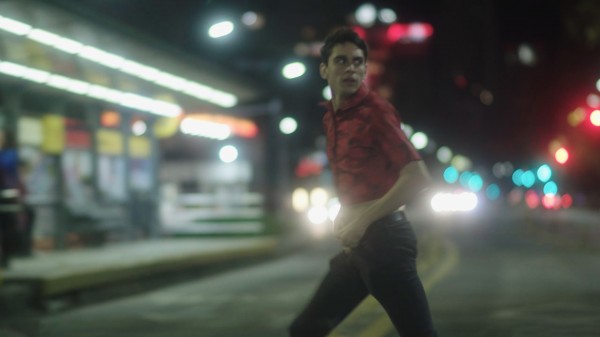
MAX SUEN IN A FEW FEET AWAY
TADEO PESCAÑA CARO: A FEW FEET AWAY (2025)
Loneliness and illusion of Grindr sex in Buenos Aires
TRAILER
"Johnny Rio, a handsome narcissist but no longer a pretty boy, travels to Los Angeles, the site of past sexual conquest and remembered youthful radiance, in a frenzied attempt to recreate his younger self. Johnny has ten precious days to draw the "numbers," the men who will confirm his desirability, and with the hungry focus of a man on borrowed time, he stalks the dark balconies of all-night theaters, the hot sands of gay beaches, and shady glens of city parks, attempting to attract shadowy sex-hunters in an obsessive battle against the passing of his youth." -- A summary of John Rechy's 1967 novel Numbers.
The description of Rechy's novel of obsessive gay sex-scoring Numbers is there to introduce a new film from Argentina because I think it is the same thing, with several important variations. Attractive gay twenty-year-old Buenos Aires resident Santiago (Max Suen) isn't a struggling has-been like Johnny Rio but a much younger gay man still with fresh skin in the game, however he may depict himself as practiced and jaded, but he too is obsessive in his pursuit of gay sex. The smartphone apps he uses for sexual encounters both speeds up the acquisition of sexual experience and gets in the way of it. The cyber and the imaginary take place of what in the past, before internet and iPhones, was fresh and flesh alone. What Tadeo Pestaña Caro and his actors give us is exciting,intense, even hypnotic, but rather depressing because this 21st-century gay sexual experience for much of the time is so much more mediated than real.
Santiago is a cyber-world creaton formed by smartphone hookup apps, especially Grindr, the quintessential LGBT "social networking" device. Both Johnny and Santiago are obsessive. But it seems that now Santiago is as much obsessed with technology as with sex. In fact early on we see him taking a moment during sex (when his intended partner goes off searching in the apartment for condoms) to snatch time away for his phone again. The smartphone is always in his hand, even in bed.
Though this is a skillful and smoothly executed film with a lithe thespian convincing in his role, Rechy's Numbers is a literary classic and has a different kind of intensity, the obsessiveness of carefully paced literary description as well as the unique intensity of the real. There is a distracted air about Santiago's sexual explorations: his head is a little bit elsewhere, in the cyber world of the app. Johnny Rio is present, counting off his sex encounters.
The message of A Few Feet Away is what we were told would happen even before smartphones came into wide use: that they would become an indispensable part of everyone's lives and always be in our pockets. But we didn't know they would invade the bedroom and the sex club - or that someone attractive and available like Santiago would compulsively utilize his smartphone for the hookup app, scrolling and swiping and adding sexy photos of himself (on requests of "Show more") even when in a hot makeout spot. The film title underlines that what the protagonist is doing sometimes is "connect" with men on his obsessive app even when hs is right in the same room with them. To repeat: the app, and the phone, have created a "connection" that is more of a barrier.
Using apps enables, even requires, the donning of a persona. Santiago online is "Seth" (which he isn't even sure how to pronounce: its "th" isn't common in Spanish and he admits to an encounter he hasn't said it himself yet). For the guys he meets he is a university student majoring in architecture or law, while in fact he has a drone job at a call center and isn't studying anything. He seems to have only one friend, coworker Karen (Jazmin Carballo), and is less assured in his everyday than when on the prowl for sex. That night Karen lures him to an office party, a sequence that is cunningly orchestrated.
Santiago constantly confides in Karen, but his confidences are, we see, embroideries on the truth (depicted for us), while the more dramatic sexual encounters he describes often in fact had ended prematurely because he lost patience or wasn't attracted. The exciting world of Grindr possibilities and sexy images has made him too jaded for a single sexual encounter. He only gets heavily involved later in the film when he enters an orgy, pushed into an orgy room to which he had been denied access earlier (despite his changing to a bare midriff outfit to conform to "cutoff night") by an older man wno pulls him and another youngman (to use Recny's spelling) along with him up past the gate. "Seth" rises to full participation on this occasion and the film reaches a climax. At this point Pestaña Caro crafts a haunting, beautiful orgy sequence with bodies darkly yet luminously in space to the throbbing music and flashing lights with Santiago floating in the shadows.
But then "Seth" is suddenly running in outside in the dead of night to another spot that is closed and he leans his face against the gate wracked with sobs. Oh, the loneliness!
I find that the lead actor Max Suen appeared last year in a film called The Pleasure Is Mine/El placer es mio directed by Sacha Amaral in which he plays Antonio, a marijuana dealer who uses his in with people and dating apps to manipulate and seduce them. But young Suen is also a stage actor who recently performed the main role in Jean Cocteau's Les parents terribles. Interesting career. And interesting actor, slight, dark, with haunting and haunted eyes.
Ris Fatah's review on Queerguru.com says what A Few Feet Away is about is "The ease of using online apps, their addictive nature, their potential to create an unreal world for the user, the risk of loneliness, the chance of meeting very odd people, the line between fantasy and reality, and the danger of ignoring real world opportunities at the expense of potential online rewards," which he says "are issues many hook-up app users will be familiar with," and he adds that though the film is set in Buenos Aires, its themes "apply to any city in the world." Fatah suggests this film might have been better if had featured someone older. At 20, Santiago can be excused as just going through a phase: if he were 35 or older, his obsessive behavior would have more serious implications and give the action more weight.
True; but this is a story of the corruption and distraction above all of the young, who were born into the app world with no knowledge of anything else. This is a smoothly executed, absorbing film for those interested in its twin topics of gayness and app-addiction, and it has a delicately modulated score provided by Balthazar Olivier and Alejandro Rosenblat, who blend artists as varied as Maluma, Kim Carnes, Midnight Oil and Gilbert O’Sullivan. Cinematography by Joaquín Castro and Andy González also is very fine, especially in the night party and orgy sequences. Director Pestaña Caro is equally deft with solitude and multiple bodies. In the end, the smartphone has the last word.
A Few Feet Away/A metros de distancia, 89 mins., premiered Mar. 20, 2025 at BFI Flare London. The North American Premiere was at Reeling: The Chicago LGBTQ+ International Film Festival. US release on the internet, VOD, digital and Unrated Director's Cut DVD from Cinephobia Releasing Dec. 9, 2025.
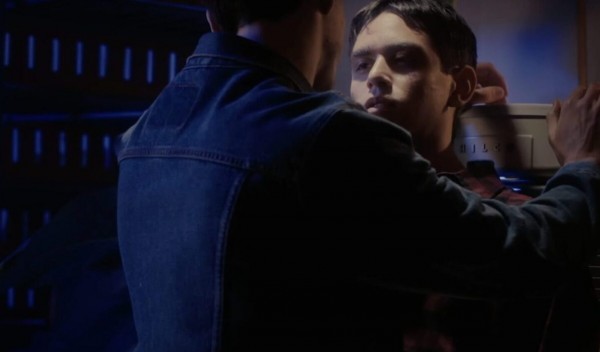
MAX SUEN IN A FEW FEET AWAY ```````````````````````````````````````````````
Last edited by Chris Knipp; 12-11-2025 at 07:10 PM.
-
DEATH OF A LADIES' MAN (Matt Bissonette 2020)

GABRIEL BYRNE IN DEATH OF A LADIES' MAN
MATT BISSONETTE: DEATH OF A LADIES' MAN (2020)
A life of self-indulgence pays off
Even Bissonete's first film, Looking for Leonard, showed an obsession for fellow Canadian Leonard Cohen's songs, and they are distributed all over this one, even with accompanying song and dance numbers. They seem the fruit of an obsession, not of necessity. Josh Slater-Williams says in his BFI Sight and Sound review that "this is Bissonete's most explicitly Leonard Cohen-inspired work to date," adding "but just why he made this movie, besides love for the songs, remains unclear."
Addiction plays an explicit part here too. The subject is Sam O'Shea (Gabriel Byrne) an alcoholic poetry professor. The Irish actor has been in some great films, including Miller's Crossing, Little Women, Dead Man and The USual Suspects. He does not discredit himself here, though where this film is going and where it comes from is frequently in doubt. It is an inexplicable indulgence, full of fantasies, visions, obtrusive songs and group performances, with a loser's tragic downward spiral that turns into a final series of implausible successes. All is filled with overconfident imagination. Chapter headings can't hide the lack of a plausible structure or real momentum. But hey, maybe you're crazy about Leonard Cohen. Some people are. And there are some watchable actors.
One review (Cath Clarke's positive one in the Guardian) points logically to Philip Roth, because this is indeed a literary tale. "If Philip Roth had ever switched his attention from the great American novel and decided to write a lightweight indie dramedy," writes Cath, "it might have turned out like this." This film indeed is the wish fulfillment fantasy (which turns, somewhat implausibly, real) of a hard drinking wannabe literary lion, not Jewish, of course, but certainly ethnic, and with his young Irish dead dad to add the juicy Irish brogue (played by another well known actor from Eire, Brian Gleeson), who turns up frequently among a series of hallucinations, puffing on cigarettes and (somewhat anachronistically) spouting F-words like everybody else.
This kind of tale of literary dishevelment often begins with domestic mess, and early on Sam enters his apartment to find a robust, longhaired younger man having at it with his wife, herself younger than him, in their bed. This leads to altercations and a mutual decision to make this Sam's second divorce. He embarks on a drunken spree, apparently not very unlike his daily routine. Along the way he eyes young women, but he's past his prime and they smack him or give him the finger - except in an inexplicable borderline offensive extended fantasy late in the film when a beautiful ex-model with the implausible name of Charlotte LaFleur (Jessica Paré) instantly falls madly in love with the man who admits to sixty-two (the actor was ten years older).
Sam goes next to the lecture hall, where he throws up into a bin and then addresses the bank of students; but that fades into another hallucination and the students all get up and dance to Leonard Cohen. Hurrah! A friend later advises Sam to see a physician, and he goes to the improbably named Dr. Sarah Savard (Pascale Bussières), who never once sounds or looks like a doctor, but tells Sam, following an initial interview and an MRI, that he has an inoperable tumor infecting every high functioning part of his brain. What can be done? he asks. Well, she more or less says, you can die. She gives him a few months to a year.
From here on Sam looks better than ever. This is partly attributed to his acknowledging his alcoholism and entering into sobriety. He winds up in one of those AA meetings you see in movies where a small group of people sit in chairs in a circle with nice lighting in a big open space and one person shares, and then the protagonist. Except that Sam gets to have a share liberally laced with colorful flashbacks before he says his "thank you for letting me share."
This is where things look up for Sam. Relations may improve with his gay son Layton (Antoine Olivier Pilon) and he helps look after his heroin addict daughter Josée (Karelle Trembley). There are several scenes in French in the film, by the way, which in my screener version lacked English subtitles and I was unable to decipher. He embarks on that project he has said earlier he has always wanted to do: writing a book. It is a memoir, containing many of the incidents alluded to in this film in conversations with the dead dad or the hallucinations and other scenes. And the book is a success, signaled by the obligatory book reading and enthusiastic signing pointing to the presence of admiring fans, including close friends and family members and, in the back of the audience, Frankenstein, for the monster has featured, inexplicably, in several of Sam's hallucinations.
I don't know whether to say Philip Ross would have done better than this, or would have done this better. Roth concocted some far-fetched tales. This in some form indeed might have been one of them. But his would have contained very little Leonard Cohen, fewer hallucinations, and more wit.
Death of a Ladies' Man, 100 mins., debuted Sept. 24, 2024 at Calgary, also Cinequest, Sonoma, Galway, Mallorca, UK internet Jul. 25, 2022, US week of Sept. 22, 2025.
Last edited by Chris Knipp; 09-18-2025 at 10:36 PM.
-
CAANFEST May 2025 THREE PALESTINIAN FILMS
CAAMFEST May 8-11, 2025 Berkeley Three Muslim and Palestinian related films
PALESTINIAN LANDSCAPES
Palestinian Landscapes brings together two powerful films exploring empire, ecology, and resistance. Razan Alsalah’s A Stone’s Throw evokes dreamlike cycles of displacement and return across fragmented geographies shaped by resource and labor economies. In Foragers, Jumana Manna traces the criminalization of foraging in Palestine, revealing how colonial legal systems regulate access to land and tradition.
A Stone’s Throw, directed by Razan AlSalah
Sunday, May 11, 5:00 pm | Roxie
Amine, a Palestinian elder, is exiled twice, from land and labor, from Haifa to Beirut to a Gulf offshore oil platform. A Stone’s Throw rehearses a history of the Palestinian resistance when, in 1936, the oil labourers of Haifa blow up a BP pipeline.
Director Razan AlSalah is a Palestinian artist and teacher
*Screener available
Foragers, directed by Jumana Manna
Sunday, May 11, 5:00 pm | Roxie
Elderly Palestinians are caught between their right to forage their own land and the harsh restrictions imposed by their occupiers on the basis of preservation.
Director/Producer/Co-Editor Jumana Manna is a Palestinian visual artist
AGAINST AMNESIA: Screening & Seminar
This program, in partnership with the Berkeley-based Islamic Scholarship Fund, explores the intertwined histories and ongoing realities of displacement, colonial violence, and resistance in Palestine and Bangladesh. Through a narrative short about a Palestinian grandmother uprooted from her home and a documentary on the forgotten 1970s genocide in Bangladesh, the program highlights the the ways in which historical violence shapes mundane aspects of everyday life. A facilitated discussion will follow.
Bengal Memory, directed by Fahim Hamid
Sunday, May 11, 3:00 p.m. | AMC Kabuki 3
A Bangladeshi American explores his father’s memories of a forgotten genocide in their
native country and uncovers the controversial role the U.S. played in it.
Director/Producer/Editor Fahim Hamid was born in Bangladesh
*Screener available
Maqluba, directed by Mike Elsherif
Sunday, May 11, 3:00 p.m. | AMC Kabuki 3
Laila, a Palestinian-American drummer, visits her grandmother in her new apartment during a powerful storm under the guise of helping her unpack. But her nefarious goals slowly unfold as they delve deeper into the mystical fateful night.
Writer/Director/Producer Mike Elsherif is a Palestinian-American filmmaker
*Screener available
SHORT
Billo Rani, directed by Angbeen Saleem
Part of the Shorts Program: Centerpiece Shorts
Sunday, May 11, 12:00pm | Roxie
When Hafsa, a sparkly and impulsive 12-year-old girl, is made aware of her unibrow at Islamic Sunday School in a lesson on “cleanliness”, her eyebrows come alive and begin to speak to her.
The film is set in an Islamic Sunday School and centers around a South Asian Muslim girl
Director/Writer/Producer Angbeen Saleem is a Pakistani Muslim artist
*Screener Available
A Stone's Throw
https://vimeo.com/868181676
pw: 7aifa
Bengal Memory
https://gumlet.tv/watch/67dc1999982f3b096493d238
pw: DOC1971!
Maqluba
https://vimeo.com/998772961?ts=0&share=copy
pw: teta
Billo Rani
https://vimeo.com/1019601428?share=copy
pw: threaded
--
Last edited by Chris Knipp; 04-14-2025 at 11:04 PM.
 Posting Permissions
- You may not post new threads
- You may not post replies
- You may not post attachments
- You may not edit your posts
-
Forum Rules




 Reply With Quote
Bookmarks