-
PARASITE (Bong Joon-ho 2019)
BONG JOON-HO: PARASITE 기생충 (Gisaengchung) (2019)
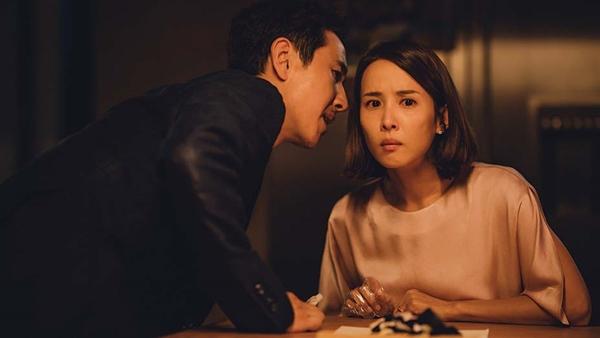
LEE SON-KYUN AND JO YEO-JEONG IN PARASITE
Crime thriller as social commentary? Maybe not.
I've reviewed Bong's 2006 The Host ("a monster movie with a populist heart and political overtones that's great fun to watch") and his 2009 Mother which I commented had "too many surprises." (I also reviewed his 2013 Snowpiercer.) Nothing is different here except this seems to be being taken more seriously as social commentary, though it's primarily an elaborately plotted and cunningly realized violent triller, as well a monster movie where the monsters are human. It's also marred by being over long and over-plotted, making its high praise seem a bit excessive.
This new film, Bong's first in a while made at home and playing with national social issues, is about a deceitful poor family that infiltrates a rich one. It won the top award at Cannes in May 2019, just a year after the Japanese Koreeda's (more subtle and more humanistic) Palm winner about the related theme of a crooked poor family. Parasite has led to different comparisons, such as Losey's The Servant and Pasolini's Theorem. In accepting the prize, Bong himself gave a nod to Hitchcock and Chabrol. Parasite has met with nearly universal acclaim, though some critics feel it is longer and more complicated than necessary and crude in its social commentary, if its contrasting families really adds up to that. The film is brilliantly done and exquisitely entertaining half the way. Then it runs on too long and acquires an unwieldiness that makes it surprisingly flawed for a film so heaped with praise.
It's strange to compare Parasite with Losey's The Servant, in which Dick Bogarde and James Fox deliver immensely rich performances. Losey's film is a thrillingly slow-burn, subtle depiction of class interpenetration, really a psychological study that works with class, not a pointed statement about class itself. It's impossible to speak of The Servant and Parasite in the same breath.
In Parasite one can't help but enjoy the ultra-rich family's museum-piece modernist house, the score, and the way the actors are handled, but one keeps coming back to the fact that as Steven Dalton simply puts it in his Cannes Hollywood Reporter review, Parasite is "cumbersomely plotted" and "heavy-handed in its social commentary." Yet I had to go to that extremist and contrarian Armond White in National Review for a real voice of dissent. I don't agree with White's politics or his belief that Stephen Chow is a master filmmaker, but I do sympathize with being out-of-tune, like him, with all the praise of Boon's new film.
The contrast between the poor and rich family is blunt indeed, but the posh Park family doesn't seem unsubtly depicted: they're absurdly overprivileged, but don't come off as bad people. Note the con-artist Kim family's acknowledgement of this, and the mother's claim that being rich allows you to be nice, that money is like an iron that smooths out the wrinkles. This doesn't seem to be about that, mainly. It's an ingeniously twisted story of a dangerous game, and a very wicked one. Planting panties in the car to mark the chauffeur as a sexual miscreant and get him fired: not nice. Stimulating the existing housekeeper's allergy and then claiming she has TB so she'll be asked to leave: dirty pool. Not to mention before that, bringing in the sister as somebody else's highly trained art therapist relative, when all the documents are forged and the "expertise" is cribbed off the internet: standard con artistry.
The point is that the whole Kim family makes its way into the Park family's employ and intimate lives, but it is essential that they conceal that they are in any way related to each other. What Bong and his co-writer Jin Won Han are after is the depiction of a dangerous con game, motivated by poverty and greed, that titillates us with the growing risk of exposure. The film's scene-setting of the house and family is exquisite. The extraordinary house is allowed to do most of the talking. The rich family and the housekeeper are sketched in with a few deft stokes. One's only problem is first, the notion that this embodies socioeconomic commentary, and second, the overreach of the way the situation is played out, with one unnecessary coda after another till every possibility is exhausted. This is watchable and entertaining (till it's not), but it's not the stuff of a top award.
Parasite 기생충 (Gisaengchung), 132 mins., debuted in Competition at Cannes, winning the Palme d'Or best picture award. Twenty-eight other festivals followed as listed on IMDb, including New York, for which it was screened (at IFC Center Oct. 11, 2019) for the present review. Current Metascore 95%. It has opened in various countries including France, where the AlloCiné press rating soared to 4.8.

PARK SO-DAM AND CHOI WOO-SIK IN PARASITE
Last edited by Chris Knipp; 02-19-2020 at 12:49 AM.
-
MOTHERLESS BROOKLYN (Edward Norton 2019)
EDWARD NORTON: MOTHERLESS BROOKLYN (2019)
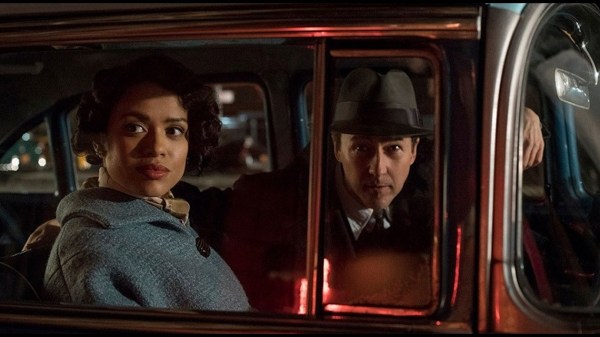
GUGU MBATHA-RAW AND EDWARD NORTON IN MOTHERLESS BROOKLYN
Edward Norton's passion project complicates the Jonathan Lethem novel
The NYFF Closing Night film is the premiere of Edwards Norton's adaptation, a triumph over many creative obstacles through a nine-year development time, of Jonathan Lethem's 1999 eponymous novel. It concerns Lionel Essrog (played by Norton), a man with Tourette's Syndrome who gets entangled in a police investigation using the obsessive and retentive mind that comes with his condition to solve the mystery. Much of the film, especially the first half, is dominated by Lionel's jerky motions and odd repetitive outbursts, for which he continually apologizes. Strange hero, but Lethem's creation. To go with the novel's evocation of Maltese Falcon style noir flavor, Norton has recast it from modern times to the Fifties.
Leading cast members, besides Norton himself, are Willem Dafoe, Bruce Willis, Alec Baldwin, Cherry Jones, Bobby Cannavale and Gugu Mbatha-Raw. In his recasting of the novel, as Peter Debruge explains in his Variety review, Norton makes as much use of Robert Caro's The Power Broker, about the manipulative city planner Robert Moses, a "visionary" insensitive to minorities and the poor, as of Lethem's book. Alec Baldwn's "Moses Randolph" role represents the film's Robert Moses character, who is added into the world of the original novel.
Some of the plot line may become obscure in the alternating sources of the film. But clearly Lionel Essrog, whose nervous sensibility hovers over things in Norton's voiceover, is a handicapped man with an extra ability who's one of four orphans from Saint Vincent's Orphanage in Brooklyn saved by Frank Minna (Bruce Willis), who runs a detective agency. When Minna is offed by the Mob in the opening minutes of the movie, Lionel goes chasing. Then he learns city bosses had a hand, and want to repress his efforts.
Gugu Mbatha-Raw's character, Laura Rose, who becomes a kind of love interest for Lionel Essrog, and likewise willem Dafoe's, Paul Randolph, Moses' brother and opponent, are additional key characters in the film not in the Johathan Lethem book. The cinematography is by the Mike Leigh regular (who produced the exquisite Turner), Dick Pope. He provides a lush, classic look.
Viewers will have to decide if this mixture of novel, non-fiction book and period recasting works for them or not. For many the problem is inherent in the Lethem novel, that it's a detective story where, as the original Times reviewer Albert Mobilio said, "solving the crime is beside the point." Certainly Norton has created a rich mixture, and this is a "labour of love," "as loving as it is laborious, maybe," is how the Guardian's Peter Bradshaw put it, writing (generally quite favorably) from Toronto. In her intro piece for the first part of the New York Film Festival for the Times Manohla Dargis linked it with the difficult Albert Serra'S Liberté with a one-word reaction: "oof," though she complemented these two as "choices rather than just opportunistically checked boxes." Motherless Brooklyn has many reasons for wanting to be in the New York Film Festival, and for the honor of Closing Night Film, notably the personal passion, but also the persistent rootedness in New York itself through these permutations.
Motherless Brooklyn, 144 mins., debuted at Telluride Aug. 30, 2019, showing at eight other festivals including Toronto, Vancouver, Mill Valley, and New York, where it was screened at the NYFF OCT. 11, 2019 as the Closing Night film. It opens theatrically in the US Nov. 1, 2019. Current Metascore 60%.
Last edited by Chris Knipp; 09-08-2021 at 01:08 PM.
-
THE IRISHMAN (Martin Scorsese 2019)
[Found also in Filmleaf's Festival Coverage section for the 2019 NYFF]
MARTIN SCORSESE: THE IRISHMAN (2019)
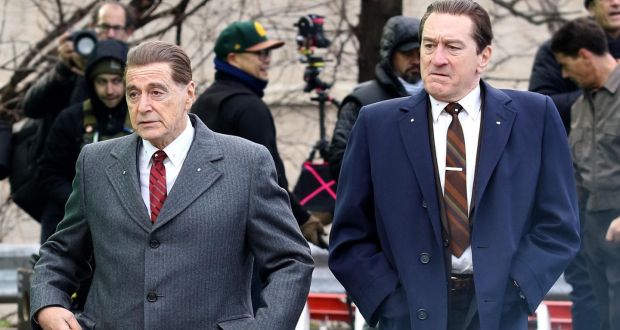
AL PACINO AND ROBERT DE NIRO IN THE IRISHMAN
Old song
From Martin Scorsese, who is in his late seventies, comes a major feature that is an old man's film. It's told by an old man, about old men, with old actors digitized (indifferently) to look like and play their younger selves as well. It's logical that The Irishman, about Teamsters loyalist and mob hit man Frank Sheeran (Robert De Niro), who became the bodyguard and then (as he tells it) the assassin of Union kingpin Jimmy Hoffa (Al Pacino) should have been chosen as Opening Night Film of the New York Film Festival. Scorsese is very New York, even if the film is set in Detroit. He is also a good friend of Film at Lincoln Center. And a great American director with an impressive body of work behind him.
To be honest, I am not a fan of Scorsese's feature films. I do not like them. They are unpleasant, humorless, laborious and cold. I admire his responsible passion for cinema and incestuous knowledge of it. I do like his documentaries. From Fran Lebowitz's talk about the one he made about her, I understand what a meticulous, obsessive craftsman he is in all his work. He also does have a sense of humor. See how he enjoys Fran's New York wit in Public Speaking. And there is much deadpan humor in The Irishman at the expense of the dimwitted, uncultured gangsters it depicts. Screenwriter Steven Zaillian's script based on Charles Brandt's book about Sheeran concocts numerous droll deadpan exchanges. It's a treat belatedly to see De Niro and Pacino acting together for the first time in extended scenes.
The Irishman is finely crafted and full of ideas and inspires many thoughts. But I found it monotonous and overlong - and frankly overrated. American film critics are loyal. Scorsese is an icon, and they feel obligated, I must assume, to worship it. He has made a big new film in his classic gangster vein, so it must be great. The Metascore, 94%, nonetheless is an astonishment. Review aggregating is not a science, but the makers of these scores seem to have tipped the scales. At least I hope more critics have found fault with The Irishman than that. They assign 80% ratings to some reviews that find serious fault, and supply only one negative one (Austin Chronicle, Richard Whittaker). Of course Armond White trashes the movie magnificently in National Review ("Déjà Vu Gangsterism"), but that's outside the mainstream mediocre media pale.
Other Scorsese stars join De Niro and Pacino, Joe Pesci, Harvey Keitel. This is a movie of old, ugly men. Even in meticulously staged crowd scenes, there is not one young or handsome face. Women are not a factor, not remotely featured as in Jonathan Demme's delightful Married to the Mob. There are two wives often seen, in the middle distance, made up and coiffed to the kitsch nines, in expensive pants suits, taking a cigarette break on car trips - it's a thing. But they don't come forward as characters. Note also that out of loyalty to his regulars, Scorsese uses an Italo-American actor to play an Irish-American. There's a far-fetched explanation of Frank's knowledge of Italian, but his Irishness doesn't emerge - just another indication of how monochromatic this movie is.
It's a movie though, ready to serve a loyal audience with ritual storytelling and violence, providing pleasures in its $140 million worth of production values in period feel, costumes, and snazzy old cars (though I still long for a period movie whose vehicles aren't all intact and shiny). This is not just a remake. Its very relentlessness in showing Frank's steady increments of slow progress up the second-tier Teamsters and mafia outsider functionary ladders is something new. But it reflects Scorsese's old worship of toughs and wise guys and seeming admiration for their violence.
I balk at Scorsese's representing union goons and gangsters as somehow heroic and tragic. Metacritic's only critic of the film, Richard Whittiker of the Austen Chronicle, seems alone in recognizing that this is not inevitable. He points out that while not "lionizing" mobsters, Scorsese still "romanticizes" them as "flawed yet still glamorous, undone by their own hubris." Whittiker - apparently alone in this - compares this indulgent touch with how the mafia is shown in "the Italian poliziotteschi," Italian Years of Lead gang films that showed them as "boors, bullies, and murderers, rather than genteel gentlemen who must occasionally get their hands dirty and do so oh-so-begrudgingly." Whittiker calls Scorsese's appeal to us to feel Sheeran's "angst" when he's being flown in to kill "his supposed friend" (Hoffa) "a demand too far."
All this reminded me of a richer 2019 New York Film Festival mafia experience, Marco Bellocchio's The Traitor/Il traditore, the epic, multi-continent story of Tommaso Buscetta, the first big Italian mafia figure who chose to turn state's witness. This is a gangster tale that has perspective, both morally and historically. And I was impressed that Pierfrancesco Favino, the star of the film, who gives a career-best performance as Buscetta, strongly urged us both before and after the NYFF public screening to bear in mind that these mafiosi are small, evil, stupid men. Coppola doesn't see that, but he made a glorious American gangster epic with range and perspective. In another format, so did David Chase om the 2000-2007 HBO epic, "The Sopranos." Scprsese has not done so. Monotonously, and at overblown length, he has once again depicted Italo-Americans as gangsters, and (this time) unions as gangs of thugs.
The Irishman, 209 mins,. debuted at New York as Opening Night Film; 15 other international festivals, US theatrical release Nov. 1, wide release in many countries online by Netflix Nov. 27. Metascore 94%.
Last edited by Chris Knipp; 11-23-2019 at 07:49 PM.
-
BACURAU (Kleber Mendonça Filho, Juliano Dornelles 2019)
KLEBER MENDOÇA FILHO, JULIANO DORNELLES: BACURAU (2019)
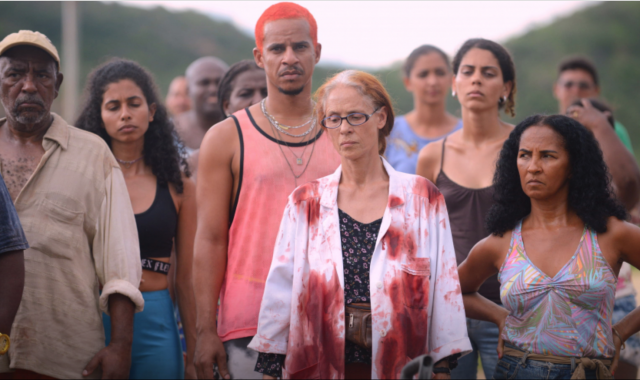
SONIA BRAGA (CENTER) IN BACURAU
Not just another Cannes mistake?
This is a bold film for an arthouse filmmaker to produce, and it has moments of rawness and unpredictability that are admirable. But it seems at first hand to be possibly a misstep both for the previously much subtler chronicler of social and political unease as seen in the 2011 Neighboring Sopunds and 2016 Aquarius, Kleber Mendonça Filho, and for Cannes, which may have awarded novelty rather than mastery in giving it half of the 2019 Jury Prize. It's a movie that excites and then delivers a series of scenes of growing disappointment and repugnance. But I'm not saying it won't surprise and awe you.
Let's begin with where we are, which is the Brazilian boonies. Bacurau was filmed in the village of Barra in the municipality of Parelhas and in the rural area of the municipality of Acari, at the Sertão do Seridó region, in Rio Grande do Norte. Mendonça Filho shares credit this time with his regular production designer Juliano Dornelles. (They both came originally from this general region, is one reason.) The Wikipedia article introduces it as a "Brazilian weird western film" and its rural shootout, its rush of horses, its showdowns, and its truckload of coffins may indeed befit that peculiar genre.
How are we to take the action? In his Hollywood Reporter review, Stephen Dalton surprises me by asserting that this third narrative feature "strikes a lighter tone" than the first two and combines "sunny small-town comedy with a fable-like plot" along with "a sprinkle of magic realism." This seems an absurdly watered down description, but the film is many things to many people because it embodies many things. In an interview with Emily Buder, Mendoça Filho himself describes it as a mix of "spaghetti Western, '70's sci-fi, social realist drama, and political satire."
The film feels real enough to be horrifying, but it enters risky sci-fi horror territory with its futuristic human hunting game topic, which has been mostly an area for schlock. (See a list of ten, with the 1932 Most Dangerous Game given as the trailblazer.) However, we have to acknowledge that Mendonca Filho is smart enough to know all this and may want to use the schlock format for his own sophisticated purpose. But despite Mike D'Angelo's conclusion on Letterboxd that the film may "require a second viewing following extensive reading" due to its rootedness in Brazilian politics, the focus on American imperialists and brutal outside exploiters from the extreme right isn't all that hard to grasp.
Bacurau starts off as if it means to be an entertainment, with conventional opening credits and a pleasant pop song celebrating Brazil, but that is surely ironic. A big water truck rides in rough, arriving with three bullet holes spewing agua that its driver hasn't noticed. (The road was bumpy.) There is a stupid, corrupt politician, mayor Tony Jr. (Thardelly Lima), who is complicit in robbing local areas of their water supply and who gets a final comeuppance. The focus is on Bacurau, a little semi-abandoned town in the north whose 94-year-old matriarch Carmelita dies and gets a funeral observation in which the whole town participates, though apart the ceremony's strange magic realist aspects Sonia Braga, as a local doctor called Domingas, stages a loud scene because she insists that the deceased woman was evil. Then, with some, including Carmelita's granddaughter Teresa (Barbara Colen), returned to town from elsewhere, along with the handsome Pacote (Tomaso Aquinas) and a useful psychotic local killer and protector of water rights called Lunga (Silvero Pereira), hostile outsiders arrive, though as yet unseen. Their forerunners are a colorfully costumed Brazilian couple in clownish spandex suits on dustrider motorcycles who come through the town. When they're gone, it's discovered seven people have been shot.
They were an advance crew for a gang of mostly American white people headed by Michael (Udo Kier), whose awkward, combative, and finally murderous conference we visit. This is a bad scene in more ways than one: it's not only sinister and racist, but clumsy, destroying the air of menace and unpredictability maintained in the depiction of Bacurau scenes. But we learn the cell phone coverage of the town has been blocked, it is somehow not included on maps, and communications between northern and southern Brazil are temporarily suspended, so the setting is perfect for this ugly group to do what they've come for, kill locals for sport using collectible automatic weapons. Overhead there is a flying-saucer-shaped drone rumbling in English. How it functions isn't quite clear, but symbolically it refers to American manipulation from higher up. The way the rural area is being choked off requires no mention of Brazil's new right wing strong man Jair Bolsonaro and the Amazonian rain forest.
"They're not going to kill a kid," I said as a group of local children gather, the most normal, best dressed Bacurauans on screen so far, and play a game of dare as night falls to tease us, one by one creeping as far as they can into the dark. But sure enough, a kid gets shot. At least even the bad guys agree this was foul play. And the bad guys get theirs, just as in a good Western. But after a while, the action seems almost too symbolically satisfying - though this is achieved with good staging and classic visual flair through zooms, split diopter effects, Cinemascope, and other old fashioned techniques.
I'm not the only one finding Bacurau intriguing yet fearing that it winds up being confused and all over the place. It would work much better if it were dramatically tighter. Peter DeBruge in Variety notes that the filmakers "haven’t figured out how to create that hair-bristling anticipation of imminent violence that comes so naturally to someone like Quentin Tarantino." Mere vague unexpectedness isn't scary, and all the danger and killing aren't wielded as effectively as they should be to hold our attention and manipulate our emotions.
Bacurau, 131 mins., debuted in Competition at Cannes, where it tied for the Jury Prize with the French film, Ladj Ly's Les misérables. Many other awards and at least 31 other festivals including the NYFF. Metascore 74%. AlloCiné press rating 3.8, with a rare rave from Cahiers du Cinéma. US theatrical distribution by Kino Lorber began Mar. 13, 2020, but due to general theater closings caused by the coronavirus pandemic the company launched a "virtual theatrical exhibition initiative," Kino Marquee, with this film from Mar. 19.
Last edited by Chris Knipp; 04-05-2020 at 12:24 PM.
-
ZOMBI CHILD (Bertrand Bonello 2019)
BERTRAND BONELLO: ZOMBI CHILD (2019)
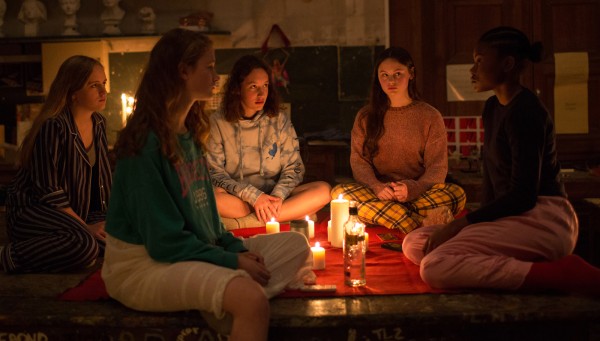
LOUISE LABEQUE AND WISLANDA LOUIMAT (FAR RIGHT) IN ZOMBI CHILD
Voodoo comes to Paris
If you said Betrand Bonello's films are beautiful, sexy, and provocative you would not be wrong. This new, officially fifth feature (I've still not seen his first one, the 2008 On War), has those elements. Its imagery, full of deep contrasts, can only be described as lush. Its intertwined narrative is puzzling as well.
We're taken right away to Haiti and plunged into the world of voodoo and zombies. Ground powder from the cut-up body of a blowfish is dropped, unbeknownst to him, into a man's shoes. Walking in them, he soon falters and falls. Later, he's aroused from death to the half-alive state of a zombie - and pushed into a numb, helpless labor in the hell of a a sugar cane field with other victims of the same cruel enchantment. In time however something arouses him to enough life to escape.
Some of the Haitian sequences center around a moonlit cemetery whose large tombs seem airy and haunted and astonishingly grand for what we know as the poorest country in the hemisphere.
From the thumping, vibrant ceremonies of Haitian voodoo (Bonello's command of music is always fresh and astonishing as his images are lush and beautiful) we're rushed to the grandest private boarding school you've ever seen, housed in vast stone government buildings. This noble domaine was established by Napoleon Bonaparte on the edge of Paris, in Saint Denis, for the education of children of recipients of the Legion of Honor. It really exists, and attendance there is still on an honorary basis.
Zombi Child oscillates between girls in this very posh Parisian school and people in Haiti. But these are not wholly separate places. A story about a Haitian grandfather (the zombie victim, granted a second life) and his descendants links the two strains. It turns out one of those descendants, Mélissa (Wislanda Louimat), is a new student at the school. A white schoolgirl, Fanny (the dreamy Louise Labeque), who's Mélissa's friend and sponsors her for membership in a sorority, while increasingly possessed by a perhaps imaginary love, also bridges the gap. For the sorority admission Mélissa confesses the family secret of a zombi and voodoo knowledge in her background.
Thierry Méranger of Cahiers du Cinéma calls this screenplay "eminently Bonellian in its double orientation," its "interplay of echoes" between "radically different" worlds designed to "stimulate the spectator's reflection." Justin Chang of the Los Angeles Times bluntly declares that it's meant to "interrogate the bitter legacy of French colonialism."
But how so? And if so, this could be a tricky proposition. On NPR Andrew Lapin was partly admiring of how "cerebral and slippery" the film is, but suggests that since voodoo and zombies are all most white people "already know" about Haitian culture, a director coming from Haiti's former colonizing nation (France) must do "a lot of legwork to use these elements successfully in a "fable" where "the real horror is colonialism." The posh school comes from Napoleon, who coopted the French revolution, and class scenes include a history professor lecturing on this and how "liberalism obscures liberty."
I'm more inclined to agree with Glenn Kenny's more delicately worded praise in his short New York Times review of the film where he asserts that the movie’s inconclusiveness is the source of its appeal. Zombi Child, he says, is fueled by insinuation and fascination. The fascination, the potent power, of the occult, that's what Haiti has that the first wold lacks.
One moment made me authentically jump, but Bonello isn't offering a conventional horror movie. He's more interested in making his hints of voodoo's power and attraction, even for the white lovelorn schoolgirl, seem as convincing as his voodoo ceremonies, both abroad and back in Haiti, feel thoroughly attractive, or scary, and real. These are some of the best voodoo scenes in a movie. This still may seem like a concoction to you. Its enchantments were more those of the luxuriant imagery, the flowing camerawork, the delicious use of moon- and candle-light, the beautiful people, of whatever color. This is world-class filmmaking even if it's not Bonello's best work.
Bonello stages things, gets his actors to live them completely, then steps back and lets it happen. Glenn Kenny says his "hallmark" is his "dreamy detachment." My first look at that was the 2011 House of Tolerence (L'Apollonide - mémoires de la maison close), which I saw in Paris, a languorous immersion in a turn-of-the-century Parisian brothel, intoxicating, sexy, slightly repugnant. Next came his most ambitious project, Saint Laurent(2014), focused on a very druggy period in the designer's career and a final moment of decline. He has said this became a kind of matching panel for Apollonide. (You'll find that in an excellent long Q&A after the NYFF screening.) Saint Laurent's "forbidden" (unsanctioned) picture of the fashion house is as intoxicating, vibrant, and cloying as the maison close, with its opium, champagne, disfigurement and syphilis. No one can say Gaspard Ulliel wasn't totally immersed in his performance. Nocturama (2016) takes a group of wild young people who stage a terrorist act in Paris, who seem to run aground in a posh department store at the end, Bonello again getting intense action going and then seeming to leave it to its own devices, foundering. Those who saw the result as "shallow cynicism" (like A.O. Scott) missed how exciting and powerful it was. (Mike D'Angelo didn't.)
Zombi Child is exciting at times too. But despite its gorgeous imagery and sound, its back and forth dialectic seems more artificial and calculating than Bonello's previous films.
Zombi Child, mins., debuted at Cannes Directors Fortnight May 2019, included in 13 other international festivals, including Toronto and New York. It released theatrically in France Jun. 12, 2020 (AlloCiné press rating 3.7m 75%) and in the US Jan. 24, 2020 (Metascore 75%). Now available in "virtual theater" through Film Movement (Mar. 23-May 1, 2020), which benefits the theater of your choice. https://www.filmmovement.com/zombi-child
Last edited by Chris Knipp; 12-07-2025 at 10:46 PM.
-
WASP NETWORK (Olivier Assayas 2019)
OLIVIER ASSAYAS: WASP NETWORK (2019)
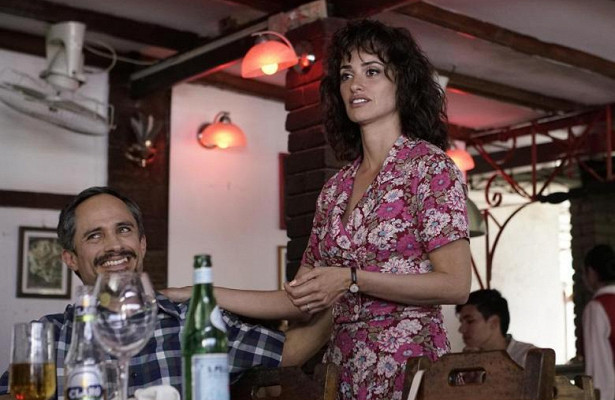
GAEL GARCÍA BERNAL AND PENELOPE CRUZ IN WASP NETWORK
Spies nearby
The is a movie about the Cuban spies sent to Miami to combat anti-Castro Cuban-American groups, and their capture. They are part of what the Cubans called La Red Avispa (The Wasp Network). The screenplay is based on the book The Last Soldiers of the Cold War by Fernando Morais, and it's mainly from the Wasp, Cuban point of view, not the FBI point of view. Unlike the disastrous Seberg, no time is spent looking over the shoulders of G-men, nor will this story give any pleasure to right wing Miami Cubans. But it won't delight leftists much either, or champions of the Cuban Five. The issues of why one might leave Cuba and why one might choose not to are treated only superficially. There's no analysis of US behavior toward Cuba since the revolution.
On the plus side, the film is made in an impeccable, clear style (with one big qualification: see below) and there's an excellent cast with as leads Edgar Ramirez (of the director's riveting miniseries Carlos), Penelope Cruz (Almodóvar's muse), Walter Moura (Escobar in the Netflix series "Narcos"), Ana de Armas (an up-and-comer who's actually Cuban but lives in Hollywood now), and Gael García Bernal (he of course is Mexican, Moura is Brazilian originally, and Ramirez is Venezuelan). They're all terrific, and other cast members shine. Even a baby is so amazing I thought she must be the actress' real baby.
Nothing really makes sense for the first hour. We don't get the whole picture, and we never do, really. We focus on René Gonzalez (Édgar Ramirez), a Puerto Rican-born pilot living in Castro’s Cuba and fed up with it, or the brutal embargo against Castro by the US and resulting shortage of essential goods and services, who suddenly steals a little plane and flies it to Miami, leaving behind his wife Olga and young daughter. Olga is deeply shocked and disappointed to learn her husband is a traitor. He has left without a word to her. Born in Chicago, he was already a US citizen and adapts easily, celebrated as an anti-Castro figure.
We also follow another guy, Juan Pablo Roque (Wagner Moura) who escapes Havana by donning snorkel gear and swimming to Guantanamo, not only a physical challenge but riskier because prison guards almost shoot him dead when he comes out of the water. Roque and Gonzalez are a big contrast. René is modest, content with small earnings, and starts flying for a group that rescues Cuban defectors arriving by water. Juan Pablo immediately woos and marries the beautiful Ana Marguerita Martinez (Ana de Armas) and, as revealed by an $8,000 Rolex, is earning big bucks but won't tell Ana how. This was the first time I'd seen Wagner Moura, an impressively sly actor who as Glenn Kenny says, "can shift from boyish to sinister in the space of a single frame" - and that's not the half of it.
This is interesting enough to keep us occupied but it's not till an hour into the movie, with a flashback to four years earlier focused on Cuban Gerardo Hernandez (Garcia Bernal) that we start to understand something of what is going on. We learn about the CANF and Luis Posada Carriles (Tony Plana), and a young man's single-handed effort to plant enough bombs to undermine the entire Cuban tourist business. This late-arriving exposition for me had a deflating and confounding effect. There were still many good scenes to follow. Unfortunately despite them, and the good acting, there is so much exposition it's hard to get close to any of the individual characters or relationships.
At the moment I'm an enthusiastic follower of the FX series "The Americans." It teaches us that in matters of espionage, it's good to have a firm notion of where the main characters - in that case "Phillip" and "Elizabeth" - place their real, virtually unshakable loyalties, before moving on. Another example of which I'm a longtime fan is the spy novels of John le Carré. You may not be sure who's loyal, but you always know who's working for British Intelligence, even in the latest novel the remarkable le Carré, who at 88, has just produced (Agent Running in the Field - for which he's performed the audio version, and no one does that better). To be too long unclear about these basics in spydom is fatal.
It's said that Assayas had a lot of trouble making Wasp Network, which has scenes shot in Cuba in it. At least the effort doesn't show. We get a glimpse of Clinton (this happened when he was President) and Fidel, who, in a hushed voice, emphatically, asserts his confidence that the Red Avispa was doing the right thing and that the Americans should see that. Whose side do you take?
Wasp Network, 123 mins., debuted at Venice and showed at about ten other international festivals including Toronto, New York, London and Rio. It was released on Netflix Jun. 19, 2019, and that applies to many countries (13 listed on IMDb). Metascore 54%.
Last edited by Chris Knipp; 07-31-2025 at 02:14 PM.
-
BLACK RABBIT, WHITE RABBIT (Shahram Mokri. 2026)
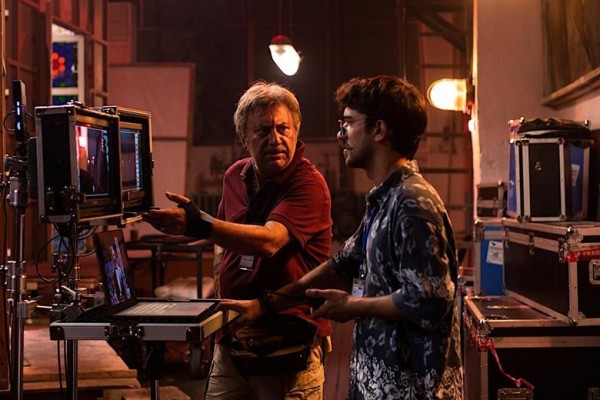
SHAHRAM MOKRI: BLACK RABBIT, WHITE RABBIT (2026)
Motion pictures
TRAILER
"A film armorer's concerns about a real gun, an aspiring actress demanding an audition, and Sara's post-crash revelation of a conspiracy lead these strangers' paths to cross." You'll need that blurb description, although those are easy parts to remember of a complicated film about filmmaking that is in constant motion and constant interweaves parts of itself which it overlaps, repeats, and playfully repeats again: these points are only part of what's going on. This is a film school fever dream of a movie. Those who like cinematic games and films about film will enjoy Black Rabbit, White Rabbit the most.
It has been called "a Moebius strip-like" film; the password of the screener I watched was "Escher." This is for those who like to think about and talk about a movie and care about that experience above and beyond the experience of watching it, which may very well be a bit of a bore, first time through. The title may suggest David Lynch, and two giant rabbits do appear toward the end off in the distance, but this is Lynchian without quite having the distinctive Lynchian style or texture. For others, at the worst, this will only seem sophomoric and annoying on a large scale. It could have been in the Lincoln Center New Directors/New Films Series or Film Comment Selects. It is not for the festival - sorry, not quite; not for the mainstream.
A summary evaluation by Siddhant Adlakha in his Variety review shows how critics approach this movie: "When it’s all said and done," Adlakha writes, "the playfulness on display in 'Black Rabbit, White Rabbit' is quite remarkable" - but then he finishes the sentence with: "even if the story’s contorting framework seldom amounts to much, beyond drawing attention to itself." This is thoroughly ambivalent: It's "remarkable" but "seldom amounts to much." It's "inviting," but "meandering."
That's a bit contradictory, but perhaps basically right. There haven't been many filmmakers who have gone to so much trouble to develop so many interwoven themes through dialogue and movement all on a series of large sound stages. But the effect is prolix and borderline tedious. These are ideas that might work amusingly if presented in a theatrical play, with a lighter, wittier touch, and in a shorter runtime. Brevity, remember, is the soul of wit.
Languages fascinate me, so I was intrigued by the exotic interweaving of languages, Tajik, Russian, and Persian that makes up the dialogue of Black Rabbit, White Rabbit, with a bit of Italian and even some pure gibberish added on top of that. The logic is this: the plot centers on a film set in Tajikistan where a remake of a classic Iranian film is being produced, with storylines involving a prop gun, a car accident, and an audition. The film is a Tajikistan/UAE co-production. There are several directors who are deemed to look so alike the crew members wandering about confuse them, and they speak different languages. The remaking scene by scene fits filmmaker Mokri's interest in doubling, and the inclusion of a major scene where a dramatic speaker before an audience is assassinated by pistol shot fits the theme of semi-comic danger. (There is also a shot unseen in a shop at the beginning, as a prelude, and that is one of the most memorable moments.) The whole idea is very Nabokovian, and that scene parallels that of the assassination of Nabokov's father while giving a political speech, a scene that recurs in multiple, often comical forms in Nabokov's fiction.
Crew members wandering around. Ah, yes. That is what people are constantly doing in Black Rabbit, White Rabbit. Did I already say this? If nothing else, this film is in constant motion. It interprets the idea of "motion picture" literally and in that feels like an early film when the makers were excited by the basic elements of the new art form. The default mode is for the camera to follow one person around as he looks for some other person or wanders into people. One of the best transitional devices is for the camera to focus on the back of one character, then seamlessly slip onto the back of another, going in a different direction, pursuing a different goal, at a different time. The effect of the film studio setting is to create a film where cast and crew are continually waiting around for their moment, waiting for the shoot to begin. And sometimes they do begin to shoot or instructions are shouted to everyone on set. I was amused at one point to be reminded that the Farsi word for "Action" - when they're not just saying "Action" is "Harakaat," which in Arabic means "movements". Black Rabbit, White Rabbit is a movie that never takes a breather.
Perhaps the image, scene, and character that stay with me are of the woman who appears early on in the film wrapped in bandages (like a mummy) following a near-fatal car accident. This is Sara (Hasti Mohammaï), whose bandages are said to stink and be in dire need of changing and a ring of light around her feet signals people to keep off. At the end she finally appears without makeup, and appears to be after all quite radiant and beautiful. Or is that an the daughter of a lead actress, who throughout the film has been wandering around (ike everyone else) hoping to get an audition? (She has brought along no CV; she doesn't think she needs one.) Sara is an example of the lack of division between "real" and "fictional." She and her story are part of a film set, but the line is never quite drawn.
Sara's husband is Bezhan (Bezhan Davlyatov), a gray-haired grump. As time goes on she comes to believe that he has doctored the brakes of the car she was driving to cause her accident, intending to get rid of her. He has failed.
We sympathize with him. But this annoying, repetitious, overlong film is nonetheless thought-provoking and and may stick with you.
Black Rabbit, White Rabbit 139 mins., premiered at Busan and in Tajikstan in Sept. 2015 and showed also at London, Chicago, and in India. US release Apr. 24, 2026.
Last edited by Chris Knipp; 05-09-2026 at 12:16 PM.
-
THE DEVIL WEARS PRADA 2 (David Frankel 2026)
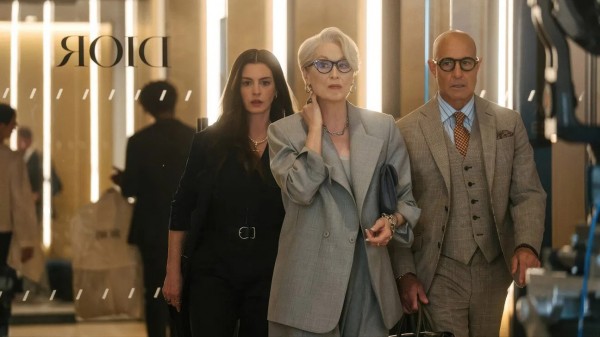
ANNE HATHAWAY, MERYL STREEP, STANLEY TUCCI IN THE DEVIL WEARS PRADA 2
DAVID FRANKEL: THE DEVIL WEARS PRADA 2 (2026)
20-year sequel full of today's "issues" that's looking like a big hit
This is a sequel to a popular film (Hollywood Reporter calls it "a culture-defining hit") and the principals are back, twenty years later. Prada 1 was fun. I saw it with Carol Sheehan, someone who brought such enthusiasm to movie-watching - especially so, as a magazine editor herself (of Country Home), to this one. But Carol is no longer with us. I sawit alone this time, and it's full of today's brutal downsizing of media. Nonetheless I found a morning showing of the new film, in a remote suburban location, surprisingly busy for cineplexes today. It's goT some good buzz.
It's got cameos like Ashley Graham, Donatella Versace, Domenico Dolce, Marc Jacobs, Lady Gaga. A Dolce and Gabbana runway show appears, and the movie goes to Milan instead of Paris this time. There are lot of other fashion or media figures who appear as extras in the film: I didn't notice them, but they're listed in a Variety piece.
We who are still around are twenty years older and so are the numerous original cast members who have returned - although, being Hollywood actors, they have ways of still looking great, as we may not. Meryl Streep again is Miranda Priestly, the imperious editor of Runway, a stand-in for Vogue,. Anne Hathaway is Andy Sachs, the then fledgling, now experienced, journalist. Emily Blunt who was Miranda's jealous, mean assistant, Emily, is now a high-powered executive at Dior, navigating a new life in Milan while dating a "daffy billionaire" named Benji Barnes (Justin Theroux). Stanley Tucci is still Nigel, Miranda's still-loyal and arguably overqualified designer. Aline Brosh McKenna, who wrote the screenplay, returned, as did David Frankel to direct. The eponymous novel by Lauren Weisberger remains a basis for the setting and characters. The novel is further in the distance now. But this sequel will easily draw fans of the original. Will they like it, though? Maybe. It has grown up, but so have they.
The first film made the characters more rounded than the novel. When the chilly editor based on Anna Wintour became the novel's Miranda Priestly played by Meryl Streep, she kept the chilliness with an edge of camp but gained nuance (which A.O. Scott wrote she "carries. . . in every pore"), and by the film's end when she is divorced there is human fallibility.
The sequel tries to maintain our awareness of the hardness of the fashion magazine world, but this is not about a young apprentice doing a trial assistant stint. It's about more grown-up stuff, like the survival of print media, the impact of digital technology on luxury, and navigating professional legacy. The owner of the magazine conglomerate Elias-Clarke Irv Ravitz (again Tibor Feldman, back from Prada 1) dies and his son Jay (B.J. Novak) immediately sets out to gut Runway . This is what happens all the time now. Somehow that gets averted.
The film does some fast footwork to manage to bring back Andy and Miranda as almost-pals. Andy has established a serious reputation as a journalist about issues who gets hired on at Runway as a features editor to give the magazine some weight and to repair the magazine's reputation after it was duped into lavishing praise on a sweatshop-using brand. Instead of abandoning Miranda in Paris during Fashion Week, she stays with Miranda as an ally. Now, the fact that magazines as print media are nearly dead is stated in no uncertain terms and the way "little things" like them are swallowed up by young billionaires on smartphones and ready-to-wear is more and more the thing and not haute couture.
Recently through the magic of YouTube I discovered Bliss Foster, who has a channel about fashion there, and has extensively reported on Paris and Milan fashion weeks, and from him, I'd say this: a lot is going on in the world of fashion now at various economic levels. And Prada 2 isn't about any of that. As an uninformed fan of fashion and style, I've welcomed Bliss Foster and practically binge-watched him.
What the new movie is about is some of the stuff that went on and entertained you in Prada 1, minus the coming-of-age - and most of the personal life - aspects, plus new issues of the new economic and media worlds we live in now. The Devil Wears Prada 2 is a massive hit, opening as the top film at the box office for the May 1–3, 2026 weekend. Projections indicate a huge $85 million+ domestic debut and a $175M–$180M+ global opening, greatly outperforming the 2006 original and setting records as a major female-driven summer opener. Go figure. And, perhaps, rejoice. Critically, it's about where the first film was. See Metacritic.
The Devil Wears Prada 2, 119 mins., premiered in NYC Apr. 20, 2026, and London Apr. 22, 2026, and opened theatrically in the US May 1. Metacritic rating: 63% (2006 Prada was 62).
Last edited by Chris Knipp; 05-01-2026 at 07:47 PM.
-
THE TRAVEL COMPANION (Travis Wood, Alex Mallis 2025)
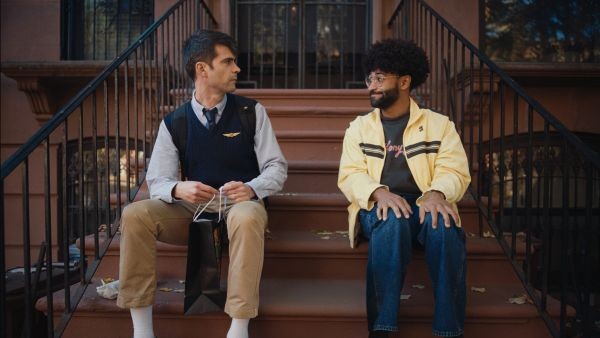
ANTHONY OBERBECK, TRISTAN TURNER IN THE TRAVEL COMPANION
TRAVIS WOOD, ALEX MALLIS: THE TRAVEL COMPANION (2025)
Three's a crowd
The center of attention (and definitely of his own) in this entertaining film is Simon (Tristan Turner), a cluelessly egotistical aspiring indie filmmaker. When he gets a clue and loses his free ride care of his Brooklyn roommate Bruce (Anthony Oberbeck), only then he actually makes that second film he's been talking up and putting off completing. You may justifiably want to strangle him much of the way, but the filmmakers (who co-wrote with Weston Auburn) save some sympathy (with help from Tristan Turner) and grant Simon some success. This is a buddy picture, a travel picture, and a slightly mumblecore depiction of the world of indie film.
Simon rooms in Brooklyn with Bruce (Anthony Oberbeck), who's been his friend since third grade. Simoh is on the front stoop with a hero sandwich for Bruce when he comes back from work at the airport. They enjoy working out together and they look good doing it. But Bruce is the grownup and Simon is the child. Bruce is the coordinator of flights for an airline. In this role he gets to designate a "travel companion" who gets free flights everywhere all year on standby. In this role Simon has been shooting film - or has he only been thinking of doing so? This activity helps give Simon a sense of creative identity to be someone other than a guy who makes short promotional films for a taxi company, his day job.
As the film begins Simon is on a festival stage with a half dozen other directors of shorts. At the end of the row, he doesn't get to be introduced before they're told they must clear the auditorium. Bruce is in the audience to support him, and also there is Beatrice (Naomi Asa), who they invite to join them for a drink. Beatrice is also a small filmmaker. She becomes a double threat for Simon. When Bruce starts to date her, Simon's importance for Bruce diminishes and he's likely to lose his "travel companion" status. Simon's jealousy and clueless self-centeredness are increasingly evident. When he talks about his endlessly shopped debut short film or his endlessly hyped but not even started second film it's all a lot of BS.
A memorable moment is the one where Bruce asks Simon to do his "schvitz" (a zip-up steam room) in his own bedroom and he takes it in the living room anyway, saying that if he did that he wouldn't be able to talk to Bruce. That "talk" obviously is mostly a springboard for Simon's monologues.
Simon is often careless or rude toward people. Somehow, Bruce's indulgence and forgiveness are a bit touching because he's being decent and a good friend. Simon is clearly not a bad person. He's just a man child in his early thirties who's not yet grown up. His creativity isn't fake. He's just stuck. But his selfishness is clear because it's obvious he's more concerned about losing his free trips than about losing his friend. Relations between him and Beatrice aren't unfriendly. He is all admiration when he encounters her making a very expensive big-production commercial in a New York residential street. Simon has to learn some home truths and Bruce has to stopp putting up with him for him to come unstuck and be a mensch.
Here where they piggy-backed on an actual film production for Beatrice's plum directing job the filmmakers are skillful at making a very good looking movie on a very small budget in a very short time. The local scene is engagingly and richly used. Simon meets up with an entrepreneurial and philosophizing cab driver (Anil Joseph) who's appealing, and makes use of the driver in his own work when that blooms finally at the end. Excellent cinematography by Jason Chiu, editing by Bryan Chang, and score by Eliot Krimsky.
I]The Travel Companion[/I], 90 mins., premiered at Tribeca June 5, 2025 and showned at a number of other small domestic fests. US theatrical release by Oscilloscope starting April 10, 2026. Los Angeles, CA – April 25 – Los Feliz 3 Theatre [+Q&A]. No Metascore yet.
San Francisco, CA – April 28 – Roxie Cinema [+Q&A].
April 25 Los Angeles, CA Los Feliz 3 Theatre; April 28 San Francisco, CA The Roxie
Last edited by Chris Knipp; 04-23-2026 at 06:15 PM.
-
CAROLINA CAROLINE ( Adam Rehmeier 2025)
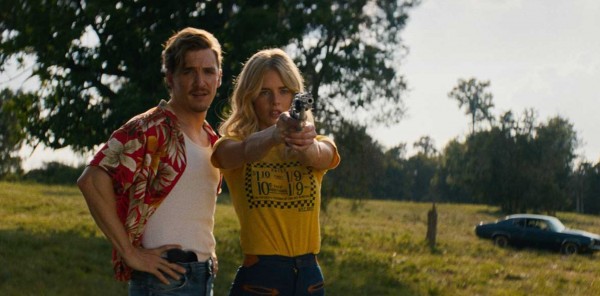
KYLE GALLNER AND SAMARA WEAVING IN CAROLINA CAROLINE
ADAM REHMEIER: CAROLINA CAROLINE (2025)
VIDEO
That doomed criminal lovers thing again
He walks into her Texas gas station. She likes the con job he performs there and runs out after him. She and he fall hard for each other. Bingo: Bonnie and Clyde. He shows her the tricks of his trade. The money-cons at rural pay stations move to shoplifting department store robberies and then - with too little fanfare - jump up to robbing local banks. She does the robberies in a black wig waving a cowboy pistol. He drives the getaway car, often changing cars and license plates. They run through some states of the Southeast, soon getting noticed.
First off Caroline wants to look up her mother in South Carolina, who abandoned her in Texas when she was less than a year old. Kyra Sedgwick in a dive bar does a gritty impersonation of this sleazy lady, but her scene lacks any particular distinction despite being "in character" and hence seems unnecessary, a failed opportunity.
This is a period-lite film, in the past but only thirty years or so back. In that way, it lacks flavor. Its flavor is of a music video, and it is full of twangy, lilting country songs that fit just right. It's full also of montages, way too many of them. They suggest the director, Adam Carter Rehmeier, was either not fully at ease filming action for the robberies, or simply faced the restraints of a tight budget and short shooting schedule. This makes the movie seem pretty, but empty, where the hard crime scenes that are the center of the narrative come in.
On the other hand, what all concede is that the stars shine. Carolina Caroline foregrounds horror actors Kyle Gallner as Oliver, the, sly, mysterious young itinerant con man, and Samara Weaving as Caroline, the Texas blonde who's beautiful and reckless enough to follow him. As anyone can see the actors are having a great time and their chemistry is great.
Caroline has never been anywhere and her first aim is to get out of town, leaving behind Jon Gries, as her father, who, though he's played many roles, for me has his own edge of a much smarter con man, since he recently played Greg Hunt in The White Lotus, who gets himself half a billion dollars without doing anything violent himself, only by proxy bumping off Jennifer Coolidge. You kind of wonder why in the late twentieth century, even if they don't have computers and AI yet, this criminal couple hasn't updated the Bonnie and Clyde MO. I guess the director and his writer, Tom Dean, just consciously want to pay homage.
But while this movie sings when Gallner and Weaving are interacting, the overall structure of Carolina Caroline can't stand comparison with the iconic 1967 Arthur Penn film starring Warren Beatty and Faye Dunaway, which, after all, got ten Oscar nominations, while this won't be likely to get any.
That's not to say it lacks good scenes, or that I didn't feel Caroline's fear and terror when she and her lover get in too deep and the law is closing in on them. I remember a scene where Caroline and Oliver dance in a twangy roadhouse again, with their images published up above the bar on the TV, and she asks if they can hide out in France and he says yes and starts to cry. The actors bring more than the script calls for all the way through.
Carolina Caroline, 105 mins., premiered Sept. 5, 2025 at Toronto, showing at a half dozen US festivals including Cinequest and Miami. US theatrical release Jun. 5, 2026. Metacritic rating: 77%.
Last edited by Chris Knipp; 05-17-2026 at 11:12 AM.
-
SOUND OF FALLING (.Mascha Schilinski 2025)
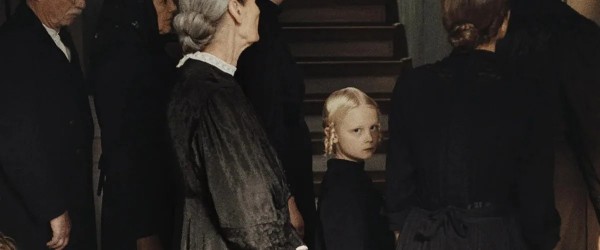
MASCHA SCHILINSKI: SOUND OF FALLING (2025)
TRAILER
Ambitious German film of generations and traumas
Mascha Schilinski's Sound of Falling (2025/2026) covers over a century of German history, focusing on four distinct periods from the early 20th century to the present day. The film, which follows four generations of women, and four young women, Alma, Erika, Angelika, and Lenka, in the same Altmark farmhouse, primarily explores the 1910s, 1940s, 1980s, and the modern day.
Over an hour into this ambitious film a young man falls in a barn and from how he lands we can see a leg is seriously damaged. His groans and cries echo on and on. It's suggested that the leg must be amputated, and someone asks if the other will have to be amputated as well.
The film uses non-linear storytelling to weave together four distinct time periods, and the trauma surrounding the leg injury acts as a focal point for the intergenerational suffering on the farm.
Is this the sound of falling? So much happens over so long a period of time, and one is left in a transcendently grim state of mind. Is life like this? Where is the real drama? Where are the successes and joys? Life has been reshuffled from an arbitrary point of view. But this is a brilliant and confident film.
Schilinski's vision and crfaft are consistently impressive, her scenes memorable. This is a film I've been hearing about since a year ago. "Brother Bro" of "The Oscar Expert," speaking from Cannes, walking along as he filmed himself, spoke first about Sound of Falling, saying its complexity led him to watch it twice, calling it "dense and complex," with "beautiful cinematography," with a "haunting tone," "very memorable as a tone piece, as a mood piece," and "ripe with layers of meaning." He described it as "a tapestry" whose meanings you can't pin down, a film that's "very abstract." He found it "amorphous" and "shapeless," but "impeccably well-crafted."
The film takes a while to establish period with people running around carrying candles; but the craft shows in an onrush of memorable moments. There is a girl walking along a body of water, who falls behind the adults, and has a fantasy of falling in and drowning. There is the image of a girl rolling down a hill into the water and splashing in. A boy is taunted in the barn, other kids yelling that he has a hard-on and taunting him to stand up, to pull down his pants and show it. We are lost in the past, and it's a jolt when somebody sitting at a picnic table pulls out a cell phone she says she "inherited" from her mother.
Who can forget the young woman Lenka (Laeni Geiseler) who asks a man for a "ride to Glowisch," but won't tell him what she's going to do there. "Disco?" he asks. He lights a cigarette, tells her no, she won't get a ride from him. she says she will hitchhike. The genius of the film is in the specific, important feel of nearly every scene, even as we don't exactly know the significance of the moment, buried as it is in the particular demands of a situation peculiar to itself. Every scene matters in and for itself. "Brother Bro" reported in his fresh response from Cannes that this film "makes you see cinema as a language and art that can communicate in a way that others can't." Each scene has a crackle of specificity, and there is often even a recurrent crackling sound, like an old record turning on a turntable. Texture is a priority here, and a sense of foreboding.
A girl's voiceover says we can never known exactly what's going on because of point of view. "Mom knows things she shouldn't even remember because she wasn't even there when they happened," she says, meaning things such as how her sister Erika always stole uncle Fritz's crutches - a scene we have seen early on - "to see if she could walk with just one leg." And now we remember she how to do this she tied her other leg up round and round with a cord go keep it out of the way. This over-and-overing of moments helps explain why "Brother Bro" called the film "layered." It's really not so much complex as focused and richly crafted, as he said, building its narrow yet decades-spanning scene-building texture.
Angelika, portrayed by Lena Urzendowsky, lives in the 1980's in the GDR East German era. In a memorable scene she watches a harvester machine cutting across a field of wheat carrying a flag over her shoulder and comes across a small animal the machine might run over and kill. In the WWII segment there is Erika, played by Lea Drinda, a young blonde woman with hair in buns who falls and laughs. She appears in the WWII-era segment, engaging in strange, playful, and sometimes dangerous behavior while exploring the farm.
The huge farmhouse also is a character and it changes radically through the century, winding up no longer in the same family's hands. And there are the servant's quarters, huddled around an inner courtyard, and, troubingly, we learn women servants are unwittingly sterilized. This act is portrayed as a brutal, systemic practice designed to ensure the servants can work uninterrupted by pregnancy and to make them "safe for the men". Astonishing and disturbing and certainly like nothing else a sign that those were different times.
For all this Schilinski slips in and out of time, sliding with tricky camera shots into one period and back again to an earlier one. This certainly contributes to a sense of the complexity and interconnectedness of time, although my feeling is that this is a current fashion that may fade and tend to date a film in a future when it is remembered again that chronology is our friend, and it's realized that too much play with time distances us from events more than it clarifies them. Nonetheless, a remarkable film and one of the standouts of this year's Cannes. It has been compared to Michael Haneke's White Ribbon but received even greater critical acclaim. Sound of Falling can be hard going, but it's a must-see.
Sound of Falling/In die Sonne schauen, 155 mins., premiered as a surprize Competition film at Cannes in May 2025 and shared the Jury Prize there with Oliver Laxe's Sirāt. It was released in US theaters by MUBI on Jan. 16, 2026. Metacritic rating: 90%. Available on MUBI and other platforms, including Amazon Prime.
Last edited by Chris Knipp; 05-07-2026 at 06:04 PM.
-
LATE FAME. (Kent Jones 2025)
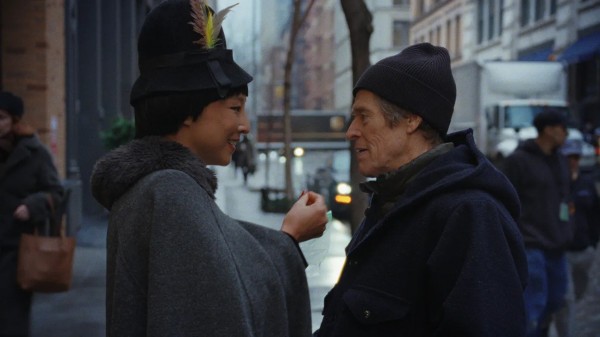
GRETA LEE AND WILLEM DAFOE IN LATE FAME
KENT JONES: LATE FAME (2025)
Past self revisited
Willem Dafoe goes back to his low-keyed indie roots to play the lead in Kent Jones' sophomore directorial effort, Late Fame,, the story, loosely based on an 1890s satirical novella by Austrian writer Arthur Schnitzler, of how a group of well-heeled young poetasters in today's NYC pluck a forgotten working class poet who produced one admired slim volume in the 1970s out of the post office where he's been sorting mail for 37 years and give him a moment of, not fame, of course - they, who anachronistically call themselves The Enthusiasm Society, abhor social media platforms - but of affirmation, a wistful hint of what might have been if he had gone on writing poetry over the last many decades, and a realization that that cannot be.
Last edited by Chris Knipp; 04-23-2026 at 06:16 PM.
-
Favorites of 2025
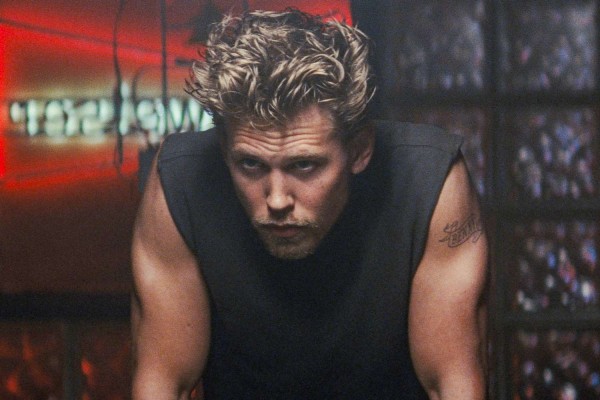
AUSTIN BUTLER IN THE BIKERIDERS
C H R I S__K N I P P'S__2 0 2 4__M O V I E__B E S T__L I S T S
FEATURE FILMS
All We Imagine as Light (Payal Kapadia)
Anora (Sean Baker)
Beast, The (Bertrand Bonello)
Bikeriders, THe (Jeff Nichols)
Blitz (Steve McQueen)
Challengers (Luca Guadagnino)
Close Your Eyes (Victor Erice)
Conclave (Edward Berger)
Goldman Case, The/Le Procès Goldman (Cédric Kahn)
Real Pain, A (Jesse Eisenberg)
Sing Sing (Greg Kwedar)
RUNNERS UP
The Damned (Roberto Minvervini)
BEST DOCUMENTARIES
Made in England: The Films of Powell and Pressberger (David Hinton)
Merchant Ivory (Stephen Soucy)
New Kind of Wilderness, A (Silje Evensmo Jacobsen)
No Other Land (Basel Adra, Rachel Szor, Hamdan Ballal, Yuval Abraham)
Sugarcane (Emily Kassie, Julian Brave NoiseCat)
UNRELEASED FAVORITES
Afternoons of Solitude/Tardes de soledad (Albert Serra)
Caught by the Tides/ 风流一代 (Jia Zhang-ke)
NOT SEEN YET
Babygirl (Halina Reijn) Dec. 25 release
Complete Unknown, A (James Mangold) Dec. 25 release
Misericordia (Alain Guiraudie) (also unreleased)
Nickel Boys (RaMell Ross) Dec. 13 release
LESS ENTHUSIASTIC ABOUT THAN SOME
Brutalist, The (Brady Corbet)
Civil War (Alex Garland)
Emilia Pérez (Jacques Audiard)
La Chimera La chimera (Alice Rohrwacher)
Megalopolis (Francis Ford Coppola)
Queer (Luca Guadagnino 2024)
Room Next Door, The (Almodóvar)
Substance, The (Coralie Fargeat)
____________________________
COMMENTS (Dec. 1, 2024)
Just a first draft; a work in progress. But I can guarantee that "Best Features" is a list only of new movies I have watched this year with a lot of pleasure and admiration and think you would enjoy. I'll be working on it. I tend to forget things, and there are late arrivals. I also may make it numerical but for now it's alphabetical. I'm expecting a lot of Babygirl, and as always there are buzz-worthy 2024 films I have not yet seen, notably Nickel Boys. I stive to focus on movies available to everyone to watch, but that's less a problem now that there are so many eventual releases on platforms. As for the "Less Enthusiastic" list, I recommend that you watch them too, because people are talking about them - a lot, especially The Brutalist, The Substance, and Emilia Pérez.
And then there's Megalopolis. Whether or not they are as great, or for that matter as awful, as some people are claiming, they will be talked about during awards season.
Enjoy - and try to get out to see all you can in a movie theter!
Last edited by Chris Knipp; 02-08-2026 at 10:13 PM.
-
CAANFEST May 2025 THREE PALESTINIAN FILMS
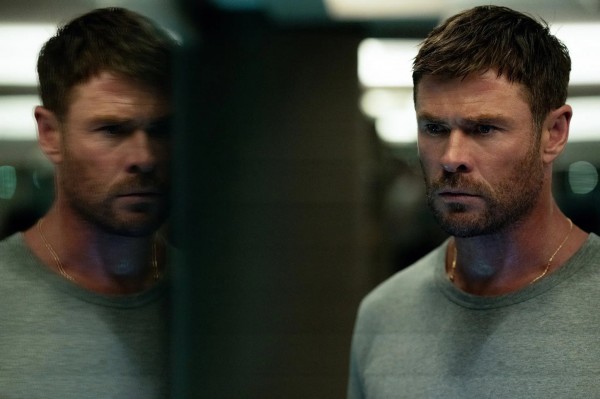
CHRIS HEMSWORTH IN CRIME 101
BART LAYTON: CRIME 101 (2026)
C+ over B-
This is a movie about a chain of lone-wolf jewel thefts in Los Angeles and the people who are in different ways involved in them. "101" has a dual meaning: the thefts are so skillful they are a course in how to do it; they're also linked by all occurring near California's Highway 101. This is a big, loud, exciting, almost contiually tense and somewhat violent movie, though the thefts are achieved, notably, without violence. It has an exciting finale. It's got a good cast. But it's not a great movie. This is for several reasons. It does not tell its story clearly. For being about a meticulous thief, it comes off as surprisingly chaotic. There are actually some plot points that get dropped. And that way much of the pleasure gets lost.
The London-born filmmaker Bart Layton is known for directing and producing true-crime hybrid documentaries such as The Imposter (2012) and American Animals (2018), also for a 2007 TV series "Locked-Up Abroad," about people who got caught up in crimes and arrests and did time in rough foreign jails. There is something of the latter in Crime 101, because several "straight" folks get caught up in crime.
Crime 101 has the marks of an early-in-the year release: there's fun here, but things aren't all quite right. It's got name actors in it. Chris Hemsworth plays a suave jewel thief; but as one critic mentions, if you want to see a good movie about jewel thievery, why not just watch the classic Rififi, from 1955? Mark Ruffalo is here as a rumpled cop whose unified theory of the jewel thefts his bosses don't buy (they'd like to rack up more arrests). Ruffalo has played many cops, including one in Zodiac and, more to the point, one in Mann’s Collateral who has a theory his colleagues don't buy. There's also Halle Berry, Jennifer Jason Leigh (underused), Barry Keoghan (too crudely used), Nick NOlte (too briefly used), Monica Barbero who convincingly impersonated Joan Baez in A Complete Unknown. Her role as the thief's girlfriend corresponds to Amy Brenneman's in Heat.
The four main cast members have all been in superhero movies and it's been suggested they are trying to atone for their sins here, because this is, relatively speaking, a "human" film. There could be more depth in character portrayal for sure, but these are people we're watching, perhaps except for the outsider criminal who comes in after the master thief has done the heist, and noisily and violently steals it from him. This character, played by Barry Keoghan, is the weak point of the action. His character isn't interesting enough or violent enough. He is not explored.
One thing that is interesting is - even though it's not handled elegantly - the way different stories are followed and, sometimes, interwoven. Sharon is a fancy insurance sales person and claims adjuster played by Halle Berry whose inability to move up the employment ladder to the level of parnter as she should due to her superior's ageist and sexist (and perhaps racist?) bias is carefully explored. She also runs into one of the bad guys and they start dating. There is the cop (Ruffalo) who's treated as a dummy and even a liability for his partner though he has the solution to the crime. All this and more would be extremely interesting in a better written and better edited film.
There is a lot of dialogue that Layton, working with Don Winslow from a novella by Winslow, have added on and one has the feeling they're going for some of the inspired use of profanity Tarantino is so good at but, of course, they're not Tarantino and the talk isn't particularly arresting. Greater brevity could have meant greater wit.
But the worst thing that is wrong with Crime 101 is that it has been found by numerous critics to be almost dumbfoundingly indebted to Michael Mann's Heat.. And if that were not enough, a lot of its visuals, especially the night aerial shots of the city, are lifted from Mann's Collateral, where, however, they are sharper and more beautiful.
Some may like the up-to-date hyperintensity of the filmmaking here. Everything is shaky-cam and super up-close. This produces excitement. So does the loud and propulsive score by multiple hands but primarily by Blanck Mass, the electronic solo project of British composer and producer Benjamin John Power, which is effective, if overbearing. But what is achieved in excitement is lost at times in the ability to observe clearly what is going on. Crime films are a matter of detail, and the audience needs to be able to appreciate the specifics and above all, the timing and the control of nerves under pressure. As has often been pointed out the dazzling jewel theft sequence in Rififi, the most memorable in the history of movies, runs for half an hour with not a word spoken and not a note of music.
Motivational talks and yoga and a phone that shows a character she has not gotten a good nights sleep are running themes in this film. Perhaps as Ben Kenigsberg says in his NY Times review, this means Crime 101 is "less a guide to criminality than a manual for self-help." But if so what good would that be?
Crime 101, 120 mins., dropped in over 50 countries Feb. 12, 2026. Metacritic rating: 68%.
Last edited by Chris Knipp; 02-21-2026 at 08:27 PM.
-
THE ETERNAL DAUGHTER (Joanna Hogg 2022)
JOANNA HOGG: THE ETERNAL DAUGHTER (2022)
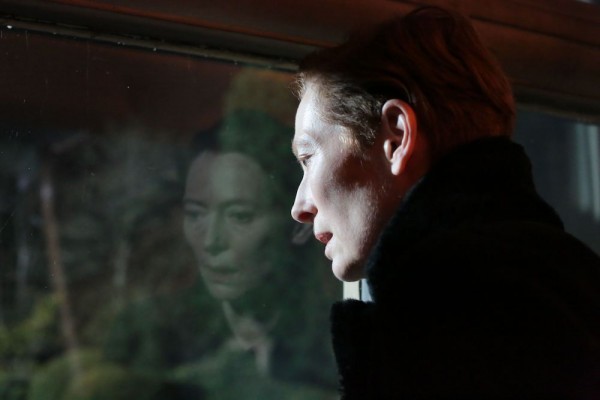
TILDA SWINTON IN THE ETERNAL DAUGHTER
A trip north
The Eternal Daughter may be categorized as a film of horror or the supernatural, but devotees of either will doubtless be disappointed. Numerous critics describe it as "a distinctly minor work" by the director, whose 2019 The Souvenir brought her to wide attention, and to mine. It's worth going back and watching all her three earlier features, Unrelated, Archipelago and Exhibition: they're not fun watches, but the unfun-ness is distinctly her own, uppermiddleclass British constraints and torments that will seem to grow out of, not lead into, the autobiographical film student with the unfortunate posh boyfriend of The Souvenir. The underimpressed critics also say The Eternal Daughter, which serves as a sequel to The Souvenir II, the end of a trilogy, that it is "slooow."
Well, The Eternal Daughter is unique, and while I'd agree it has its longeurs, and is almost Beckettian in its uneventfulness. It's also subtle and beautiful, and the performance at the center of it by Tilda Swinton as both Julie Hart, a filmmaker, and Rosalind Hart, her mother, whom the hyper-attentive Julie takes to a big old, apparently empty hotel for her birthday, is remarkable. The double performance is not just a stunt. It's also a brilliant idea central to the film's themes and ideas, which magnify and unfold over time like the old Japanese paper flowers that grew when you dipped them in water. And all this isn't just cleverness. It serves to deliver hard emotional honesty that characterizes Hogg's best moments in the other films. After the slow passages, as I watched, the emotion grew, and at the end I was devastated with a still unfolding sense of sorrow too deep for tears.
Hogg makes much use of the horror vibe and genre ticks throughout - a pale face in a window; knocks in the night; Rosalind's setter Louis (the canine companion an important character in many a family), brought along, disappearing and then popping up back in the room; the odd, unfriendly "staff;" the confounding corridors and rooms; the fog outside - and all these events and things allow for the general feeling we have that something strange is going on. Many will doubtless guess the film's secret early on. That's unimportant. It's all in the very distinctive nuance of the film and the interchanges between Julie and Rosalind. It's very important that until the end, a two-shot doesn't occur. You see Julie saying something, then you see - or will you see? You never know - Rosalind. And yes, you're very aware that both are Tilda Swinton in two different sorts of drag. The Rosalind drag includes peculiarly subtle aging makeup. She's not made to look very old. (A very old woman is seen toward the end, in a kind of coda and subtly spooky jolt.) You're marveling at the costumer's and makeup artist's art and the acting, but you're very aware that you're watching Tilda Swinton.
And all this is kind of creepy, if not what you'd call "horrible." Or maybe it is; maybe you can anticipate a Hitchcockian shock coming. It's not like that. It's more like the air goes out of the tire. (Or tyre.) The more overt horror-supernatural vibe comes from the great aristocratic house in Wales that Julie and Rosalind are staying at. It is a place, then in private hands, where Rosalind, as a young girl, was sent with other family members to escape the bombing during the War. But Julie doesn't know much about this. She has devoted much of her life to caring about and loving her mother - she has a husband, but no children - but her mother remains largely a mystery to her. Other later visits to the house turn out to have occurred later, and things happened, not happy memories, that Julie didn't know about. The place is beautiful, in a mournful way. The accoutrements of the rooms, even the keys at the front desk, are handsome. the ornate, formal landscaping outside, shrouded often in cinematic fog, is beautiful in its layers of green. The exterior shots look like subtle color lithographs.
The place isn't particularly friendly. Julie and Rosalind are greeted by a grumpy receptionist (Carly-Sophia Davies), who also reappears as the waitress at the dining room (and there are only four dishes on the menu). Is Harold Pinter an influence? This is in some ways like a magnificently visually expanded play, a chamber drama, a drama in the head. A warmer character is a groundskeeper (Joseph Mydell) who talks to Julie a few times and comforts and shares an understanding of loss. He says his wife died a year ago.
Julie is here to celebrate Rosalind's birthday - or is she? The birthday celebration turns out to be grotesque and sad, family happiness gone wrong, though a a bottle of champagne is uncorked and poured from and a birthday cake is brought in. Julie chooses to bring it in herself. But whenever Julie and Rosalind are seated talking together at meals, Julie surreptitiously sets her smartphone out to record the conversation. Early on she's said she's here to work, on a new film presumably, and she goes to a special place to do so, but she can't sleep, she's uncomfortable, and she goes day after day without getting any work done. The other use of the smartphone is to try to talk to her husband. This she has to do out in front of the hotel pacing about near a hedge trying to get reception, which isn't good. And the wi-fi is patchy in the building as well.
These descriptions sound ordinary enough. But in Joanna Hogg's skilled hands and the meticulous, complicated interchanges of Tilda and Tilda, they resonate with meanings you go on pondering long after the film is over. The heart of the matter is the confrontation of lives and family relationships, the permanent, difficult, mysterious, inescapable ones. The daughter is "eternal" because filial relationships never end. Imagine making a movie about your mother and its turning out to be a sort of horror film. Others would make a story that's joyous and celebratory. But where is the truth? I remember the priest who Malraux talks about in his Anti-Memoirs who, questioned on what he had learned about people from thirty years of hearing confession, gave two ideas; there is no such thing as a grownup person; and people are much less happy than they appear. But the scenes we have watched have been an expiation. And the end Julie has come thorough and is typing away on her laptop: the new film has come to her. This one.
If any of this sounds intriguing, you are urged to see The Eternal Daughter. It's a marvelous film, a study of grief, memory and family relationships that cuts to the bone. A minor work? Remember the little Fragonard painting in the Wallace Collection in The Souvenir. That whole film grows out of it.
The Eternal Daughter, 96 mins., debuted Sept. 6, 2022 at Venice, showing at nine or more other international festivals, including Toronto, Zurich, London, New York (Main Slate), Vienna, Seville, AFI, Thessaloniki and Marrakech. Limited US theatrical release and on itnernet Dec. 2, 2022. Metacritic rating: 79%.
Last edited by Chris Knipp; 12-06-2022 at 07:01 PM.
 Posting Permissions
- You may not post new threads
- You may not post replies
- You may not post attachments
- You may not edit your posts
-
Forum Rules




 Reply With Quote
Bookmarks