-
RENDEZ-VOUS WITH FRENCH CINEMA at Lincoln Center 2026
Last edited by Chris Knipp; 03-02-2026 at 03:13 PM.
-
AT WORK/À PIED DE L'OEUVRE (Valérie Donzelli 2025)
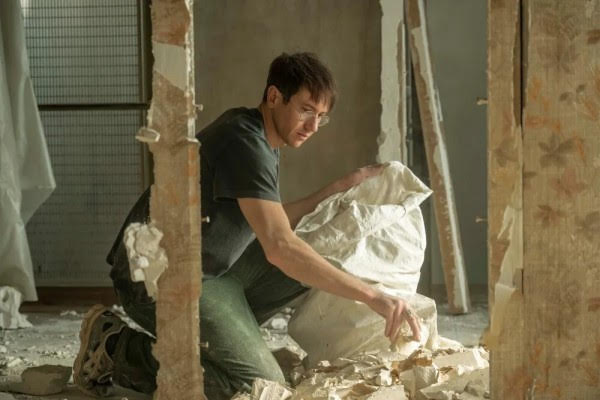
BASTIEN BOUILLON IN AT WORK
VALERIE DONZELLI: AT WORK/À PIED DE L'OEUVRE (2025)
Oath of poverty of an author doing Uber-style work
THe French review Les Inrockuptibles of Valerie Donzelli's quietly powerful and succinct new film, describes the hero, Paul (Bastien Bouillon) thus: "a rebellious, unconventional artist who chooses fulfillment in poverty and marginality rather than compromise in the limelight." Some French reviewers see the subject of At Work negatively, as a tale of of "uberisation." Surely is not so. Uber is just a thing people do on the way to something else. But Uber reflects a fracturing of work that was simpler before. In the words of the author of the source novel, which is a realistic, experienced-based account, it is "a clever blend of liberty and deprivation." To put it another way, Paul, an established, published writer but not a hugely successful one, allows himself to be exploited for the little things to avoid the big exploitation of a profitable but shameful and dishonest job, like, say, finance or advertising, or even teaching, which is too close to the intellectual activity of writing. Menial work puts the writer in direct touch with life at its most ordinary and keeps him honest.
Paul (Bastien Bouillon, who is brilliant here, and makes the film), is in his early forties, recently divorced with several grown children, whom circumstances lead to be living by himself now; the wife takes the kids to live in Canada. He was a successful photographer, making two or three thousand euros a month. He looks at his cameras, relics now. He will not go back to photography to make money. He has published three novels and is embarking on his fourth.
Though unnoted, the publisher is NRF/Gallimard, publisher of such luminaries as Proust, Sartre, St. Exupéry, Céline and De Beauvoir. Paul is not one of those. His number three did poorly as his editor (Viginie Ledoyen) reminds him. He is making 250 euros a month where before, as a photographer, he made two or three thousand. But Paul wants to write, so he must do other work to live. But not photography, which was another life.
The film is about the work he chooses to do, and about his dedication to the métier of writer. Occasionally we see his editor, and moderately but also essentially we glimpse his wife, played by Donzelli herself. He chooses to work at menial jobs to leave himself time and mind to write and the film focuses much on these jobs. Why not write a bestseller?, his disapproving father (André Marcon) asks. He would not consider it. The jobs are ordinary but sometimes grueling, piecework, miscellaneous gig economy jobs. He takes three hours to cut a lawn because the owner has only clippers. He struggles unloading a metal curved staircase down a stairway out of an apartment for too heavy ahd too cumbersome for one person. He spends ages laboriously removing big boxwood plants (we may pity the plants themselves too) from large planters on a Paris balcony, only to learn that there is another side to the balcony with another eight boxwoods to drag out and bag.
He takes a gold ring to sell, and finds out it's not 18 carat gold. He lets it go anyway, for thirty euros.
Paul is so swamped, and so poor now, he can't afford trips for festive events involving his children who are out of town, and must attend them via Zoom. His hair has been cropped close with clippers: he's like a monk. A friend he dines with says "tu décelaire," you're slowing down, but it sounded to me like "tu désalaire" - you're giving up salary. It's both. Slowly, quietly, invisibly, Paul makes his life workable, earning enough to live on minimally by odd jobs, while continuing to write, and keeping not of all the people and scenes he observes on his jobs.
He is an Uber to and from the airport. One is a lonely lady he goes to bed with on arrival. But they are both out of practice and it's awkward and dodgy. He must give up the loaned space he's moved to and is faced with homelessness, becoming a 'clochard.' His computer gives out and something goes so wrong not only can it not be repaired, but he loses his drive and all his work on it. A lady barkeep has pity on him and leads him to a rest space behind the bar and says he can stay there and write there. He takes to felt pen and pad.
The whole business, the family, the publisher, the odd jobs he does for a pittance to get them from the hot online competition, life day to day, go into the packet of pages he produces and gives to his editor. She directs it to be typed up and bound and when we see that, we know good news has come at last. She finds the book good, it will be his next book.
At the signing, he gets a text about a job, a referral from a previous client. "In two hours?" he texts -- he will go from the book signing to another repair job, because the editor, having paid him an advance some time ago, cannot give him any more when she takes his manuscript. But the buyers of the book are loyal. "I like your writing. I've read all your books." That, at least, is real gold. But better than that,platinum perhaps, is the enormously moving call from his own son, who has read the book (which his children had not done the early ones) and loves it and in whose eyes he has become a mensch.
As an Uber worker Paul points out in the book, he has to be constantly rated, and he is only hirable if he gets five stars. A customer writes he is too untalkative and gives him one star, and his rating drops. Employers no longer fear employees. It's a tough buyer's market out there. What happened to Liberté, Égalité, Fraternité?
In the neat final scene of this neat little film, the client after the book signing thanks Paul for his toilet repair, gives him the 25 euros, and says, "My friend is moving tomorrow morning. Can I recommend you to her?" and Paul says, "Yes. But I don't work mornings. Mornings I write." End of story.
(À pied d'œuvre, the title, means in English " » signifie en anglais « to be ready to start work," "to be on site and ready," in or "to be hard at work" in the context of a team project or construction site.)
At Work/À pied d'oeuvre, 92 mins., premiered in competition at Venice Aug. 29, 2025, showing also at Hamburg, Marrakech and Göteborg, and opened Feb, 4 in France and will open Mar. 5 in Italy. AlloCiné press rating 3.9 (78%). Screened for this review as part of the Mar. 5-15, 2026 Rendez-Vous with French Cinema at Lincoln Center. Showtimes:
Sun., Mar. 8 at 9:00pm – Q&A with Valérie Donzelli
Fri., Mar. 13 at 4:00pm
-
LOVE ME TENDER (Anna Cazenave Cambet 2025)
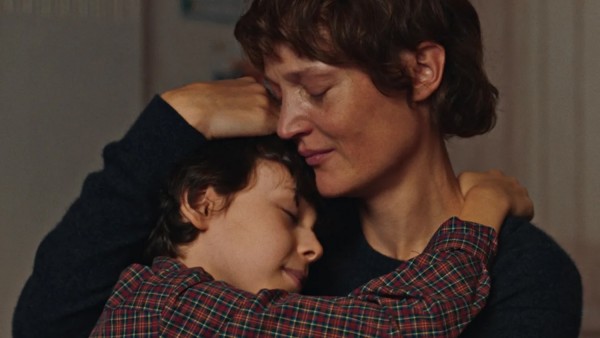
VIGGO FERREIRA-REDIER AND VICKY KRIEPS IN LOVE ME TENDER
ANNA CAZENAVE CAMBET: LOVE ME TENDER (2025)
Stubborn lady
This film dominated by the engrossing (if not exactly enderaring) performance of the always excellent Vicky Krieps is based on the autobiographical docufiction book of the same name by Constance Debré, from which it differs in certain ways. It doesn't make clear how illustrious her family is, though it hints at that. It doesn't make clear how distinguished her legal career was before she renounced it to live as a lesbian and a writer. The film pares down effectively, focusing on the most difficult and devastating aspect of her life, her struggle with her ex-husband for custody of her young son. Also unmentioned here is that she was a mature mother, because she was married for fifteen years before she had a child.
This film is a tough watch. But it becomes engrossing as one watches a painful process unfold. Everyday life has a hard time peeking in from time to time. Advocates of the film argue that its over two-hour length is necessary to convey the experience, which is a long and painful one. Maybe. But then why does it leave one numbed and confused? In his Hollywood Reporter review Jordan Mintzer calls this film "hard-hitting" but says it "overstays its welcome." One might have understood this woman better if one had known more of the details of her unusual life given in the book source and described in 'Alexis Okeowo's 2022 New Yorker article, which considers how LGBTQ people and women considering giving birth might relate to the ideas in Debré's book.
The film is powerful and sad. What happens is that Clémence Delcourt (Krieps) meets with her ex, Laurent Lévêque (Antoine Reinartz) at a Paris cafe and tells him that she is "seeing women." Laurent mumbles and stumbles in response, saying he wants her to be happy. In fact, he immediately takes legal action to completely cut off Clémence's contact with eight-year-old Paul (Viggo Ferreira-Redier). To this end Laurent accuses her of incest and pedophilia, charging her with having homosexual friends who are pedophiles and citing books she has that are obscene. This will dominate the film, with the lesbian love life next best, swimming after that, writing, cycling (she takes Paul for a ride in the country) and last her on-and-off social life. She seems to move from place to place, seemingly longest subletting from a perky young man called Léo (Julien De Saint Jean).
Clémence has to wait for months to see her son again, and when she does, it is with two other women present as observers at a "Center." While Laurent has intimated that Paul has no use for his mother, he was being fed ideas by his father. Investigation shows that he loves his mother and wants to see her. The meetings are unbearably painful and touching and real, though a less experienced actor to play the boy might have worked even better.
Then as time, even years, go by with a long break, for a while Clémence gets to be with Paul not just for an hour but for twenty-four. She can take him on an outing. At his request she takes him to see her father, played by veteran actor Féodor Atkine. Clémence sees her father regularly. We learn that he lives in a guard house on the great estate that he once owned, and that he is dependent on the French morphine substitute Subutex (buprenorphine) which is administered to him by a visiting nurse.
Clémencet tells Paul "we will get through this." But Laurent is working all the time on his son. The hostility so disturbs Paul that he begins refusing to see his mother. She meets with a judge who supports her, but he warns her that his opinion will have no effect. Later we learn Laurent repeatedly fails to conform so that Clémence sees less and less of Paul and they become more and more estranged.
While all this is going on, the film struggles a bit to provide a balanced picture of Clémence's growing life as a writer and as a lesbian. It's only past half way through that she meets a woman journalist, Sarah (Monia Chokri) with whom she becomes serious. Even then, Clémence is cagey and so plainly and brutally tells Sarah that the relationship with her son is more important than she is that it almost ends the relationship, which eventually does end.
In retrospect Clémence's stubborn independence as a shaved-headed, mannishly-dressed, athletic lesbian camping out here and there, living an artistic life as a writer and proclaiming her "dedication" to eschew social gatherings at cafes - while smoking a lot despite the swimming regime - may be seen as rather a luxury, since it is all a matter of self-denial by choice by someone whose family is so rich she would never have been homeless, starving, or penniless. Hence one begins to understand a little bit the disapproval of the ex-husband. But he is seen exclusively as a very weird kind of jerk, and nothing could justify his seeking to cut her off from her own son, or being a homophobe. A secondary theme of the film is how powerfully in conflicts like this the French State works to crush women who are unconventional.
At the end of the film Clémence declares that, having effectively lost custody and contact with her son through her husband's efforts, she has learned to renounce him. She says there is no reason why this kind of tie, mother to son, can't simply end like any other love relationship. And the film leaves us confused, because she also says that Paul may want to reconnect with her: "You know how unpredictable teenagers are" and earlier, the boy has said when he grows up he wants to take her and her grandfather's name - weighted though that name may be. The way the film leaves us confused at the end reflects how difficult it was trying tame the powerful, unruly book source.
Love Me Tender, 134 mins., premiered at Cannes in Un Certain Regard May 20, 2025. Opening Dec. 10, 2025 in France, it received a 3.3=66% critics score on AlloCiné. Screened for this review as part of Rendez-Vous with French Cinema at Lincoln Center (Mar. 5-15, 2026).
Showtimes:
Sat., Mar. 7 at 12:00pm – Q&A with Anna Cazenave Cambet and dp Kristy Baboul
Thurs., Mar. 12 at 3:00pm
-
METEORS (Hubert Charuel, Claude Le Pape 2025)
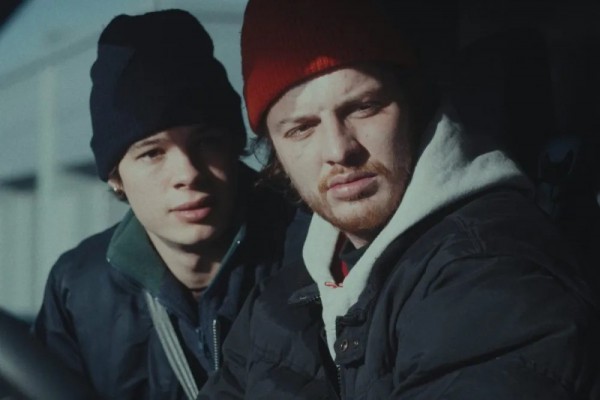
PAUL KIRCHER, IDIR AZOUGLI IN METEORS
HUBERT CHARUEL, CLAUDE LE PAPE: METEORS (2025)
A deed-end rural coming-of-ager
Debuting at Cannes last May, Meteors focuses on three late-twenties young "losers" in rural France (Mika (Paul Kircher, one of France's brightest young actors), Dan ( César-nominated Idir Azougli) and Tony (Salif Cissé, rather underused), and follows to see who will succeed and who will fail. The actors are excellent; the story is depressing. The setting is what is called in the film the "upper Marne," and explained by Jessica Kiang in her Variety review penned at the film's Cannes Un Certain Regard debut as "the sparsely populated swath of France that extends southwest from the borders of Belgium and Luxembourg to the Pyrenees: the 'diagonale du vide' or 'empty diagonal'."
The idea of a "nowhere land" is a persistent one in France: the idea that nowhere matters but Paris and if you want to be somebody, you have to go there; the idea that provincial France, if you remain there, will pull you down and keep you from really succeeding. To be a Frenchman, you must be a Parisian. The backlash against this also exists: the resentment toward Paris as a pseudo-important city and Parisians as snobs and pretenders. Meteors seems to perpetuate this picture with its story of three young men two of whom basically fail. An AlloCiné viewer's comment says Meteors "mixes genres, buddy comedy, social drama, thriller, and melodrama, and creates a seemingly personal film about male friendship and dependence," but it almost seems to me most of all a horror film.
Tony, who is Black, is the industrious one. He has organized a kind of sub-business of local employees who work in his waste disposal business. At first we see all three together at a bowling alley partying just as they did as teens. Later on the film focuses mostly on the unhealthily codependent buddy relationship of the kooky, doomed Dan, who has pointless dreams and dangerous schemes, such as moving to Madagascar to look after street dogs, and the dull but well-meaning Mika, who works in a Burger King. Dan's harebrained idea of stealing a neighbor's Maine Coon cat with Mika as the getaway driver results in their both getting on six months probation, and the escape of the cat.
Mika and Dan see a female social services officer who examines their case. To fare well with the judge in six months, and for Mika to regain his driver's license, she tells them they must have proper housing (they are couch surfing) and both must have proper jobs (including Dan). Since Tony has begun a big job at the local nuclear waste plant, Dan slides in with him and at first Mika too. When Dan has an epileptic fit on the job, the resulting medical exam reveals that he already has serious liver damage from his continual drinking, but when he learns this he just goes on drinking. Mika stops drinking and smoking. Later, Dan disappears at the waste plant. No one can find him. This is deemed not unusual.
At the film's end Mika receives a letter from Dan, which may or may not be real and offer a ray of hope. Overall the feeling is of the disintegration of youth directly into a state of no-exit maturity. The convincing image of the film is of Mika and Dan's toxic, tragic relationship. Kircher and Azougli turn in superb performances, but they cannot save the dead-end plot.
This is the Saint-Dizier-born Charuel's second feature based in his home region, the first, quite different in import, having been the 2017 Bloody Milk/Petit paysan, about a desperate small dairy farmer who finds one of his cows sick and tries to hide it because of the danger of having to kill the whole herd and being ruined. This succeeded because of a solider theme and also the lead played by the fine Swann Arlaud, whose specialness shows up in better and better roles, including a key witness in Ozon's By the Grace of God (2019) and the lawyer in Triet's Anatomy of a Fall (2023). Charuel and his writing partner were trapped in pure drear with the oddly named Meteors. This film is another sincere and dedicated depiction of the region, but the action has too little spark and the characters wind up seeming one-note despite the excellent actors portraying them.
Meteors/Météors, Debuted May 2025 at Un Certain Regard in the Cannes Festival. Ir opened Oct. 8, 2025 in France, receiving an AlloCiné press rating of 3.6=72% (spectators ditto). It was screened for this review as part of the Rendez-Vous with French Cinema at Lincoln Center (Mar. 5-15, 2026). Showtimes:
Monday, March 9 at 6:00pm – Q&A with Salif Cissé
Wednesday, March 11 at 3:30pm
-
NINO (Pauline Loquès 2025)

THÉODORE PELLERIN IN NINO
PAULINE LOQUÈS: NINO (2025)
Drastic realignment
TRAILER
Young Québecois actor Théodore Pellerin won the Critics’ Week Rising Star Award for his "soulful" lead performance as 29-year-old Parisian Nino Clavel in Pauline Loques’ debut feature after it premiered at Cannes 2025 Critics' Week. Linked by Le Monde's film critic, who called this a film "of striking depth and tenderness," to Buster Keaton, Pellerin is tall, deep-voiced, with an open, innocent face. The combined effect is of both strength and vulnerability. The film follows Nino doggedly over a long weekend starting Friday morning and ending Monday morning, beginning when he goes into a hospital and gets dire newss that leaveS him unmoored, swept into a Kafkaesque nihtmare. The string of days and hours that follow are a meandering odyssey for Nino in which he is realigning to this new reality and ends when he reports back to the hospital to begin radical treatment. Thes events unfold with an economy, almost a casual offhand manner, that marks this as an starkly fresh approach to a familiar subject.
Through overcrowding or confusion at the hospital the young woman doctor who sees him (Victoire Du Bois, identified in the cast list as "The Oncologist") thinks he's already been given the news that he has throat cancer and begins matter-of-factly describing what's next for him. No time, then, to process this information that is, pun intended, very hard to swallow. Clanging noises outside in this scoreless film affirm that a world goes on that for Nino has frozen. The oncologist is competent, yet almost bored. She shows him some imaging and explains has throat cancer caused by human papillomavirus (HPV) from a sexually transmitted disease he had a long time ago. Because of his youth, he will get priority and start treatment on Monday. Assuming he wants to have children he needs to produce sperm and deliver it to be banked, and he gets a labeled tube.
Nino's apartment isn't very far away, but he will not get into it. He has lost his keys, apparently not for the first time, and the concierge ("Gardien") is out, and then when he's in, a disaster overwhelms the situation. Nino will sleep on the floor, then go to a flophouse where a well-meaning man in a sad, shabby suit played by Mathieu Amalric will help him shower and clean up.
There are three main people, his mother (played by iconic French actress Jeanne Balibar), a school classmate Zoe (Salome Dewaels) he doesn't remember who has a little boy, Solal (Balthazar Billaud) and his best friend Sofian (William Lebghil), who gives him a surprise birthday party. Yes, this is the weekend of Nino's birthday. He gets close to his mother, huddling close almost like a child. The party shows the withdrawn Nino isn't totally disconnected. His couch-surfing situation draws him to Zoe, and she helps him with the sperm sample. He also enjoys playing dad to Solal.
At first Nino can't see, tp tell anyone, later he does. As Allan Hunter puts it in his Screen Daily review, "Nino carries his cancer diagnosis alone, as if the very act of sharing his news would make it feel all the more real." This also defines the kind of person he is. He hints at a big change to his mother, but she misinterprets him, and thinks it may be he's transitioning. The first time he tells anyone flat out "I have cancer," it's suddenly and impulsively to two strangers who're about to walk out the door and not be seen again. But later Sofian provides warm, intense concern. He really is a best friend.
The lost keys provide a useful external correlative to Nino's total disruption. He has a bureaucratic job that's well handled through conflicting peripheral references. It's quite real, but not quite relevant now. It is a "shit job" in the eyes of a family member, yet it may be socially essential work. Coworkers absurdly sympathize with his vaguely referenced trouble, thinking he's a bit jaded and suggesting he will be okay if he just takes regular breaks from his computer.
Some of these things would be funny at least if the situation were not so grim; or maybe they are funny, anyway. Nino seems protective of his body with his mother, trying also to stop smoking, but on this weekend he does smoke and drink and get quite drunk at the birthday party and he laughs then. He delights at telling a bedtime story for little Solal. The boy probably needs a man in his life and Nino seems to click with him. He and Zoe are unable to make love but she finds a unique use for a baby telephone.
As Hunter points out, French precedents for this theme include Agnes Varda’s Cleo From 5 to 7 (1963), in which a young singer awaits test results, and Francois Ozon’s Time To Leave (2005) in which a young photographer faces terminal cancer. He notes that "Loquès also tips her hat to the cinema of Claude Sautet with her touching use of a photograph of Romy Schneider from his timeless The Things Of Life (1969)," a film in which a man lies by the road dead or dying after a car accident and thinks back over all the "choses de la vie" that are so sweet now.
It's nice that Loquès loves Sautet's warm humanistic cinema but this is a French film of a quieter, drier, later kind. We can appreciate the avoidance of melodrama or bathos but Nino can be frustrating to observe - you may just want to grab him and shake him - and the film is a very slow burn. Despite a lot of very specific details, at times it's almost as if the idea of the film is more powerful than its playing-out. I was reminded from the start of Joaquim Trier's French-inspired Norwegian film 2011 Oslo, Aug. 31 where Anders Danielsen Lie plays a man whose intense brief pathway through the hours is marked not by cancer but a persistent death wish. The structure is similar but the personality is more dynamic. Still, Loquès economical screenplay, co-scripted with Maud Ameline, has a lot going for it, and this isn't a screen experience that it's easy to get out of your head. Unlike Oslo, the end is a beginning and has hopefulness about it as the protagonist is shocked out of his numbness, the threat of death bringing him back to life.
Pellerin is a remarkably versatile actor who is wholly bilingual in French and English and has starred and appeared not only in other French films but also in American films and TV shows including Boy Erased, Lurker, and "On Being a God in Central Florida."
Nino, 96 mins., premiered at Cannes Critics' Week May 18, 2025, also showing at Toronto, Hamburg, Haifa, Warsaw, Rome, Valladolid, Göteborg and other international festivals. It opened in France Sept. 17, 2025. AlloCiné press rating 3.8=76%; spectators 3.9=78%). Screened for this review as part of Film at Lincoln Center's Rendez-Vous with French Cinema (Mar. 5-15, 2026). Showtimes:
Showtimes:
Sat, March 7, d9:30 PM Q&A
Thu, March 12, 1:00 PM
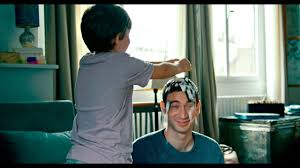
BALTHAZAR BILLAUD, THÉODORE PELLERIN IN NINO
Last edited by Chris Knipp; 03-20-2026 at 11:01 PM.
-
WRITING LIFE:ANNIE ERNAUX THROUGH THE EYES OF HIGH SCHOOL STUDENTS(Claire Simon2025)
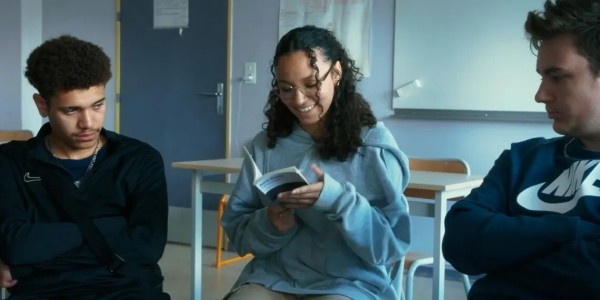
CLAIRE SIMON: WRITING LIFE: ANNIE ERNAUX THROUGH THE EYES OF HIGH SCHOOL STUDENTS (2025)
Literature as female empowerment
From her descriptions Claire Simon appears to have arranged to have the works of the French writer Annie Ernaux, winner of the 2022 Nobel Prize for Literature, read by students and then filmed their discussions of them conducted by teachers, mostly in classes, a few in informal settings such as a bus stop. Ernaux has written over two dozen books, mostly autobiographical in nature and frank in subject matter in a style she calls " l’ecriture plate," "flat writing." Her intentionally unadorned descriptions include the discovery of a lost sister, a sexual assault, a miscarriage, and an illegal abortion. (The latter has been made into an award-winning film, Audrey Diwan's Happening/L'Événement (2021) Passages from these are read by girls, also by a few boys. The discussions necessarily take on a feminist perspective.
The classes are in various parts of France as well as Cayenne, in French Guiana, and many of the students are non-white. A few are in the Paris region. It appears to be warm, sunny weather. The locations are given for each section but other explanations are left out. There is no external commentary.
The outspoken frankness of these passages comes through, particularly the miscarriage. The girl laughs as she begins reading it (see photo above), perhaps from embarrassment. Opinions vary, but generally the students overwhelmingly approve the writing - though the BFI reviewer, Laura Venning, wonders "if more disparaging comments were left on the cutting room floor." They find it easier to relate to than the usual "Bac" fare of classics like Balzac or Flaubert, Molière or Racine. On the other hand, if students in French lycées spent all their time on Ernaux or other easily relatable writers they would be shortchanged on their cultural heritage as well as their "Bac" exam preparation.
Or would they? As the demographics change, the ability to connect with that cultural heritage may vary also. But the wise literary student may hue to the traditional because it is what we have, whether she agrees with it or not. This is a conflict cogently discussed by E.D.Hirsch, author of the Cultural Literacy books and advocate of the notion of a core curriculum. If we focus only on the current and the relevant, we lose contact not just with the cultural legacy, Hirsch has shown, but with our store of necessary basic knowledge. Annie Ernaux can only be valuable as a side course when the spotlight is on the classics. But this is not the purpose of the film to consider.
Ernaux's Nobel Prize for Literature comes at a time when women are now receiving the award every few years - 2015, 2018, 2020, 2022, while early in the last century they came much more rarely. The Nobel may help qualify Ernaux as an instant "classic," but this is another topic beyond the scope of the film. It is an interesting dip into cultural history however to read the list of names and the different reasons given over the years for the committee's granting of the prestigious award. Notoriously Stockholm has overlooked some of the world's, and particularly the West's, greatest writers, such as Proust, Joyce, Frost, Orwell, Forster (it was "too late" when they were considered). Ibsen and Twain were deemed "too realistic": what would that committee say about Ernaux? Nabokov was passed up over and over for much more minor and forgettable writers, several of them Swedish and members of the committee itself. Some of the most honored writers in English have been recognized, recently Bob Dylan and Toni Morrison, earlier Faulkner, Hemingway, Naipaul, Pinter, Beckett, Bellow. Despite the scandals, the prestige is there, mattering more for the world now in science.
Ernaux's Nobel recognition reflects these times, and not just the committee's whims. But it feels as if the committee is pussyfooting around when it said it was recognizing Ernaux for "for the courage and clinical acuity with which she uncovers the roots, estrangements and collective restraints of personal memory." That's not "écriture plate," which would come right out and say what she stands out for is how directly she talks about horrible experiences women have gone through due to the cruelty of men. At least the words about Isaac Bashevis Singer when he got the Nobel mentioned the word "Jewish." But calling a spade a spade is not the Nobel committee's way.
It could be Ernaux was writing her "flat" auto-fiction particularly for high school students, as well as for any woman suffering because of her sex. That makes this film particularly relevant. On the other hand a staged series of discussions doesn't wholly provide the kind of "fly on the wall" picture we seek in a documentary, and fiction films about high school life can be a better picture of it, more fully observed. When there is a young woman or a young man who is particularly bright or articulate here in these scenes recorded by Simon, we wish she had tweaked more to increase their number and, also, to increase the drama.
And what about "writing life" (Écrire la vie)? The students don't read anything they themselves have written. They only read aloud from Ernaux's various texts and comment on them. Nor do they visibly delve into or discuss Ernaux's own personal life as a writer, the risks she took to write the way she did. Simon has done a good job of showing Ernaux's relevance to young people. Now we would still like to know more about Ernaux herself, though her age (she was born September 1, 1940) makes that difficult now.
Writing Life: Annie Ernaux Through the Eyes of High School Students / Écrire la vie - Annie Ernaux racontée par des lycéennes et des lycéens, 90 mins., comes Apr. 8, 2026 to French theaters. Screened for this review as part of the Rendez-Vous with French Cinema at Lincoln Center (Mar. 5-15, 2026). Showtime:
Tuesday, March 10 at 6:00pm – Q&A with Claire Simon
-
METEORS (Hubert Charuel, Claude Le Pape 2025)
PAUL KIRCHER, IDIR AZOUGLI IN METEORS
HUBERT CHARUEL, CLAUDE LE PAPE: METEORS (2025)
A deed-end rural coming-of-ager
Debuting at Cannes last May, Meteors focuses on three late-twenties young "losers" in rural France (Mika (Paul Kircher, one of France's brightest young actors), Dan ( César-nominated Idir Azougli) and Tony (Salif Cissé, rather underused), and follows to see who will succeed and who will fail. The actors are excellent; the story is depressing. The setting is what is called in the film the "upper Marne," and explained by Jessica Kiang in her Variety review penned at the film's Cannes Un Certain Regard debut as "the sparsely populated swath of France that extends southwest from the borders of Belgium and Luxembourg to the Pyrenees: the 'diagonale du vide' or 'empty diagonal'."
The idea of a "nowhere land" is a persistent one in France: the idea that nowhere matters but Paris and if you want to be somebody, you have to go there; the idea that provincial France, if you remain there, will pull you down and keep you from really succeeding. To be a Frenchman, you must be a Parisian. The backlash against this also exists: the resentment toward Paris as a pseudo-important city and Parisians as snobs and pretenders. Meteors seems to perpetuate this picture with its story of three young men two of whom basically fail. An AlloCiné viewer's comment says Meteors "mixes genres, buddy comedy, social drama, thriller, and melodrama, and creates a seemingly personal film about male friendship and dependence," but it almost seems to me most of all a horror film.
Tony, who is Black, is the industrious one. He has organized a kind of sub-business of local employees who work in his waste disposal business. At first we see all three together at a bowling alley partying just as they did as teens. Later on the film focuses mostly on the unhealthily codependent buddy relationship of the kooky, doomed Dan, who has pointless dreams and dangerous schemes, such as moving to Madagascar to look after street dogs, and the dull but well-meaning Mika, who works in a Burger King. Dan's harebrained idea of stealing a neighbor's Maine Coon cat with Mika as the getaway driver results in their both getting on six months probation, and the escape of the cat.
Mika and Dan see a female social services officer who examines their case. To fare well with the judge in six months, and for Mika to regain his driver's license, she tells them they must have proper housing (they are couch surfing) and both must have proper jobs (including Dan). Since Tony has begun a big job at the local nuclear waste plant, Dan slides in with him and at first Mika too. When Dan has an epileptic fit on the job, the resulting medical exam reveals that he already has serious liver damage from his continual drinking, but when he learns this he just goes on drinking. Mika stops drinking and smoking. Later, Dan disappears at the waste plant. No one can find him. This is deemed not unusual.
At the film's end Mika receives a letter from Dan, which may or may not be real and offer a ray of hope. Overall the feeling is of the disintegration of youth directly into a state of no-exit maturity. The convincing image of the film is of Mika and Dan's toxic, tragic relationship. Kircher and Azougli turn in superb performances, but they cannot save the dead-end plot.
This is the Saint-Dizier-born Charuel's second feature based in his home region, the first, quite different in import, having been the 2017 Bloody Milk/Petit paysan, about a desperate small dairy farmer who finds one of his cows sick and tries to hide it because of the danger of having to kill the whole herd and being ruined. This succeeded because of a solider theme and also the lead played by the fine Swann Arlaud, whose specialness shows up in better and better roles, including a key witness in Ozon's By the Grace of God (2019) and the lawyer in Triet's Anatomy of a Fall (2023). Charuel and his writing partner were trapped in pure drear with the oddly named Meteors. This film is another sincere and dedicated depiction of the region, but the action has too little spark and the characters wind up seeming one-note despite the excellent actors portraying them.
Meteors/Météors, Debuted May 2025 at Un Certain Regard in the Cannes Festival. Ir opened Oct. 8, 2025 in France, receiving an AlloCiné press rating of 3.6=72% (spectators ditto). It was screened for this review as part of the Rendez-Vous with French Cinema at Lincoln Center (Mar. 5-15, 2026). Showtimes:
Monday, March 9 at 6:00pm – Q&A with Salif Cissé
Wednesday, March 11 at 3:30pm
-
NINO (Pauline Loquès 2025)
THÉODORE PELLERIN IN NINO
PAULINE LOQUÈS: NINO (2025)
Drastic realignment
TRAILER
Young Québecois actor Théodore Pellerin won the Critics’ Week Rising Star Award for his "soulful" lead performance as 29-year-old Parisian Nino Clavel in Pauline Loques’ debut feature after it premiered at Cannes 2025 Critics' Week. Linked by Le Monde's film critic, who called this a film "of striking depth and tenderness," to Buster Keaton, Pellerin is tall, deep-voiced, with an open, innocent face. The combined effect is of both strength and vulnerability. The film follows Nino doggedly over a long weekend starting Friday morning and ending Monday morning, beginning when he goes into a hospital and gets dire newss that leaveS him unmoored, swept into a Kafkaesque nihtmare.. The string of days and hours that follow are a meandering odyssey for Nino in which he is realigning to this new reality and ends when he reports back to the hospital to begin radical treatment. Thes events unfold with an economy, almost a casual offhand manner, that marks this as an starkly fresh approach to a familiar subject.
Through overcrowding or confusion at the hospital the young woman doctor who sees him (Victoire Du Bois, identified in the cast list as "The Oncologist") thinks he's already been given the news that he has throat cancer and begins matter-of-factly describing what's next for him. No time, then, to process this information that is, pun intended, very hard to swallow. Clanging noises outside in this scoreless film affirm that a world goes on that for Nino has frozen. THe oncologist is competent, yet almost bored. She shows him some imaging and explains has throat cancer caused by human papillomavirus (HPV) frm a sexually transmitted disease he had a long time ago. .Because of his youth,he will get priority and start treatment on . Assuming hhe wants to have children he needs to produce sperm and deliver it to be banked, and he gets a labeled tube.
Nino's apartment isn't very far away, but he will not get into it. He has lost his keys, apparently not for the first time, and the concierge ("Gardien") is out, and then when he's in, a disaster overwhelms the situation. Nino will sleep on the floor, then go to a flophouse where a well-meaning man in a sad, shabby suit played by Mathieu Amalric will help him shower and clean up.
There are three main people, his mother (played by iconic French actress Jeanne Balibar), a school classmate Zoe (Salome Dewaels) he doesn't remember who has a little boy, Solal (Balthazar Billaud) and his best friend Sofian (William Lebghil), who gives him a surprise birthday party. Yes, this is the weekend of Nino's birthday. He gets close to his mother, huddling close almost like a child. The party shows the withdrawn Nino isn't totally disconnected. His couch-surfing situation draws him to Zoe, and she helps him with the sperm sample. He also enjoys playing dad to Solal.
At first Nino can't see, tp tell anyone, later he does. As Allan Hunter puts it in his Screen Daily review, "Nino carries his cancer diagnosis alone, as if the very act of sharing his news would make it feel all the more real." This also defines the kind of person he is. He hints at a big change to his mother, but she misinterprets him, and thinks it may be he's transitioning. The first time he tells anyone flat out "I have cancer," it's suddenly and impulsively to two strangers who're about to walk out the door and not be seen again. But later Sofian provides warm, intense concern. He really is a best friend.
The lost keys provide a useful external correlative to Nino's total disruption. He has a bureaucratic job that's well handled through conflicting peripheral references. It's quite real, but not quite relevant now. It is a "shit job" in the eyes of a family member, yet it may be socially essential work. Coworkers absurdly sympathize with his vaguely referenced trouble, thinking he's a bit jaded and suggesting he will be okay if he just takes regular breaks from his computer.
Some of these things would be funny at least if the situation were not so grim; or maybe they are funny, anyway. Nino seems protective of his body with his mother, trying also to stop smoking, but on this weekend he does smoke and drink and get quite drunk at the birthday party and he laughs then. He delights at telling a bedtime story for little Solal. The boy probably needs a man in his life and Nino seems to click with him. He and Zoe are unable to make love but she finds a unique use for a baby telephone.
As Hunter points out, French precedents for this theme include Agnes Varda’s Cleo From 5 to 7 (1963), in which a young singer awaits test results, and Francois Ozon’s Time To Leave (2005) in which a young photographer faces terminal cancer. He notes that "Loquès also tips her hat to the cinema of Claude Sautet with her touching use of a photograph of Romy Schneider from his timeless The Things Of Life (1969)," a film in which a man lies by the road dead or dying after a car accident and thinks back over all the "choses de la vie" that are so sweet now.
It's nice that Loquès loves Sautet's warm humanistic cinema but this is a French film of a quieter, drier, later kind. We can appreciate the avoidance of melodrama or bathos but Nino can be frustrating to observe - you may just want to grab him and shake him - and the film is a very slow burn. Despite a lot of very specific details, at times it's almost as if the idea of the film is more powerful than its playing-out. I was reminded from the start of Joaquim Trier's French-inspired Norwegian film 2011 Oslo, Aug. 31 where Anders Danielsen Lie plays a man whose intense brief pathway through the hours is marked not by cancer but a persistent death wish. The structure is similar but the personality is more dynamic. Still, Loquès economical screenplay, co-scripted with Maud Ameline, has a lot going for it, and this isn't a screen experience that it's easy to get out of your head. Unlike Oslo, the end is a beginning and has hopefulness about it as the protagonist is shocked out of his numbness, the threat of death bringing him back to life.
Pellerin is a remarkably versatile actor who is wholly bilingual in French and English and has starred and appeared not only in other French films but also in American films and TV shows including Boy Erased, Lurker, and "On Being a God in Central Florida."
Nino, 96 mins., premiered at Cannes Critics' Week May 18, 2025, also showing at Toronto, Hamburg, Haifa, Warsaw, Rome, Valladolid, Göteborg and other international festivals. It opened in France Sept. 17, 2025. AlloCiné press rating 3.8=76%; spectators 3.9=78%). Screened for this review as part of Film at Lincoln Center's Rendez-Vous with French Cinema (Mar. 5-15, 2026). Showtimes:
Showtimes:
Sat, March 7, d9:30 PM Q&A
Thu, March 12, 1:00 PM
BALTHAZAR BILLAUD, THÉODORE PELLERIN IN NINO
 Posting Permissions
- You may not post new threads
- You may not post replies
- You may not post attachments
- You may not edit your posts
-
Forum Rules




 Reply With Quote
Bookmarks