-
BERLIN & BEYOND March 19-23, 2026
Last edited by Chris Knipp; 03-12-2026 at 07:05 PM.
-
ZWEITLAND (Michael Kofler 2025)
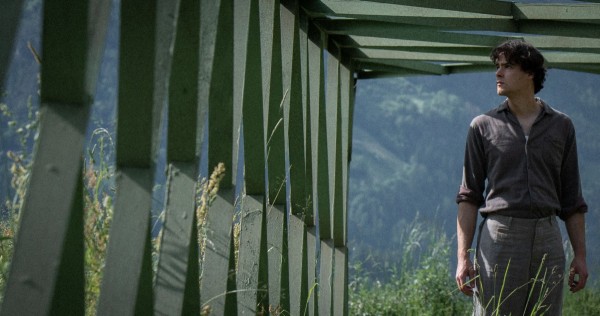
THOMAS PRENN IN ZWEITLAND
MICHAEL KOFLER: ZWEITLAND (A LAND WITHIN) (2025)
Ethnic and family conflict in the South Tyrol, 1961
Zweitland is an intimate portrait of the little region between Austria and Italy called South Tyrol or Alto Adige at a time of dramatic conflict, 1961. It is peaceful today, and the home of sunny-dispositioned world no. 2 tennis star Jannik Sinner, but as recently as the early 1960's, when this film takes place, Italy and Austria fought over it and its inhabitants died in the crossfire. Zweitland (A Land Within) is told in this strong first film by local native Michael Kotler, who intensely concentrates the story's geopolitical and historical complexity through the lives of three siblings who live in a rural village, Anna Passler (Aenne Schwarz), Anton Passler (Laurence Rupp), and Paul Passler (Thomas Prenn).
The opening scene is an intense wresting match between Paul and Anton. Anton wins, but Paul deals him a hard blow at the end. Paul dreams of moving away as soon as possible to study painting at the Munich Academy of Art. He struggles in this with the image of their father, who besides being a farmer was a sculptor but died of drink, mocked as a failure. During these years the South Tyrolean Liberation Committee (BAS) is organising frequent terrorist attacks, mainly against the Italian security forces, in order to return to Austria. In Italy, since the Fascist era, it had even been forbidden to speak German in the region. Anna, a schoolteacher, wants to make her classes bilingual. The locals want to focus on German. They speak a local Germanic dialect.
Paul is a courageous and idealistic young man. Precisely because he belongs to the German-speaking minority, he struggles to find work and is very close to both his friend Hans (Fabian Mair Mitterer) and his family. However, when Hans is arrested by the Italian police and brother Anton is wanted for organising an attack, Paul finds himself forced to give up his dreams to run the family farm and take care of his sister-in-law (Aenne Schwarz) – who is also strong and courageous, but is now forbidden to teach because of this situation.
The film is dark, brooding, and slow-moving, though not lacking in a sense of the intense political tension and day-to-day danger of the explosive situation. Though Laurence Rupp is the star member of the cast, it is the poetic Thomas Prenn who carries the film. The camera loves him and lingers on him. Those who see this film as part of the Berlin & Beyond festival will at least learn something about ethnic conflict in Europe. Though I don't know German, the impression is that this is an authentic recreation of the local dialect and local manners and customs and a passion project for the South Tyrol-born first-time director, who does his best to keep things exciting and intense, even though he slows down the action a lot at times too - not always a bad thing.
Zweitland, 112 mins., premiered at Munich Jun. 29, 2025, showing at other festivals including Kolkota, in the US at Palm Springs Jan. 6, 2026. Screened for this review as part of Berlin & Beyond, San Francisco & Berkeley, Calif., Mar. 19-23, 2026. Showtime: Rialto Elmwood, Berkeley – March 22 at 4:45 PM – Buy Tickets
Special Guest: Thomas Prenn (Actor)
Last edited by Chris Knipp; 03-08-2026 at 02:01 PM.
-
KÖLN 75 (Ido Fluk 2025)
This review was previously published for the Oct. 2025 NYC and LA release.

MALA EMDE IN KÖLN 75
IDO FLUK: KÖLN 75 (2025)
This review is reprinted here for the film's presentation as the opening night film at Berlin & Beyond*
TRAILER
A zealous teenage German promoter turns a doomed concert into the most famous solo piano album of all time
This story begins with keyboard artist Keith Jarrett: his brilliance, his passion, and the risky ego that led him in the early seventies to start touring halls playing solo piano concerts improvised entirely from scratch each night. But a primary focus of this film is someone most of us never previously heard of: a teenage German girl called Vera Brandes (Mala Emde) - sixteen when first seen, claiming to be twenty-five - whose drive, ambition, and desire to prove her dentist father wrong about her lack of a future in music promotion led her to stage a concert that seemed doomed, but has gone on to sell over 3.5 million albums.
The Köln Concert (TKC) is a live solo piano improvisation double album (two-discs on vinyl) by Jarrett recorded at the Opera House in Köln, West Germany on 24 January 1975 that is reportedly both the all time best-selling solo jazz album and the all time best-selling piano album. Jarrett is eighty now and, crippled by strokes since 2018, unable to play with his left hand, but this achievement is likely to stand. Jarrett is worth remembering because of his versatility, not only in those glorious, wildly self-indulgent and awesomely confident solo improvisation concert performances - I've been listening to them for a while and one can happily get lost in them for many an hour - but his beloved jazz Standards Trio with Gary Peacock on bass and Jack DeJohnette on drums, and, not to be forgotten, a number of fine classical recordings. Jarrett is a uniquely versatile musical personality, was so in 1975 and remains so.
His first notable solo improvisation album was earlier, and was called Facing You. On its fiftieth anniversary pianist Kenny Werner said of the seminal album, "For me, it changed everything," explaining, "He introduced a totally fresh way of playing over his changes. It sounded totally original."
The Cologne concert all started with Ronnie Scott. And a 16-year-old Vera Brandes who wanted to make money. In the couple of years since Ronnie asked her to book him, just assuming she could and turning out to be right, she had built a career as a concert promoter. She had panache, it seems. Jazz Bunny, a big headline called her, in a flashy article her family mocked her for. Soon she had booked a lot of jazz acts, making enough to move out of the family home and rent her own office. It was jazz, not rock n' roll, she was booking. Berlin in the seventies was a jazz mecca.
This film dramatizes all this - Vera's life - and the "scaffolding" she built - in the filmmaker's metaphor - by creating a framework in which the Köln concert could happen.
The early seventies was a time of ferment and musical crossover and Keith Jarrett was a kind of crux or apex of those explorations. Jarrett was a prodigy keyboardist - he rejected an invitation to study classical piano with Nadia Boulanger in Paris to attend the Berklee College of Music in Boston with its strong jazz focus. Jarrett had been a pianist for Miles Davis. Miles reportedly asked him to play in his group three times before he consented, this film tells us, suggesting that shows a great degree of panache or chutzpah. Miles Davis' searing Bitches Brew had come out in March 30, 1970. His hypnotic In a Silent Way was from the year previous. Miles had expressed incomprehension of Jarrett's ability to play "out of nothing."
In Berlin the girl saw Keith Jarrett play the first time. Jarrett is played by John Magaro, who has fuzzy hair, but doesn't much resemble Jarrett. But remember, this is a recollection of Vera Brandes (Mala Emde, old for the role, being the age Brandes claimed to be, not the age she was). Vera set her sights on the Cologne Opera House, rebuilt in modernist style after the war and having 1,300 seats. Vera insisted. The evening she wanted Alban Berg's opera Lulu was scheduled. Then it will have to be after eleven, when the instruments were removed and the place cleaned up. Eleven p.m. in January? January 24? You are mad, the theater manager says. But she goes ahead, knowing she will need nothing - only the opera house's Bösendorfer Imperial concert grand piano. But that Bosendorfer turned out to be the biggest problem.
There was a big Keith Jarrett solo concert in Lausanne before Cologne. He was coming from the Swiss city to the German one to play now.
Another key figure in this tale is Manfred Eicher (Alexander Scheer), a record producer and founder of ECM records. He was touring with Jarrett, and ECM was destined to be a major supporter of Jarrett and recorder of his improvisations. Also important here is Michael Watts (Michael Chernus), a journalist who wrote about jazz sent to interview Keith Jarrett. Watts talks directly to the audience, breaking the fourth wall. He tells us how hard it is to improvise completely. Even the most advanced jazz players don't do it. They hang their playing on "standards" or a set composition and number of bars, Watts explains to us.
Jarrett is exhausted by these one-hour pure-improvisation concerts. Before Cologne, he is strung out from the coughing in the audience, and he has a bad back which is bothering him. He and Manfred are driving on the tour in a little car to save money, because it turns out they are cashing in the plane tickets the promoter gives them at the airports to have the funds to continue on the tour. It's not making money. Michael Watts bums a ride with them and writes about Keith without admitting he has been in the car because---no interviews!
Jarrett's 1975 Cologne album isn't his first but the third in this mode, nor necessarily his best, but his most famous. The first was the aforementioned Facing You (Oslo 1971), the second Bremen/Lausanne (1973). Director Ido Fluk has gathered actors to recreate the event that is now legendary. Keith Jarrett's fans are worshipful, and they will want to watch and fantasize about what it would have been like to be there that cold January night in Cologne when the magic happened.
This film shows how you can make something lasting and famous out of virtually nothing. That goes, in a way, for the film itself. It gets some things right: for example, that Keith Jarrett's solo piano improvisations are not jazz (not just jazz, not just classical; a kind of crossover genre). They are something special also because, as the film stresses through Michael Watts, improvisation from scratch is very hard to do. These can be contrasted with Brad Meldau's solo improv piano concerts, for instance, which are wide-ranging, but return to known elements. Jarrett's material is abstract. Mehldau, while also improvising, frequently incorporates pre-composed material, including classical pieces and his own compositions, into his solo shows. Jarrett never did that. Jarrett's more remote, etheriel solo concerts take their wrapt audiences out into somewhere in outer space.
It's not entirely clear how it happens, but at eleven p.m. that January night the Cologne Opera House has sold out for Jarrett's concert. We have seen Vera had worked hard to promote it with handbills, radio announcements, and in the end even selling tickets directly on the street. This film is about that promotion, and that energy. And always the almost-didn't-happen element of the event.
And there is drama. When the day came, they couldn't get that Bösendorfer Imperial Grand. It wasn't there. The piano that was there was lousy. In the final hours before the concert, while Alban Berg's opera Lulu is being performed at the opera house, Vera is rushing around finding piano tuners and persuading them to tune the lousy piano with the opera in the background. They have to work some kind of magic. But, apparently, Keith Jarrett worked some kind of magic too; and so did Vera.
Given the terrible conditions, particularly the lousy piano, Jarrett wanted to cancel the recording. (They could not cancel the concert.) But Manfred said the engineers were scheduled to be there, so they agreed to go ahead and record - but just for their own information, they thought. It did not turn out that way.
The film doesn't use sounds from the actual concert recording, just a few hints of Jarrett's playing, but hopefully viewers, even non-Jarrett fans, will understand that he did weave magic in his solo improvisations. That's why there is this story to be told. Jarrett's solo playing is special. It's not to dance to or rock to. It's to sit with folded hands and let it flow over you. It can be somewhat overpowering. If it works, it can feel transcendent - that's why staging this concert in the hour before midnight made sense, after all.
Köln 75 will appeal to Keith Jarrett fans, but could lead others to take a listen. This is a cute story about youthful drive, and also a piece of modern musical history.
Köln 75, 112 mins., premiered at the Berlinale Feb. 16, 2025; also Sofia, Istanbul; and opened in eight other countries. Now opening in the US, Oct. 17 in New York, Oct. 24 in Los Angeles. It is included also in Berlin & Beyond (Mar. 19-23, 2026):
*Showtimes:
– Castro Theatre, SF – March 19 at 6:00 PM – Buy Tickets
– Rialto Elmwood, Berkeley – March 22 at 1:45 PM – Buy Tickets
Special Guests: Mala Emde (Actor), Ido Fluk (Director)

KEITH JARRETT PERFORMING IN GERMANY IN 1975
Last edited by Chris Knipp; 03-11-2026 at 12:55 AM.
-
KREATOR – HATE & HOPE (Cordula Kablitz-Post 2025)

KREATOR TODAY: JÜRGEN "VENTOR" REIL, MILAND "MILLE" PETROZZA, SAMI YLI-SIRNIÖ, FRÉDÉRIC LECLERCQ
CORDULA KABLITZ-POST: KREATOR – HATE & HOPE (2025)
TRAILER
Portrait of a foundational German thrash metal band
This film, of particular interest to fans of the thrash metal band musical genre, traces the foundational German thrash metal band Kreator back to its origins forty+ years ago in Essen, Germany (1982). Their first album was called Endless Pain, but they were a bright and attractive group of boys and seem quite nice men some of them vegans who have llived sober for thirty years. A father of one of the boys who was a miner said, "Don't go down in the mine. It's the worst thing you can do." The original members tell how as teens they got some guitars on sale. They were not musical and, like other bands of this genre, acquired their chops later, while performing. Yet their work was sufficiently newsworthy to get management and a recording contract fairly early on. They only rank around 31st among the thrash metal bands, but in certain aspects, particularly the songwriting, they have gotten special mention. Eleven different musicians have played in the band, and only two of the original ones remain, both age 59, but they are the lead singer , Mille Petrozza, and the drummer, Jürgen Reil.
Kreator come in for praise on several counts. Lyrics have been mentioned. For playing tight, disciplined music. But also for being the only heavy metal band that came out overtly against the extreme right. Otherwise only punk bands did that. This, someone says, shows the leader was closer to puink. Band members are shown visiting a concentration camp and commenting that after rthe war Germany held off from right wing populism for 10 or 20 years longer than the rest of Europe, but now it has arrived and is viewed as "not so bad" since France and Holland have got it.
With the other bands Destruction, Sodom and Tankard, Kreator forms "the Big Teutonic Four" thrash metal bands. The bands have long wanted to play a joint concert, and finally there is one, a huge amphitheater gathering. But then, just when the concert is beginning, it has to be cancelled and the crowd ordered to go home because of weather. Indeed, a terrible storm does come, so they have to admit it was necessary. This winds up being a painful non-event, but the filmmakers get to do some interviews with representatives of the various bands. We can imagine what the passionate longtime fan who has come from Costa Rica to hear his metal gods feels about this. (Similar stories of devotion are told in other metal band docs.)
There aren't many intimate moments captured at first. One band member does show himself cleaning his teeth and putting on scent. He says he prepares for the crowd and his fellow band members like he was going on a date. One of the highlights of the film is the rare early footage of the band when it was in its infancy. Tall lead singer song-writer "Mille" Petrozza often reminisces for the camera about earlier days but no major dramas, conflicts, or scandals come out. He says he has no belief in the concept of "sex, drugs, and rock 'n' roll"; that life can only be lived, if at all, for a few years in the early twenties, otherwise it will kill you, and he could fill a whole graveyard with all the musicians he has known who have died during his career. There's also mention of the toll of heavy metal headbanging on musicians' bodies: displaced retinas, and neck problems.
Things seem to be going well with the current band of singer "Mille," drummer "Ventor," and the Finnish lead guitarist Sami Yli Sirniö, a member since 2001, and French bassist Frédéric Leclercq, with the band since 2020. There is the obligatory tour coverage - though the band has taken a year off for recording: the Far East, Japan, Malaysia, Singapore, Thailand, and Australia are mentioned; Japan seems a particularly friendly venue, but coverage of an Indian concert is awesome. There is also history of the bank's first tour of America. It was fun, but hardly an experience of grand success. One venue turned out to be a pizzeria. Kreator has toured every year, "Mille" says, and must come to America more often because it forgets them faster. An observer says Kreator is the only German thrash metal band from the Eighties that is touring on this level.
In the end, viewers of this film at Berlin & Beyond will feel director Cordula Kablitz-Post has performed the feat of taking something done frequently - a documentary about a heavy metal band - and still conveyed the sense that this one is special.
Kreator: Hate & Hope,110 min., premiered at Filmfest München Jul. 1, 2025 with a German theatrical opening Sept. 4, showing also at Kinofest London Mar. 4, 2026 and Thessaloniki Documentary Festival. Mar. 5. It was screened for this review as part of Berlin & Beyond (San Francisco & Berkeley, Calif., Mar. 19-23, 2026). Showtime:
Showtime: SFMOMA’s Phyllis Wattis Theater – March 21 at 3:30 PM – Buy Tickets
Last edited by Chris Knipp; 03-11-2026 at 01:24 AM.
-
BAD PAINTER (Albert Oehlen 2025)

UDO KIER (RIGHT) IN BAD PAINTER
ALBERT OEHLEN: BAD PAINTER (2025)
An artist's surreal, playful self-portrait
This film isn't in German but mostly in English, but it's about, sort of, the 71-year-old German artist Albert Oehlen, who's played, sort of, by the late German film actor Udo Kier, then 81. Albert Oehlen, also the director of this film, is one of those highly successful international artists, rolling in dough from the look of it, whom we've never heard of. He's school of Cologne, born in the Fifties and therefore somewhat indebted to Gerhard Richter, but he's also associated with Germany's Neue Wilde movement. His work consists of mid-sized bulbous sculptures and, more frequently, of mid-sized semi-abstract paintings. Imagine what it would be like if Jackson Pollack had a bad marriage with Francis Bacon and Picasso came in to put a flesh-colored figurative touch at the end.
You won't acquire that information about Oehlen's painting from this film, however, which doesn't highlight his work but rather uses Kier to muse in general about what being an artist means and what the process of painting is like. It uses a riff off Dali and Buñuel's Un chien andalu's eye-gouging at the outset to establish the filmmaker as a tongue-in-cheek provocateur. The film has a hard time maintaining a consistent tone thereafter, alternating so often as it does between the pompous and the playful. In the opening sequence several voices overlap, (Kier's with that of Kim Gordon) musing about painting while Kier dabs color on a canvas with brushes. "Painting is hard," muses Oehlen/Kier; "that's why they call it PAIN - TING." Very clever.
The painting Kier is making looks dreadful at first, the overlapping musings interfere with each other and don't make much sense, and the first quarter hour of the film go quite badly. But as the film and Kier's monologue settle in and the painting he's working on becomes more layered - perhaps with help from the unseen hand of Oehlen himself - both the painting and the film acquire greater complexity and what Oehlen is saying starts to seem more helpful, perhaps even, for some, enlightening, although having an aging actor pretend to make a painting still seems like a bad idea. Does "Bad Painter" really mean "Bad Filmmaker"? As an artist myself I am sympathetic to Oehlen's effort, but disappointed by the result. Though the Kier/Oehlen painting doesn't acquire the fluidity and transparency of Oehlen's own actual current paintings, it might eventually seem like, say, a bad De Kooning.
When we think of making an abstract painting with brushstrokes De Kooning does come to mind, and again I think of the "______ Paints a Picture" series in in the leading Fifties art magazine, Art News and the feature on "Willem de Kooning Paints a Picture, " important since de Kooning was the leading Action Painter in the dominant era of Action Painting and Action Painting is a school focused on process. Any painter's work is an evolving process, even that of Ivan Le Loraine Albright (anoher subject of an Art News "_____ Paints a Picture" article) . But in Action Painting, the process is the key element of the work. And Oehlen seems to be alluding to that here.
But that isn't a conscious focus here. At moments the film turns surreal, with the Oehlen/Kier artist seeming to pull a middle-aged woman out of oblivion as if to reanimate her (is she an ex-wife? the ghost of his mother?), and with a younger women he takes out to dinner at a fancy Italian restaurant where he orders the "pasta con tartufo." Later, as he wanders around his handsome modern house, Oehlen/Kier is annoyed by a poorly trained small bulldog roaming the premises, and resolves the problem by shooting and killing the poor creature. We are spared the sight of this provocation, but in the next scene Oehlen/Kier wonders aloud if he shouldn't also kill his other dog. He has also driven to the home of an artist friend and slapped him across the face. The woman with him questions this but he justifies it by saying that "art is violent." All this, somewhat in the spirit of early Yorgos Lanthimos, doubtless grows out of the fact that besides being a painter, Oehlen is also an installation artist. The artist-painter here doesn't emerge as a sympathetic humanist but an egotist, showing off with pride a finished painting and drinking toast to it, making fun of himself. Badf Painter can be seen as a sort of self-roast.
At one point Oehlen/Kier meets with another prolific artist, the restaurant chain founder Michael Chow (Mr. CHow), who studied in London at St. Martin's School of Art, and whose paintings are light and airy abstractions he describes making with large pieces of crumpled paper and different sized hammers. Later, We see Oehlen/Kier quite drunk and he is warned not to try to paint in such a state. Finally Oehlen/Kier is dead - before that, blind, wandering onto a tennis court, unable to paint - and a small group of conoscenti, shown by a handsome ginger-bearded man the now deceased Oehlen's "final thesis," writhe on the floor groaning, while his female inner voice goes on musing.
This is one of three films by artist Albert Oehlen, including an earlier one from 2024 called Yellow (a color he seems to have special feelings about) and a later one from 2026 called The End and featuring the glamorous Nichole Galicia, who played Sheba in Quentin Tarantino's 2012 Django Unchained. Kier is seen brandishing a photo of Galicia in Bad Painter. Before these films there was a 2021 documentary by Oliver Hirschbiegel called Der Maler (The Painter) described as "A one man tour de force depicting artist Albert Oehlen struggling with a painting." So it would seem that Oehlen has gotten his "______ Paints a Picture." (Hirschbiegel made the 2004 film about the end of Hitler, Downfall.)
This wasn't Udo Kier's last film: there are several others as well as TV episodes in post-production. Last year he had a small role in Kleber Mendonça Filho's The Secret Agent.
Bad Painter, 80 mins., premiered at Rotterdam Feb. 3, 2025. US showing Jan. 9, 2026 at Palm Springs. It was screened for this review as part of Berlin & Beyond (San Francisco & Berkeley, Calif., Mar. 19-23, 2026). Showtime:
Showtime: SFMOMA’s Phyllis Wattis Theater – March 21 at 3:30 PM – Buy Tickets
Last edited by Chris Knipp; 03-12-2026 at 12:17 AM.
-
MIROIRS NO. 3 (Christian Petzold 2025)
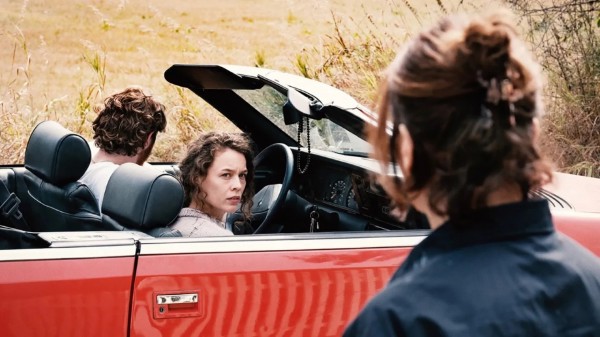
PAULA BEER IN MIROIRS NO. 3
CHRISTIAN PETZOLD: MIROIRS NO. 3 (2025)
TRAILER
A modern gothic fairytale about grief
The brilliant German auteur Christian Petzold's new muse Paula Beer is featured in this engaging, peculiar film that has elements of fairy tale and perhaps of a Fifties American movie, a favorite point of reference for him. It's also another treatment by Petzold of changed identity and escaping from a past life. Not one of his very best, it's still an enjoyable and thought-provoking piece that tells a peculiar tale. The appeal of Miroirs No. 3 (which alludes to a piano composition by Maurice Ravel) is it the way it draws us into a certain coziness and desire to escape, before, two thirds of the way through we say "Wait a minute! What the heck is going on here?"
Things get off to a dramatic start: Laura (Beer) is riding along in the German countryside beside a handsome young man, Jakob (Philip Froissant) who's driving a red convertible with the top down when Bang! it runs off the road, flips over, and Jakob is instantly killed. Laura is thrown from the car and survives with only a very minor injury.
Laura is unharmed, but of course very shaken. She immediately takes up residency with her rescuer, the middle-aged Betty (Barbara Auer), asking to stay with her and not go to a hospital. Betty readily agrees. Laura has a cozy bed and joins Betty in painting the picket fence white. Betty recalls Tom Sawyer. Soon Betty's husband Richard (Matthias Brandt) and her son Max (Enno Trebs) come over. She invites them for dinner when she learns that Laura can make Königsberg dumplings, their favorite dish which is the one thing she can't make. The three turn out not to have sat down to a meal, or for anything, ina quite a while. Why Laura feels nothing about the demise of Jakob or what inner need for escape impels her to stay on, we never learn.
Betty has perked up, evidently, but Richard is worried that something is up and knows she is "off her meds." What meds? What is going on? The film ambles along for a while placing Richard, Max, Laura, and Betty in various situations before the explanation finally comes. The two men who're tradesmen, working men, who immediately fix things, take care of repairing the leaky tap, then the broken dishwasher, then other things. A piano tuner tunes the piano, for Laura, you see, is a music student and her playing is very fine. She needs practice; for them she plays a Chopin prelude. The one who used to play the piano was Betty's dead daughter Yelena.
Those who are good at guessing plotlines may have figured out what was going to happen in the first ten minutes., but it's only in the last five that, through a kind of ritual of reenactment, a gridlock of grief is, provisionally at least, released. And this is assisted partly with the healing power of music that Laura brings, especially in a late scene of her recital graduating from an academy of music in Berlin, when she plays Ravel's "Une barque sur l'océan" from Miroirs.
Along with music, this is a quiet country world of jeans and beer, dumplings, pickup trucks and rickety bicycles. And beides the cdlassical music there are pop ballads including "The Night" by Frankie Valli & The Four Seasons (where Petzold alludes to Michael Cimino) and "You Go to My Head" by Mathilde Santing.
As usual with Petzold, the casting is a rock-solid building block. Barbara Auer has a zen-like calm and mystery, as does Paula Beer, as did Nina Hoss before her. Trebs and Brandt have a kind of movie star old-shoe masculinity: they seem by their presence to question Auer's Betty, but also to leave her be. There is a traditional feel of old American films of the country family who are strong, but with trauma behind them somewhere and the actors convey this nicely. And yet of Petzold's recent series of "ghost stories" this has been called the minor one, and it doesn't have the depth or impact of his other work and, carrying along the music image, can be indeed considered a "chamber piece." But it is also a typically spare and elegant piiece of work that doesn't at all overstay its welcome. Even if this is minor Petzold attendees of this year's Berlin & Beyond will find here contemporary German filmmaking at its most prestigious.
Miroirs No. 3, 86 mins. premiered at Cannes Directors Fortnight May 17, 2025. Also at Sidney, Munich, Jerusalem, Busan,São Paulo, New York, BFI London, Vienna, Thessaloniki, and many other international festivals. It was screened for this review as part of Berlin & Beyond. Showtime:
Showtime: Rialto Elmwood, Berkeley – March 23 at 6:45 PM – Buy Tickets.
Miroirs No. 3 opens theatrically in the US Mar. 20, 2026.
Last edited by Chris Knipp; 03-12-2026 at 10:56 AM.
-
THE FROG AND THE WATER (Thomas Stuber 2025)
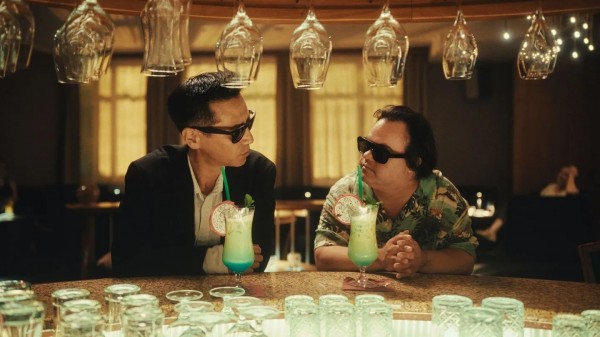
KANJI TSODA AND ALADDIN DETLEFSEN IN THE FROG AND THE WATER
THOMAS STUBER: THE FROG AND THE WATER (2025)
Improbable buddies' wordless world
A young German man with Down syndrome, who chooses not to speak, and a Japanese tourist on a journey of his own cross paths in Germany and go on a journey together, forming an unexpected bond that goes beyond words. That is the setup for The Frog and the Water (Der Frosch und das Wasser), the new film from In the Aisles writer and director Thomas Stuber. Georg Szalai wrote in Hollywood Reporter about the film, which features Kanji Tsuda (Onoda: 10,000 Nights in the Jungle) as the austere Japanese man and Aladdin Detlefsen as Buschi, dubbed "Buschi-san" by the Japanese tour group, which sounds like a Samurai warrior name, who has Down Syndrome.
Buschi wanders off when the institution for differently abled people has taken its inhabitants on an outing in Köln, and gets onto a Japanese tour bus headed for Weimar. Nicole Schierloh (Bettina Stucky), who is responsible for Buschi, goes frantically in search of him, but without ultimate success.
The Japanese tour members take a liking to Buschi, and when someone wants to evict him, Hideo (Tsuda) jumps in the way protectively, and they become an odd wordless couple. An origami frm becomes curiously playful and symbolic. The two passports Hideo carries hint gently of loss and a special need apart from others on his tour. When the group is taken to a restaurant, Buschi sits opposite Hideo and imitates his every move. We learned earlier that he can't swim, but he certainly can eat properly. He follows Hideo to his hotel room, and takes off his shoes as Hideo does. What will happen now? The Frog and the Water is a film that plays it by ear, working with nothing to make something, which can be an interesting choice if played right.
But it could have made more. As Cineropa's reviewer Davide Abbatescianni says, pushing the "conflictual aspects" of the relationship - as when Buschi plays loud movies on TV when Hideo is trying to sleep in his hotel room , might have revealed a "richer, more textured" relationship, a few more revealing "cracks" in. the story's "fairy-tale facade" without undermining ins underlying "tenderness." And yet, in its overlong runtime, THe Frog and the Water does gesture toward transcendence.
The Frog and the Water/Der Frosch und das Wasser, 100 mins., debuted primarily at Tallinn Black Nights Nov. 19, 2025, also showing at festivals in Germany and Switzerland. Reviewed here as part of Berlin & Beyond. Showtime:
Showtime: Rialto Elmwood, Berkeley – March 23 at 1:45 PM – Buy Tickets
Last edited by Chris Knipp; 03-12-2026 at 08:08 PM.
 Posting Permissions
- You may not post new threads
- You may not post replies
- You may not post attachments
- You may not edit your posts
-
Forum Rules






 Reply With Quote
Bookmarks