Wall*e
(Warning! This review contains spoilers)
Wall-e – a film by Andrew Stanton (Finding Nemo)
It is no coincidence that baby boomers are having their say this year, though nearly drummed out by loud chest beating by conservative old timers like Charlie Gibson (ABC News) and ex-Bush White House pundit Carl Rove, still pushing Republicanism. The most underwhelming political event of the season was boomer and environmentalist Al Gore’s endorsement of boomer Barack Obama, not covered by any network. Gore’s message to save the planet is especially relevant, seeing the last administration has been operating as a cheerleader for large corporations and ignored the issues.
For isn’t all of this global warming, diving economy, and threats to start drilling off shore for oil (John McCain’s little plug in Texas that only pleased the oil crowd. My brother lives in Texas. The majority of Texans aren’t thrilled with the white sands of Padre Island being muddied with oil), all tied into how we’ve squandered the moment.
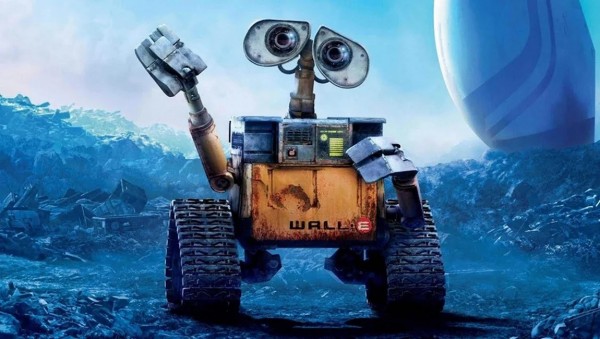
What I mean to say, is that, with all of our advanced technology (wind is now so advanced, it can easily outstrip nuclear in efficiency and wattage) we cannot reduce our dependence on burning oil or coal and polluting our planet? That is the final lesson to be learned from Pixar’s little film, “Wall-e”, the story of the little robot that falls in love. While the love story is an important aspect of “Wall-e” the story centers around leaving the planet because pollution has rendered it unlivable.
The solution? Have robots clean up the place and return it to the pristine condition it was. Only, the robots fail in their job. Every living thing on the planet dies. Hundreds of years pass. Large space-faring vehicles carry the population of the planet around in luxury liners, whose passengers have become bloated, self-indulgent, reflections of their former, selfish, ancestors. They send out probes into the universe searching for a sign of life, and every year they come back empty handed… except this year.
Poor little Wall-e. He falls in love with a movie, Barbara Streisand’s version of “Hello Dolly!” He is especially enamored with the tune, “It only takes a moment,” which happens to be my favorite song from the film, mostly because I could play it on the piano. I loved that song. Michael Crawford, who would later become the Phantom of the Opera, sings the silly love song in the middle of the film, its melody becomes a mantra for the little mechanical device with a quirky personality.
The stark realism of a rusty-brown earth is a sharp contrast to the bright colors and pristine appearance of the modern and efficient liner, run by advanced robots with a built in hierarchy of purpose. Naturally, Wall-e falls in love with one of them, the robot designed to bring back the life form it discovers. Of course, the villain in this piece turns out to be none other than the computers themselves, content to keep humans a docile bunch. In one hilarious moment, one billowy man struggles to actually stand-up to the strains of Kubrick’s 2001 theme music, bringing down the house with laughter.
“Wall-e” is what we’ve come to expect from Pixar… fun, inventive, intelligent, relevant, and beautifully created with images never seen in any form. While the stories often have simplistic endings, as do most Hollywood films, we can rely on a Pixar film the same way we could always rely on a Walt Disney film in our youth, to see great art, great story with lots of heart, and a subtle message, that the call to fix the environment is on our doorstep. This is the last chance. Our vote should reflect that change. “Wall-e” is the most relevant film of the year.
Colige suspectos semper habitos




 Reply With Quote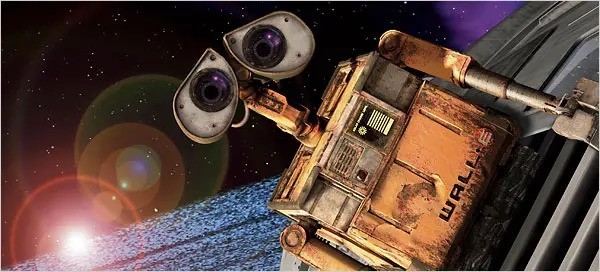

Bookmarks